


When Eli Prosper stands on the side patio of James Logan Elementary School and looks out across the school property, he doesn’t see 2.2 acres of gray pavement.
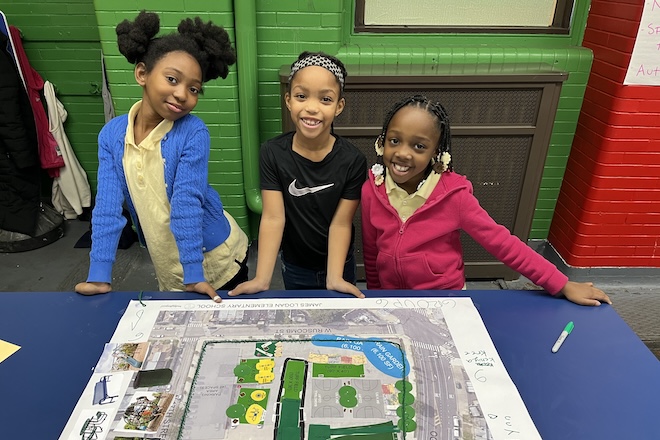
He sees what’s coming next, a plan conceived by Logan third graders and fine-tuned with the help of neighbors: a landscaped green yard with sections for social gatherings and quiet reflection, and courts for basketball, soccer and tennis. Around it all will be a walking/running track and a bike track that will be perfect for the Logan students who received free bikes last year through another Prosper project.
The property is fenced, but the gate will be left open.
“It’s a generational investment,” Prosper says. “Whenever a green space is installed at a school or nearby, it drives attendance from new families and current students who want to play with their friends and see the new space.”
Prosper is Logan’s Community School Coordinator, a job he’s held for four years. Logan is one of 20 community schools in Philadelphia, all participants in a program based on the idea that a school should be a neighborhood hub, and a place where local businesses and stakeholders can make tangible contributions that strengthen both the school and the neighborhood.
At Logan, Prosper wanted to tackle the massive project of reshaping the school’s grounds, and he asked community partners if they could help. Among those that stepped up for this major rehab were the Trust for Public Land, the Pennsylvania Horticultural Society, PECO, the Pew Charitable Trust, the Green Family Foundation, the Mayor’s Office of Education, the School District’s Office of Green Infrastructure, and the Philadelphia Water Department.
That’s a lot of different groups with different goals, but managing them and making things happen? That’s Prosper’s job. The result? A project with an estimated cost of $2.1 million that cost the school nothing.
“To have one person focused on community affairs makes a difference,” Prosper says. “Now you’re going from five to 10 hours to 40 hours.” At Logan, having someone like Prosper has made all the difference. Not every community school has had the same outcomes, and Mayor Cherelle Parker has shifted the focus of the Office of Education to extended day and year schooling — which makes Logan’s success all the more impressive.
Community partners
Logan currently has about 30 community partners, including the ones mentioned above, the athletic department of nearby LaSalle University and Stenton, the historic Germantown home-turned-museum.
Kayla Bock, LaSalle University’s Assistant Athletic Director of Student Athlete Success, strongly believes that community service enhances the college experience. The school’s athletes have organized toy and school supply collections, read to classes, and provided free labor, taking on chores like painting. They’ll also hang out with students during lunch and play with them at recess. Crucially, Logan students also take swim lessons in LaSalle’s pool.
Bock hopes Logan students see the LaSalle students as role models athletically and academically.
“We always try to remind [our athletes] that yes, you’re here to compete, but you’re also here to learn,” Bock says. “I think that lesson alone is super important for young people. They’re the next generation, our future leaders.”
The LaSalle students also gain a lot from their experiences. “I can’t count how many times one of them has come up to me like, Things aren’t going great in the pool or on the field right now, but man, (volunteering) really puts things into perspective for me,” she says. “It’s a constant reminder that there are a lot of things bigger than we are.”
Involving students in decision-making also encourages ownership. Each floor of the school is painted a different color based on a selection by the students and teachers who use it.
Stephanye Watts, Stenton’s Community Engagement Coordinator, says it’s important for institutions like hers to be good neighbors. It’s how they stay relevant. Former Logan students have interned at the nonprofit.
“When you are a museum that’s in a residential area, you’re not just a historic house. You’re also a community center. You are a recreation center,” Watts says. “You have to provide services that are culturally relevant to the community that lives around you.”
Stenton was built in the 1720s by James Logan, the prominent Quaker for whom Logan Elementary is named. When Logan students visit Stenton, they learn about Logan, but they also learn the story of Dinah, a woman who was enslaved there.
“Many people were taught in school that Philadelphia is where you come to get free. So for the students to know that not only was slavery active in Philadelphia, but also active in the community where they now live, they’re usually really intrigued by it,” Watts says.
Watts grew up in the neighborhood but did not attend Logan. She says she can see how much the institution’s changed in the last decade.
“Logan Elementary has turned around to be a place that’s not only vibrant in terms of how it looks — literally, with the yellow paint and portraits of students — but there’s also a different energy than it’s ever had before,” she says. “I think that’s all attributed to them becoming a community school.”
A school for community
Not every partnership or program that Prosper makes has to lead to a “generational investment.” Some are smaller and shorter lived, but still incredibly meaningful to participants and beneficiaries.
Parent Aldine Badal, who worked with Prosper and Logan on the school’s flourishing vegetable garden, says the coordinator has also helped her personally, connecting her with a resident looking for a gardener, finding her a working laptop when hers died, and telling her about education programs offered by the Pennsylvania Horticultural Society.
“He’s doing his part, and then he’s going up and beyond that,” says Badal, whose son, Yaakov, is in kindergarten. “Sometimes I just send him a random text …. Logan needs you. Stay strong.”
Badal says Prosper takes the feelings of others into consideration. The school has a food pantry with a designated distribution day, when families who are food insecure line up to pick up goods. But some parents, she says, don’t want to be seen in that line. In those cases, they can talk to Prosper about possibly picking up a box on another day.
That’s a lot of different groups with different goals, but managing them and making things happen? That’s Prosper’s job. The result? A project with an estimated cost of $2.1 million that cost the school nothing.
“To really be part of something, you have to be hands on, because if you’re not you won’t know the real needs and the things people are going through,” she says.
That’s Prosper. During a recent tour, he showed off one of the school’s side patios. Once neglected and ignored, it’s newly painted with a yellow brick road and has a mix of unmatched tables and chairs. Jersey Cares, a long-time Logan partner, donated some of the furniture. Vertex, an accounting firm, did the painting.
“That was a donation; that was a donation; that was a donation,” Prosper says, pointing. “Now it’s a community space. Classes can come here and eat their lunch and hang out.”
He continued with a list of others who would benefit from this refreshed space, “Our (Autistic Support) classes can come out here. We can have adults gather here, parents and staff, and we can have our staff appreciation event. Our Eagle Council can meet here …”
The possibilities, as Prosper sees them, are endless.
An end to community schools?
Philadelphia’s community schools program launched in 2016 with nine schools. Then-Mayor Jim Kenney’s Office of Education assigned each participating school a full-time employee like Prosper. For several years, the program grew. In 2022, the City added three new community schools, bringing the total to 20. No schools have been added since.
While local education observers have wondered why Mayor Parker’s Office of Education hasn’t announced plans to open any new community schools. The administration’s answer is twofold.
Deputy Chief Education Officer Sharon C. Ward cites Parker’s focus on adding a “sister” program in Extended Day, Extended Year (EDEY), which launched as a pilot in 2024 with 25 public and charter schools and expanded in 2025 to 40 schools. EDEY offers free extended before and after school hours and camps during winter, spring and summer breaks, based on findings that one, long, mid-year vacation can do more harm than good to student development, and that the “summer slide” is most profound among underserved students.
Ward says like community schools, every EDEY school focuses on building outside relationships and employs a coordinator who is responsible for both partnerships and for out-of-school-time / extended day programming.
“Everyone’s working towards the same end … to meet the needs of students in the school, remove barriers, support families,” says Ward.
The second argument comes from Maxwell Akuamoah-Boateng, the city’s Director of Operations who oversees community schooling. He says it’s best to think of community schools as a strategy, rather than an official, sponsored, and overseen program. He believes all schools should be community schools. They should take advantage of relationships with neighboring residents, businesses, and institutions. They can use work like Prosper’s as a template for building these relationships.
Akuamoah-Boateng uses Logan’s swim lesson partnership with LaSalle as an example of good work that can be repeated elsewhere in the district. Taking that from idea to reality took time: There were safety issues to address, transportation to arrange, instructional choices to be made, etc. But now that the program has launched, it can serve as an example for other schools with similar needs. The same goes for other partnerships, past and present, established by Prosper and his colleagues.
“The District is saying, Hey, we see this, and this potentially could be something other schools can do. We could do it at Drexel. … We could do it at Temple, all these schools down the list,” he says. “Sometimes there’s a barrier and (Prosper) broke that barrier. Now the District can see that this is possible among other schools.”
Not every school needs an onsite coordinator focused on partnerships, and budget constraints make that impossible, Akuamoah-Boateng says.
“The work is not just based on a coordinator. It requires conditions where people are connecting, coordinating, collaborating, and then celebrating the success of these resources and strategies that address student and family needs collectively,” he says. “The coordinator is just the linchpin that helps mobilize that and ensures great impact and continuous improvement. The schools that actually need a coordinator are schools that have existing systems but are not seeing the impact of collaboration, and thus are in dire need of someone who can bring those people together.”
Still, at Logan, having Prosper has made all the difference. And with school staffing at an all-time low — and District plans to make further cuts — it’s hard to imagine any non-community school employee having the bandwidth to do the work that Prosper has done, to make the professional and emotional contributions he’s made.
Prosper modestly credits Logan’s “sensible students, supportive parents, and incredible staff,” and smaller, localized nonprofits like B.E.T (Bringing Everybody Together) for the school’s successes. “I can say I’ve fallen in love with that corner of the city. It’s a gem, with a silently strong infrastructure,” Prosper says. “With a little more investment, Logan can be a small economic engine in North Philly.”
“This is where you live”
Richard Washington, Logan’s first Community School Coordinator, believes all schools should be community hubs even if they don’t have the official designation or someone like Prosper. Logan, he says, has always played an important role in neighborhood life. His work, and now Prosper’s, built on that foundation.
“When people feel they’re a part of something, it makes a world of difference,” says Washington, now Logan’s Climate Manager, a job he says is similar to that of an Assistant Principal or Dean of Students. “Everyone should feel welcome — parents, families, the community — whether it be through a home and school association or a parents club or some other sort of program. … You don’t have to be a Community School [to succeed] but you do need to be community-oriented.”
“To really be part of something, you have to be hands on, because if you’re not you won’t know the real needs and the things people are going through.” — Aldine Badal
And while the outside partnerships are crucial, those connections would mean little if students, staff, and faculty aren’t part of the story. To tighten inner-school relationships, Logan starts each day with what they call “an inclusive welcome” with its 218-strong student body.
“Instead of our students lining up in the schoolyard and then the teachers coming out to pick them up, everybody comes into the auditorium when school starts at 8:50 [am] and we meet as a school community,” Logan Principal Kia Brady explains.
The morning gathering builds relationships between students on different grade levels — Logan is currently pre-K to grade five but will begin the gradual move to add on sixth, seventh and eight grades in the next three years. Daily announcements and monthly student honors are part of the morning gathering.
End of day announcements are also special, Brady says. “We tell them our catchphrase, We love and care about you at James Logan School and we hope to see everybody tomorrow morning bright and early.”
Involving students in decision-making also encourages ownership. Each floor of the school is painted a different color based on a selection by the students and teachers who use it. Other interior improvements include adding bright LED lighting, branding the school’s outer doors, and modern classroom furniture.
“We teach our young people and families that This is where you live. We are more responsible than anybody else for taking care of it,” Washington says.
Adrienne Pearson, great-grandmother to Logan second grader Aadyn, says children “take their cues from what they see adults do.” She also believes that it’s a boost for student morale when they realize how many businesses and organizations want to partner with them.
“They see that somebody else thinks that the school is important, and that speaks volumes,” she says. “Somebody who is not teaching them or walking the halls of this school have an interest and are willing to make an investment and take some time for them — it’s stunning.”
 MORE ON PHILLY SCHOOLS
