



There is a line in Dinah’s manumission papers that is blotted out. Illegible and unknowable, it exists on the page as an erasure in the archive — like so much of Dinah’s life itself. A silence where a story should be. A gap where a human being once stood, labored, resisted, and ultimately demanded her freedom in April of 1776.
Listen to the audio edition here:
Dinah — an enslaved woman in colonial Philadelphia — entered the household of the Logan family as property, reportedly given as part of a dowry when Hannah Emlen married William Logan, son of James Logan. She was, in the language of that moment, a “serving girl.” In the reality of that moment, she was a Black girl navigating the brutal contradictions of slavery in a city that would later dare to call itself the birthplace of liberty.
It may surprise some that the Logans were Quakers — a community that would, in time, become synonymous with abolition. But in the mid-18th century, many Quaker families still participated in slavery, even as their theology evolved toward recognizing “the light” in every human being, even if they were Black. Dinah lived inside that contradiction. She embodied it.
And then, in 1776 — the same year that white colonists declared independence from British tyranny — Dinah demanded her own. Her liberation, marked on April 15, 1776, quietly precedes the nation’s founding mythology. Dinah’s manumission complicates it; it exposes it. It demands that we ask: What does American freedom mean when a Black woman must insist upon it in the very moment a nation claims it as self-evident?
As Philadelphia — and the nation — approaches the semiquincentennial of American democracy, Dinah’s story offers a necessary point of entry. Perhaps there is no better way to mark 250 years of this democratic experiment than to sit with what we do not know about her life — and what we do know about her insistence on freedom. The blotted (absent) line matters.
According to historian Amy Jane Cohen, “Dinah’s full story will never be known, but thinking about her actions and the way she is described … poses meaningful questions about her feelings and her motivations.”
There is, of course, the story we have inherited.
At Stenton — the Logan family estate in Germantown — Dinah is remembered for an act of loyalty and quick thinking. In 1777, during the British occupation of Philadelphia, two soldiers reportedly arrived at the house intending to burn it down. Dinah, who remained at Stenton as a paid servant after her manumission, directed them to a barn for hay. Then, when a British officer appeared searching for deserters, she pointed him toward the would-be arsonists. They were arrested. The house was saved.
It is a remarkable story. It is also, perhaps, an incomplete one. Like the blotted line in her manumission papers, the story carries the marks of history told by those who preserved it — those for whom the saving of Stenton mattered more than the fullness of Dinah’s life. Whether entirely true or partially embellished, it reflects a familiar pattern: Black presence remembered in service to white preservation.
Dinah offers us another path. Not celebration alone. Not rejection alone. But contemplation.
And yet, even within that narrative, Dinah’s agency flickers. Her wit. Her decision-making. Her survival. For far too long, however, even that fragment of her story was nearly lost beneath the grandeur of the Logan family legacy — 500 acres, agricultural production, wealth, and influence in colonial Philadelphia. The enslaved and indentured labor that sustained that estate was treated as backdrop.
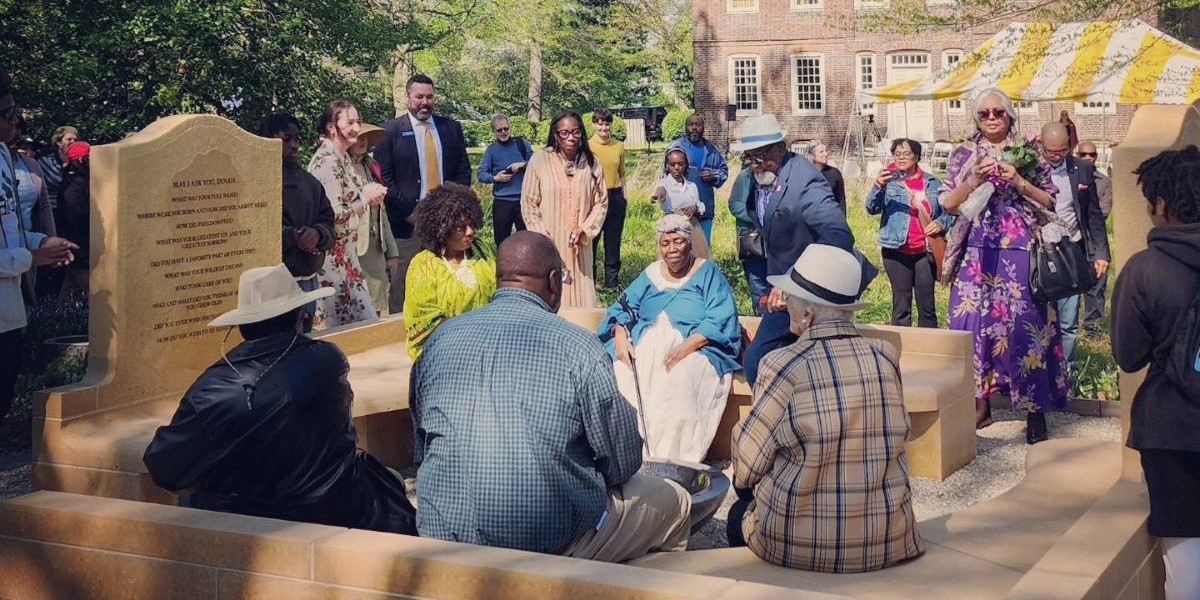
Now, that is beginning to change. At Stenton, the annual observance of Dinah Day has emerged as a powerful act of historical reckoning. Visitors encounter not only the architecture of privilege but the stark inequalities that structured life on the plantation. They are invited to imagine the spatial divide between those who lived in comfort and those who labored in bondage. They are asked to sit with the unknowable.
A monument to Dinah by Philadelphia artist Karyn Olivier offers a place for reflection — a physical embodiment of absence and presence, of memory and erasure. As historian Amy Jane Cohen has noted, what we know about Dinah is limited, fragmentary, mediated through the writings of descendants like Deborah Logan. She appears in those accounts as a “faithful servant” — language that tells us more about the worldview of the writer than the lived reality of Dinah herself.
But what if we read against that grain? What if we center not her “faithfulness,” but her demand for freedom? To do so is to place Dinah in conversation with other Black women whose lives illuminate the costs of liberation.
Ona Judge fled the household of the first president rather than return to bondage, living the rest of her life in uneasy freedom. In Lorene Carey’s The Price of a Child, the fictionalized account of an enslaved woman in Philadelphia, freedom comes at an unbearable cost: the loss of her child. These stories — historical and literary — tell us that Black women’s liberation has never been abstract. It has always been negotiated in flesh, in family, in loss.
Dinah’s story belongs in that lineage. So what does it mean to commemorate the semiquincentennial of American democracy? For some, it will be fireworks, parades, and patriotic reflection. For others, it will be a moment of critique — a reckoning with the contradictions embedded in the nation’s founding.
Dinah offers us another path. Not celebration alone. Not rejection alone. But contemplation. To mark her liberation is to acknowledge that American democracy was never singular in its meaning. It was, from the beginning, contested terrain — claimed differently by those who were included in its promises and those who were excluded from them. The blotted line in Dinah’s manumission papers reminds us that history is not only what is written, but what is obscured.
Her demand for freedom reminds us that democracy is not only declared, but enacted — sometimes quietly, sometimes defiantly, always incompletely. If we are to mark 250 years of this fragile experiment, we would do well to begin there. With Dinah. With what we know. With what we do not know. And with the enduring question of what freedom has meant — and still must mean — for those who had to demand it in the first place.
 MORE FROM DR. JAMES PETERSON