





Teacher Andrea Barile didn’t think her students could do it.
Barile has taught at the George Sharswood K-8 public school in South Philadelphia’s Whitman neighborhood for 25 years. Never before had she tasked first graders to write three-stanza poems about the sun — or anything else for that matter. “ They didn’’t even know what a poem was, let alone how to write their own,” she says.
But Barile dug in. She taught about twilights, sunrises, dawns, adjectives and prepositions.
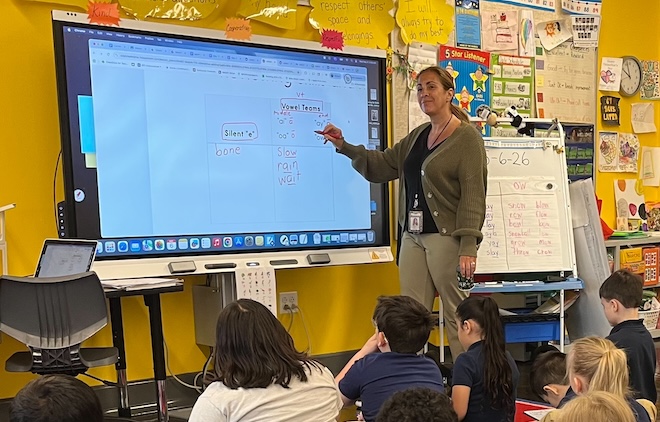
And to her surprise, the poems were actually … good. Even better: They showed an understanding of grade-level literacy skills. She was so elated she invited their parents to class, and each student read their work aloud to an audience.
The students’ achievements are a reflection of a remarkable success-in-the-making story: At Sharswood, the share of students who were proficient or advanced in reading jumped 11 percentage points — to 43 percent — in the 2024-25 school year over the previous year, the first year using the District’s new science of reading curriculum. That result far outshone what happened District-wide, where proficiency rates dipped slightly from 34 percent to 33 percent compared to 2023-24.
As for those in third grade, the pivotal time that experts say often predicts a student’s lifelong reading outcome, proficiency rates District-wide went down by three percentage points, while at Sharswood, they jumped 20 percentage points. More than half of their third grade students were proficient or advanced, compared to 31 percent across the District, according to state exam data.
This year’s Sharswood third graders are also on track to exceed their goals, according to principal Leigh Vitvitsky.
Vitvitsky and others at the school believe a combination of factors have likely contributed to Sharswood’s successful curriculum implementation: the curriculum itself, but also how a strong principal implemented it, while maintaining high teacher morale and zero staff vacancies. Sharswood teachers are given flexibility, have time to spend on learning the curriculum instead of covering for absent teachers, and, critically, receive support when they request it, including from a specialized onsite literacy coach.
Reading as fundamental
The science of reading is widely considered state-of-the-art in literacy instruction. Cognitive science informs the approach, which emphasizes phonics — connecting sounds with letters — while also building content knowledge and vocabulary by focusing on one topic for several weeks at a time. States across the country are embracing and mandating the method, like in Mississippi, now known for its so-called “Mississippi Miracle” for bringing fourth grade reading scores from 45th to first in the nation. But it had much to do with the implementation, like supporting teachers, that made the reform work.
At Sharswood, the share of students who were proficient or advanced in reading jumped 11 percentage points — to 43 percent — in the 2024-25 school year over the previous year, the first year using the District’s new science of reading curriculum.
The School District of Philadelphia purchased its curriculum from New York City-based EL Education for $25 million. Some District educators, including a few at Sharswood, have criticized the speed of the rollout, the pacing and density of the materials, and insufficient teacher development — just two District-mandated training days in the summer of 2024.
Even so, educators at Sharswood have recognized the benefits of the approach itself and dedicated themselves to teaching literacy in a new way, even, at times, coming in early to do unpaid prep work during the school year.
The hard work is paying off. Some, like Barile, have been “blown away” by how students have improved their writing, Vitvitsky says.
Sharswood teachers want to stay
While the curriculum is important, so are Sharswood’s less tangible supports and overall environment for its educators
Sharswood has a “really healthy culture,” says MJ Tecce DeCarlo, a professor of literacy studies at Drexel University, who taught several aspiring educators who now work at the school. That culture becomes a “virtuous circle,” she says, which starts with “high quality leadership that respects teachers.” That attracts high quality teachers and quality substitutes. “Then over time, that’s an effective school,” Tecce DeCarlo says. It’s a supportive environment amongst the teachers, according to Barile.
“We have lunch together every day and we talk about problems and solutions. We can go to each other with anything really,” Barile said.
Vitvitsky, who started in the District in 2001, was a reading specialist and special education teacher for the bulk of her time before becoming assistant principal at Forrest Elementary in 2017. She was an early believer in explicit phonics instruction.
Vitvitsky landed at Sharswood in 2019. The small school of 317 students enrolls 57 percent of kids from outside the neighborhood — a clear indication of a positive reputation. Class sizes are small — averaging 20 students. As throughout the District, most of the school’s students are economically disadvantaged; 61 percent are students of color.
Students are engaged. Vitvitsky says teachers have classroom procedures — routines and structure they establish for students, like the way they should enter the classroom in the morning or split into small groups for activities — and all of them are certified in literacy instruction, unlike at other schools, which have had to scramble to fill vacancies with teachers who have emergency permits and are less experienced.
About 65 percent of Sharswood’s teachers have been at the school longer than 5 years, according to Vitvitsky. Meanwhile, the District has struggled retaining teachers over the last decade. According to a 2024 analysis from Pennsylvania State University, of teachers hired in 2017, just 55 percent were still working in 2022-23 in District schools.
One reason for the higher rate of retention? Well, take the science of reading curriculum rollout in 2024. At first, the curriculum felt overwhelming to Vitvitsky. There are many moving parts — new materials to print or cut out, slides, and so much to learn. It also felt, at times, convoluted. The learning modules are long; students may learn about a topic for four months at a time.
Vitvitsky knew it was important to make it clear to her teachers that she wasn’t looking for perfection, that they should use the curriculum as a guide, not a script. She had faith that the staff would know how best to serve their students.
Nicole Clarke, Sharswood’s third grade teacher, credits Vitvitsky for giving her that “professional trust.” She’s worked in the District for 26 years and at Sharswood for seven. Not being micro-managed contributes to its positive morale, she says. “Trust me to get to what I need to, but give me the time and space to do it,” she says.
Sharswood teachers are given flexibility, have time to spend on learning the curriculum instead of covering for absent teachers, and, critically, receive support when they request it, including from a specialized onsite literacy coach.
As a veteran teacher, Clarke is used to making in-the-moment decisions depending on her students, while focusing on teaching the standards. One recent literacy lesson called for watercolor paints, which wouldn’t have been possible in the timeframe. So students used markers instead. “ I have to adjust and move on,” she says.
Flexibility is key, says Drexel’s Tecce DeCarlo: “ There is no research that shows if every fourth grader in a single school is on page X of the curriculum on April 14, that somehow you have better outcomes.” Even so, Tecce DeCarlo said teachers District-wide have long complained about being told they have to follow a script faithfully. Learning doesn’t work that way. “It’s a deeply personal, social thing,” she says.
Vitvitsky still keeps her finger on the pulse of her school community. She follows the data on student performance to track what’s working and what’s not, and applies that when coaching teachers. “I want to be more curious about why teachers make decisions instead of pointing the finger,” she adds.
Clarke says teachers want to stay at Sharswood because of the class sizes, their available prep time, and maybe most importantly, because they feel “respected.”
Time kept “sacred”
Teachers’ professional learning communities (known as PLCs) are kept “sacred,” Vitvitsky says.
PLCs are meetings amongst teachers to dissect curriculum and methods. Though they are common District-wide, Vitvitsky has her own way of running them. She and teacher leaders ensure each weekly meeting has a purpose, dispersing agendas in advance.
Sharswood was also one of a limited number of schools chosen to receive an EL coach from the company that created the curriculum, who works with the school’s instructional leadership team to navigate the materials and define goals for the year. The team passes those lessons on to the PLCs.
The research on effective PLCs supports Sharswood’s approach. They should be “predictable, dependable, and reliable,” says Tecce DeCarlo. “There has to be a purpose to it.”
Teachers are also able to use their daily preparation time as intended — for their own development — because they are not needed to fill in for absent colleagues. That’s because Sharswood doesn’t have vacancies — despite Philly’s prolific vacancy issue — and they have a dedicated building substitute teacher.
However, an impending District-wide budget shortfall of as much as $225 million could throw this into disarray. If more funds from the state and city aren’t forthcoming, District leadership is warning, 220 building substitute positions could be cut.
That’s a concern for Vitvitsky. A lack of substitute teachers “breaks down morale and the culture of the school,” she said, which can inevitably impact literacy gains.
Like almost every other District school, Sharswood isn’t immune to other staffing cuts if the budget is approved. But Vitvitsky believes it will at least remain as one of 30 “pioneer schools” a District-based designation that allows Sharswood to use $20,000 to pay teachers to come in early before school starts to specifically prepare for math, leaving them more time during the regular school day to work on literacy instruction.
The District is working on furthering support for teachers and leaders, according to Nyshawana Francis-Thompson, the District’s chief of curriculum and instruction. She says that principals and teachers District-wide are receiving curriculum-based professional learning, District-wide development days. Literacy Professional Learning Specialists also coach instructional leadership teams, she says.
The District has adjusted the curriculum based on feedback, like adding more “flex days” for grades three to five, which give teachers more time to reteach or reinforce concepts. The District is also reducing the number of modules from four to three for grades six through eight and launching. And in March, the district launched the Instructional Advisory Collaborative (IAC), a group of educators who are giving feedback on the curriculum’s design and implementation.
Only time will tell whether these changes help other schools catch up to Sharswood’s success.
As of mid-April, Clarke was teaching “Peter Pan” to her third graders. It’s challenging to make time to unpack the gender roles and racism in the plot — lessons baked into the curriculum — while also teaching comprehension and the standards. The curriculum still needs tweaking, she said, teachers need more time to process it. But, she’s feeling more confident this year.
 MORE ON OUR PUBLIC SCHOOLS