



On a recent weekday, 9-year-old Max Cortez of Wynnewood is running and weaving between the wooden posts at Sister Cities Park’s new Playful Learning installation. He’s playing, but when asked one of the questions posted on the installation — What invention would you come up with if you could? — he’s also learning.
Listen to the audio edition here:
His creation, he says, would be “a super large RV, that has everything that I need whenever I need to travel somewhere, with a lot of room and structures.” He pauses then provides more details..
“It has a bedroom and a room that has video games, even a garage,” he goes on. “And machines that clean the floors for you. And when people pass by with their own car, they’ll be like, Wow, that guy has to be super rich. And the other RVs on the road would also be like, Wow. So cool.”
With one simple question, Max is engaged, entertained, and excited. And that, the team behind the concept of Playful Learning, is the whole point.
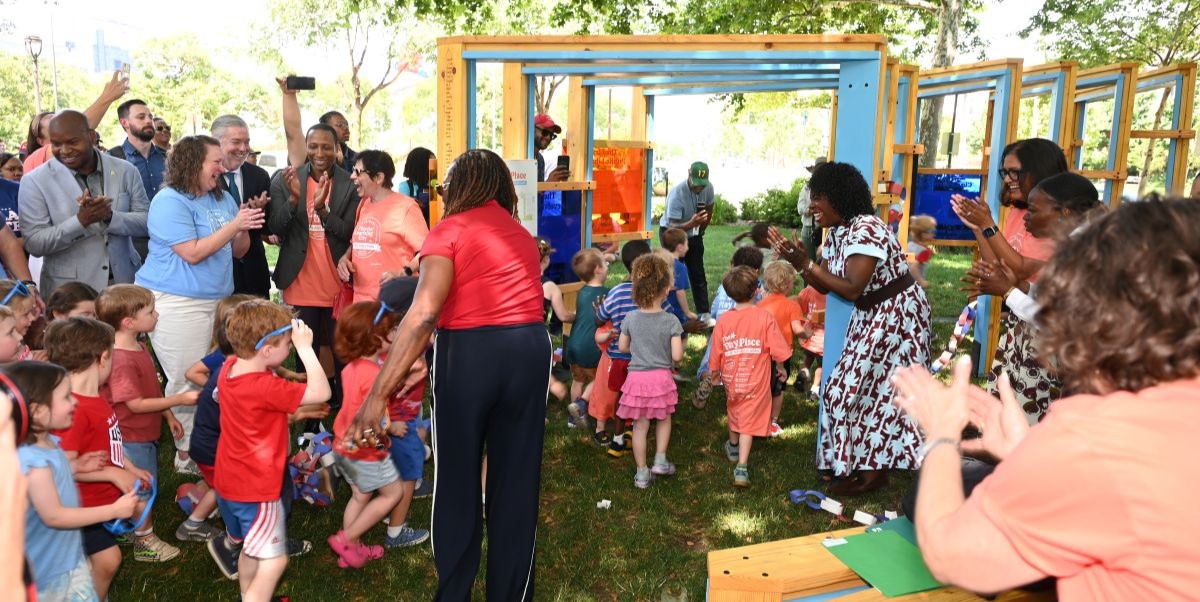
In early June, the nonprofit Playful Learning Landscapes unveiled 11 new installations in Center City designed to engage families in discussion and creative movement. The Sister Cities Park installation, where the project was officially kicked off, is centered on inventions, both Philadelphia firsts and those conceived by kids.
When the team behind the project were looking for a theme to build around, they met with experts on play — children and their families — to find out what most captivated them. Among the stories the organizers shared was one about Ben Franklin who, when he decided he wanted to swim farther and faster, invented swim flippers. Franklin was 11 years old.
“It was very powerful for them, hearing about other children who invented things,” says Sarah Lytle, Executive Director Playful Learning Landscapes (PLL), the nonprofit spurring the project. “The kids were like, ‘I can invent something too!’ With Philadelphia being the city of inventions, of firsts, we had a direction.”
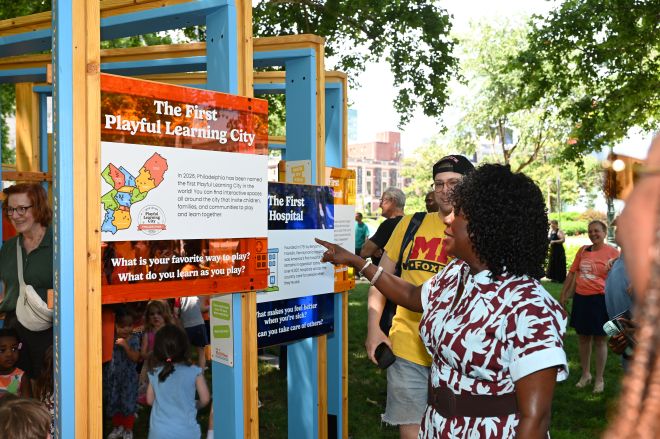
The installation at Sister Cities, called the project’s “launchpad,” includes signage that notes the cheesesteak was a Philadelphia first, then asks, “What’s your favorite sandwich? Ask a friend!” Another reveals that the city is the home of the nation’s first hospital, then posits, “What makes you feel better when you’re sick?” Yet another sign reveals that a six-year-old came up with the idea of a toy truck that could be taken apart and rebuilt in 1963, then asks, “What new toy would you invent? What would it do?”
Playful Learning is also a Philadelphia invention, developed by Temple University’s Kathy Hirsh-Pasek in 2009. Research shows that active social interaction builds language and emotional regulation skills. Engaging children in goal-driven thought exercises outside their classrooms helps them academically and in building creativity, confidence, and critical thinking. It’s most impactful for those aged two to eight. Most children primarily engage in “passive” play that may be physically rigorous — jumping rope, running around a playground, playing tag — but doesn’t light up brain synapses.
In some ways, it’s tricking kids into using their brains, that is to say, having them engage in something healthy without them knowing, like adding pureed vegetables to meatloaf and broccoli bits to macaroni and cheese for better health outcomes.
“I would change that to say it’s taking curious kids and sparking a light so their brains can go places that you and I can’t even imagine,” Hirsh-Pasek says.
Unlike most of the city’s Playful Learning installations — there are 73 — this new batch inhabits oft-visited public spaces so tourists in town for any of the city’s big ticket 2026 events could join locals in the fun.
The sites are within walking distance of each other. (Depending on the temperature, of course. Not all are in shaded areas.) Leaving Sister Cities, a family can visit LOVE Park and the Playful Learning spinning wheel that encourages story-telling with prompts, including setting, central character, and genre. From there, it’s a short walk to Dilworth Plaza, where the Playful Learning installation, tucked under trees near 15th Street, then to other locales — 11 in total, stretching from Elfreth’s Alley to the Zoo.
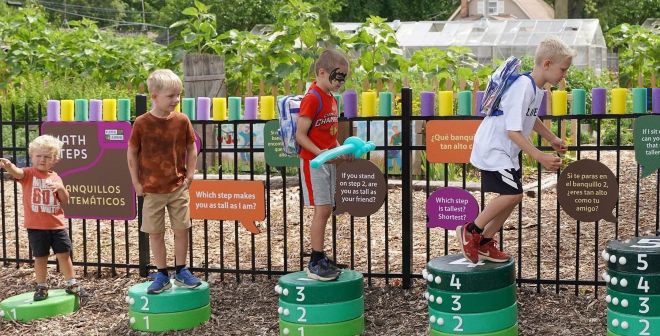
The first Playful Learning installation was installed in Philadelphia in 2013. Since then, the idea has spread to 33 cities worldwide — including “Math Steps” in Aurora, Illinois and an I-Spy Mural in Santa Ana, California. Still, Philadelphia has the most, one reason Playful Learning Landscape gave it its inaugural Playful Learning City acknowledgement. When Mayor Cherelle Parker accepted the honor on the City’s behalf, she noted that “Great cities, truly great cities, invest in their children.”
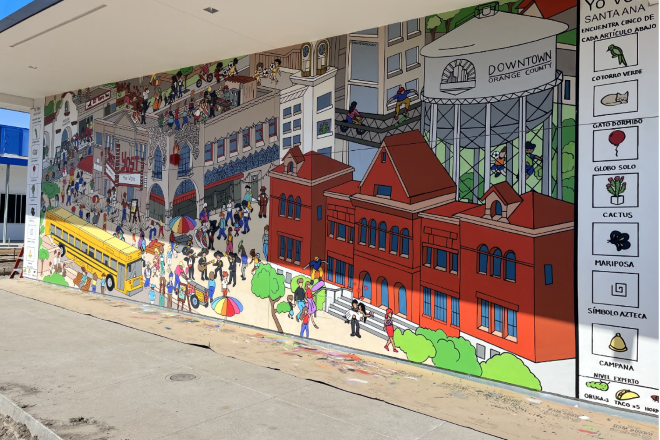
Anyone interested in visiting other Playful Learning installations — most are outside Center City and/or in specific buildings, including museums, shelters, and libraries — can find a listing on Playful Learning Landscapes website.
Some are elaborate, like the spelling and climbing wall that’s helped double attendance at the Free Library’s Cecil B. Moore branch. Others are simpler, like the brightly-colored panels reminiscent of a revolving door also at Sister Cities Park. (The revolving door? Another Philadelphia first.)
Hirsh-Pasek says play spaces make children feel welcome, especially those in areas they may find intimidating, like a public library. She’s spent many happy hours watching children and families interact at Playful Learning installations.
“I’ve seen with my own eyes the difference it makes when these kids get a chance (to play),” she says.
And while long-term effects haven’t been definitively correlated, she says early evidence suggests the positive impact of engaged play. For example, children who enjoy puzzles often have an easier time grasping math concepts. The American Academy of Pediatrics says play can improve one’s ability to plan, engage with others, and regulate emotions.
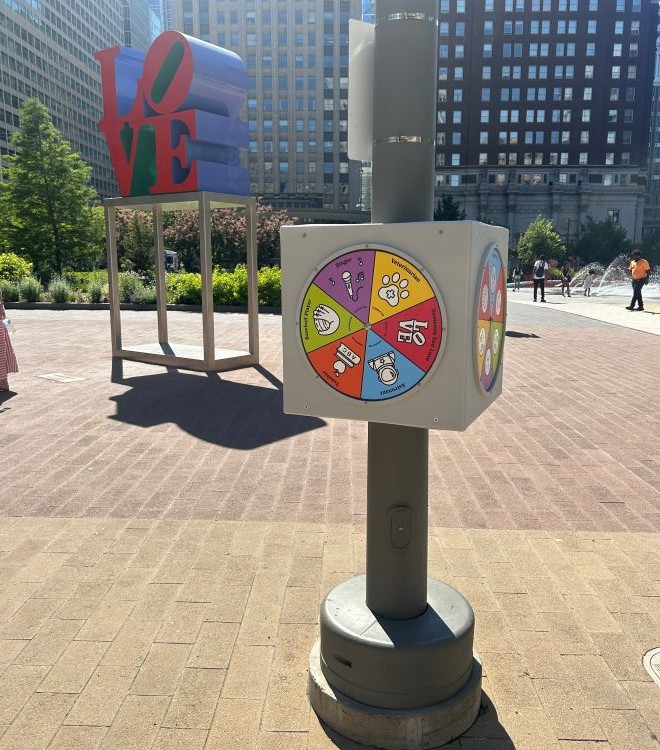
Playful Learning, Hirsh-Pasek says, has grown from a “germ of an idea” 17 years ago to a concept being put to use internationally. It’s grown and changed along the way, but that’s another lesson.
Remember Ben Franklin’s swim flippers? Well, his first design definitely needed work: The originals were pieces of wood shaped like painter’s palettes attached to his hands and wood flats that fit the soles of his feet like sandals.
Max’s super RV idea will probably evolve over time, but just talking about it excited him, and that’s enough for now.
Correction: a previous version of this story mentioned Eakins Oval; it has been updated to reflect that the 11 sites are between Elfreth’s Alley and the Zoo.
 MORE STORIES OF CHILDREN LEARNING AND GROWING