

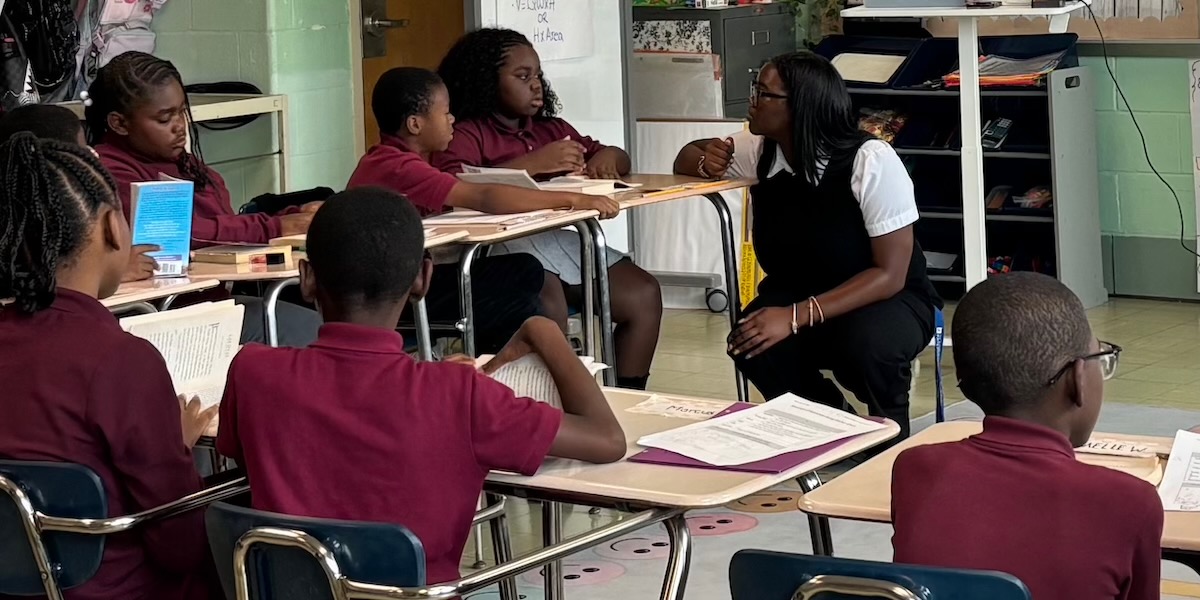


One morning during our class meeting, my 22 fifth graders decided to imitate me.
We were sitting in a circle on the carpet, and I asked them to share a phrase they hear me repeat often.
Hands shot up.
“We should be on Level 0.”
“This transition is done quietly.”
“Track the speaker.”
They repeated my words almost perfectly. We laughed because they meant no harm. If anything, it was proof of something I had worked hard to build. They knew the routines and the structure.
I am a first-year teacher in the School District of Philadelphia, and I am staying. Not because this job is easy. It is not. I am staying because the right preparation and support made the hardest parts survivable.
Much of the conversation about teaching in Philadelphia rightly centers on shortages, burnout, staffing gaps and the weight of state testing pressure. Those problems are real. As the sole fifth-grade teacher in a small K to 8 school, there are days when pacing feels relentless. I am responsible for making every minute count.
But recruitment alone will not solve these challenges. Retention is built, or lost, in year one. And what kept me in the classroom was not grit. It was preparation, mentorship, and a school culture that treats first-year teachers like developing professionals, not emergency replacements.
First, practical training matters.
Before I had my own classroom, I trained at Breakthrough of Greater Philadelphia, a local nonprofit that places aspiring teachers in real classrooms under veteran educators. They emphasized one principle: Routines are everything. Too much unstructured time is where classroom management unravels. That still shapes the way my classroom runs today.
My students start each morning by choosing a greeting and checking a slide on the board that tells them exactly what materials they need. They gather their things, settle onto the carpet, and we begin with a check-in before moving into a short activity.
If we are serious about solving teacher shortages, we need structured mentorship in year one, with real time coaching, modeling, and feedback.
I first learned the power of this structure at Breakthrough, where every day began with a morning meeting. There was something grounding about that routine and I’ve carried that into my classroom.
We use attention-getters so I never have to raise my voice. Students know exactly where to turn in work. They know what to do when they finish early. The routines do the heavy lifting, so the energy in the room can go where it belongs: learning. Those systems did not appear by accident. And because of them, we can laugh during morning meetings instead of constantly correcting chaos.
Second, mentorship cannot be optional.
During training with veteran teachers at Breakthrough, I had a grade team and someone who taught the same subject as me. In my current role, I am the only fifth grade teacher in the building. What supports me now are the adults who step in. My school-based teacher leaders and Peer Assistance and Review Program (PAR) coach, check in regularly. They plan with me, give feedback, and model lessons so I can see suggestions in action.
One day, my math coach was observing and gently stepped in. “Ms. Banks said this. How can we show this with our hands?” she asked the class, turning an abstract explanation into something visual. Then she stepped out. That small moment changed how I approached misconceptions. It reminded me that feedback is growth. Without that support, it would be easy to internalize every rough lesson as failure.
Third, onboarding should be thoughtful, not rushed.
As a first-year teacher, I am constantly learning to give myself grace. There is so much to learn. I have an incredible team that helps me set timers, tighten transitions, and protect instructional time. That kind of support should not depend on luck or landing in the right building. It should be the standard. If we are serious about solving teacher shortages, we need structured mentorship in year one, with real time coaching, modeling, and feedback.
At the start of this year, my class read a book called “Our Class Is a Family.” Months later, that still feels true. There is respect in our room. There is laughter. There is structure.
When my students can predict exactly what I am going to say next, it is not because I am rigid. It is because we built something consistent together.
I am staying because I was shown how to build it.
Kayla Banks is a fifth grade teacher at James G. Blaine Academics Plus in North Philadelphia and a Howard University graduate. A Cheltenham Township native, she spent three summers as a Teaching Fellow with Breakthrough of Greater Philadelphia, where she gained hands-on classroom experience before beginning her first year with the School District of Philadelphia.
The Citizen welcomes guest commentary from community members who represent that it is their own work and their own opinion based on true facts that they know firsthand.
 MORE ON OUR SCHOOLS