




I’ve been watching former Greater Manchester Mayor Andy Burnham for years, seeing how he has helped to transform an ailing post-industrial city into one that is thriving and wondering if his Manchester offers a model for similar cities in the U.S., like Philadelphia where I live. Like Manchester, Philadelphia is a proud post-industrial city that has spent decades in the shadow of a dominant nearby capital — for us, it’s actually both New York and Washington, D.C.. And like Manchester, we’re also chasing the goal of being a tech and life-sciences hub.
Listen to the audio edition here:
Here’s what I wrote about Manchester three years ago, when I summarized some of the interesting things happening in the city:
How many mayors say they wish their city had a SXSW? And how many mayors actually make such a festival happen? Andy Burnham is one of the mayors who did make it happen for Manchester. This October Beyond the Music will launch as a “change making conference and new music festival.” One interesting facet of the conference: You can buy a membership with various levels of participation rights in shaping the conference.
But the music festival is just one of the latest things that caught my attention about Manchester. Andy Burnham is another mayor to follow on Instagram — in fact you can (could) follow his regular mayor account or his night mayor account, which basically collects photos of him having beer with people.
Burnham has a vision for Manchester — cultural, carbon neutral, tech-forward. Ever since Brexit, the U.S. and the U.K. have yet to create a comprehensive trade agreement, but Burnham went ahead and made his own trade mission between his city and North Carolina. He wants to make Manchester the fastest growing tech and life sciences hub of Europe with the motto of “look beyond London.”

After the emergency pedestrianization of parts of Manchester during COVID, the city has continued to focus on pedestrianization and increasing transportation alternatives, building upon the legacy of a 1980s pedestrianization of Market Street.
Lastly, the city will be home to a stunning new OMA-designed cultural center opening this October. Look beyond London? Definitely sold on that one.
Now Burnham is in contention to be the next Prime Minister of the U.K. (And perhaps not surprisingly, his old Night Mayor Instagram handle has been deleted.) Critics are wondering if he is just a less gray, smart-casual Keir Starmer, but Burnham is already distinguishing himself with a key idea: devolution.
What is devolution?
It’s a word that hasn’t become commonplace in the U.S., but it’s one that comes up rather regularly across the pond.
What does devolution mean? In the simplest words: giving localities more control. Frankly, I wish the word were “decentralization” — it sounds less like devolving.
Back in 2024, the government issued a white paper, “Power and Partnership: Foundations for Growth,” explaining how devolution could restore growth to U.K. cities beyond London.
That lines up with Burnham’s recent speech — considered the “soft launch” of his premiership — where he pledged growth in every locality in Britain and promised to make the power shift visible by creating a No. 10 North, a satellite office of the prime minister, in Manchester.
The crucial thing to understand about Burnham’s argument is that it’s not only about political power — it’s about economic growth, too. The remedy isn’t just to let other places govern themselves differently. It’s to actively move the country’s economic center of gravity beyond the capital.
That distinction matters, because the closest U.S. analogue is something quite different. We don’t really have a movement to put more control in the hands of mayors and county executives. What we have is a longstanding conservative wish to reduce the role of the federal government in favor of states’ rights. But states’ rights is about autonomy — lessening distant federal control so states can differentiate their policies for their own populations. Devolution is about redistribution — moving infrastructure, capacity, and growth out of the dominant center and into the regions. One wants the freedom to differ; the other wants the resources to catch up.
These ideas have real support in urbanist think tanks. The Centre for Cities argues that devolution is essential to addressing the longstanding economic underperformance of places outside London: Give city-regions more powers and resources to improve their local economies, and those economies will in turn contribute more to the national one. They point out that UK cities lag their European counterparts, that Britain is the least fiscally devolved economy of the G7 and that closing the gap means devolving political and fiscal powers down to the level of “economic geography” — areas that match how local economies actually function — for planning, housing, transport, and skills.
Other sources agree. A Bloomberg article cites OECD research on the topic:
The share of UK tax revenue raised at a subnational level was less than 5 percent in 2023, compared with 14 percent for France, 24 percent for Spain and close to a third for Germany…The country also has far higher levels of geographical inequality than its peers. International experience suggests regions tend to do better when they raise more of their own revenue. Increasing tax decentralization by 10 percent is associated with a 1.75 percent long-run increase in gross domestic product per capita, a 2018 OECD study found.
What is unitarisation?
At the same time as Burnham has people talking about devolution, there’s another complementary but distinct government idea that’s been much discussed lately: unitarisation. This is the idea of replacing local and county authorities with a single tier of government.
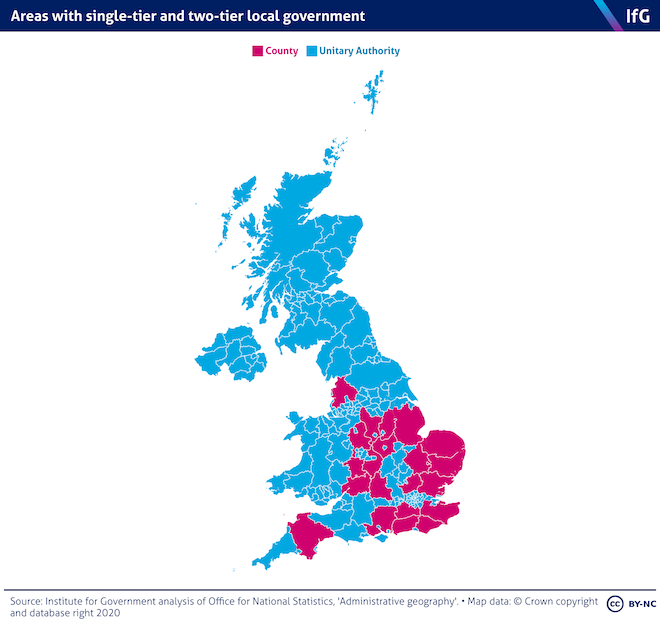
It’s nothing short of a major restructuring of local government, and one Americans should watch closely. A movement to create more city-county mergers here would be brutally hard to pull off, but it would help defuse the zero-sum competition between city and suburb over population, tax base, and infrastructure in nearly every metro region. If the U.K. does it, I wonder if the concept of unitarisation will catch on here.
Will this work?
We have a chance to watch another country grapple with the question: What is the right level of government for which kind of policy? I really like Andy Burnham, but the American experience doesn’t exactly confirm his ideas.
Britain’s problem is too much centralization. The States’ problem can sometimes be too much localization. On housing, we’ve spent years discovering that local control is precisely where things break down — it’s the level where a handful of NIMBYs can block the homes a whole region needs. So the reform movement here is pushing in the opposite direction from devolution: States like California are pulling zoning authority up, out of the hands of municipalities, to override local obstruction. In Pennsylvania, we’ve yet to achieve any major statewide housing legislation. Harrisburg has largely left zoning to the municipalities, and the Philadelphia region’s separate governments each guard their own land-use rules. The result is exactly the fragmentation Burnham wants to fix.
The same logic applies to transit, where raising capital at the local level is nearly impossible and the interconnected nature of the system often demands federal money.
Britain has lodged too much at the top and is trying to push it down. America has lodged housing too far down and is trying to lift it up. Neither “more local” nor “more central” is the answer on its own. The answer is matching each policy to the tier that can actually deliver it — and being willing to move power when the match is wrong.
That’s also why I’m of two minds about Burnham’s plan. The instinct is right; the execution is daunting. Critics of Burnham’s speech were quick to point out that Scotland devolved years ago without the transformation its champions promised, a reminder that handing power down doesn’t automatically produce growth if the capacity to use it isn’t there too.
I also worry that restructuring the size and scope of regional government is the kind of renovation that can destabilize a country. After the debacle of Brexit, is this really a good idea?
But Britain’s struggles are real — the country has faced stagnation and widening inequality for nearly 20 years. No wonder people are willing to consider drastic measures. I wish Andy Burnham the best of luck!
Diana Lind is a writer and urban policy specialist. This article was also published as part of her Substack newsletter, The New Urban Order. Sign up for the newsletter here.
 MORE FROM THE NEW URBAN ORDER