



When Southwest Philadelphian Adriane Parks looks at the railway swing bridge south of Grays Ferry Avenue, she sees a relic of a bygone industrial age.
Listen to the audio edition here:
The American Bridge Company built the steel behemoth in 1901. Freight trains used it to cross the Schuylkill River, but when a ferry or tall ship needed to pass, the bridge’s truss would rotate. Rather than connecting the banks, it ran parallel to the shoreline, allowing boats to navigate around it. Parks remembers standing on the shore and watching it turn as a child.
Then, in 1976, Conrail acquired the swing bridge and took it offline. It wasn’t the only closure along the river in those years. Four years later, Marshall Labs, maker of everything from toothbrushes to Teflon, shut down their manufacturing operations near what is now the Pennovation Campus. Paint factories and chemical producers soon followed — if they hadn’t already closed down in the decades prior. Parks, who spent her life bouncing between West and Southwest Philadelphia, saw neighbors lose their jobs. The swing bridge rusted over.
In the decades since, Kingsessing and other Southwest Philadelphia neighborhoods have struggled with the economic and environmental degradation wrought by deindustrialization. The poverty rate runs as high as 40 or 50 percent in some parts of Kingsessing, with 31.9 percent of households earning a yearly income that falls 125 percent below the Federal Poverty Level. The neighborhood has some of the highest childhood asthma hospitalization rates in Philadelphia, in part due to decades of pollution. That hasn’t changed — nearby highways still bring increased air contamination.
“We get a lot of smog over here,” Parks says. “All of those fumes and stuff have started to affect my neighbors.”
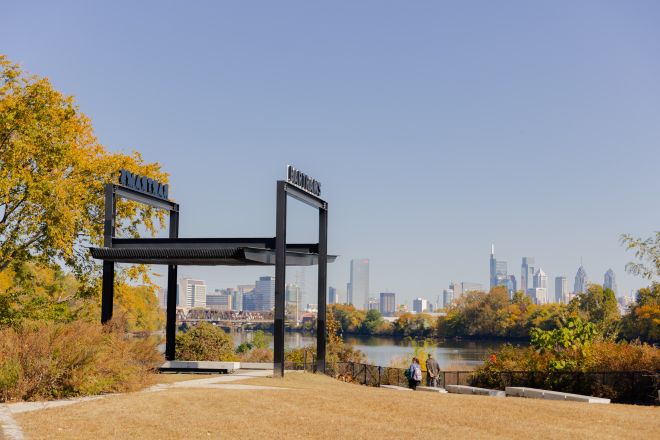
But just as the swing bridge was a symbol of industrial decline, Parks hopes it might be a harbinger for a brighter future. The City of Philadelphia has been working to replace the corroded, more than a century-old bridge with a shiny, new lighter weight model, set to open later this summer. The vision: a pedestrian crossing that connects walkers and cyclists to Bartram’s Mile on the west bank and the Schuylkill River Trail to the east. The City is dubbing it “Schuylkill Crossing.”
The new trail will increase residents’ access to greenspace. More importantly, it has the potential to ease commutes into both Center City and the burgeoning Bellwether District — especially for people who don’t own cars. But many fear that the bridge will drive up rents and property values, displacing long-term residents before they can take advantage of any environmental or economic benefits the trail may bring.
In other words, the bridge is “a good thing,” says Parks … “ as long as we do not leave out the community.”
Transforming the swing bridge into a pedestrian crossing
Joe Syrnick first thought about transforming the old swing bridge into a pedestrian pathway around 2006. Syrnick, former chief engineer with the Philadelphia Streets Department, was the recently minted president of the Schuylkill River Development Corporation (SRDC). He’d built the first Schuylkill Banks trail section, spanning from MLK Jr. Drive to Locust Street, in 2000 and had a dream: build trails along the tidal Schuylkill banks. All of it.
“He said, We’re going all the way to the Navy Yard,” recalls Tony Sorrentino, CEO of the Fairmount Park Conservancy. Sorrentino was on the SRDC’s marketing committee at the time. “We thought that was impossible.”
“We’re helping to clean up the river, to make it a healthier habitat for urban and migrating wildlife. We’re adding trees to the riverbank where there used to not be any, helping clean the air.” — SRDC interim CEO Heather Saeger.
Syrnick knew the swing bridge would prove to be a key connector in his plan. So, he rounded up about a dozen SRDC board and committee members, got them on a boat, and drove them out to see the bridge. Even though rust prevented the bridge from turning, Sorrentino was awestruck.
“Joe had this incredible vision, to connect people across time and space, culture and background, suburban and urban,” Sorrentino says.
It would take nearly a decade to realize that vision. Piece by piece, the SRDC worked with the City to acquire land and build out the trail system. The 2,000-foot long Boardwalk in 2014, Bartram’s Mile in 2017, and, last year, the Christian to Crescent segment. Sadly, Syrnick will never see the next step, the swing bridge linking paths on the east and west sides of the river. He died in January.
The promise of a new connection
Justin Dennis calls the project the “missing link” to the Schuylkill Trail setup. Dennis is the cycling advocate who chairs the Circuit Trails Coalition, a collaborative of nonprofits, foundations, agencies, and other groups who advocate for more bike and walking trails in Greater Philadelphia.
It’s also part of a larger project to create stormwater infrastructure and restore the environment.
“We’re helping to clean up the river, to make it a healthier habitat for urban and migrating wildlife. We’re adding trees to the riverbank where there used to not be any, helping clean the air,” says SRDC interim CEO Heather Saeger. So far, the SRDC has worked with the City to build 4.5 miles of trails and opened up 29 acres of land where the public runs, walks, bikes, and set up riverside family picnics.
West Philadelphian Ahmed Moor is enthusiastic about the swing bridge. Moor graduated from Penn about 20 years ago and remembers it as a “very different trail back then … There was a lot of refuse. It was kind of junky in parts.” Now he runs along the path to train for marathons and takes his family on bike rides.
The trails along the Schuylkill also fit into a broader network, connecting Philadelphia neighborhoods to Camden and communities in suburban Pennsylvania and New Jersey. These Circuit Trails span 500 miles, including the pedestrian pathways across the Benjamin Franklin Bridge, the Pennypack Path Connector, and the route, similar to the Schuylkill River Trial, along the Delaware Waterfront. They hope to reach 800 miles by 2040.
“There’s a palpable excitement about it in the garden and amongst people in the neighborhood,” says Maitreyi Roy, executive director of Bartram’s Garden. “Perhaps you’ll go biking to your job, or your doctor’s office, or a museum. So many things open up.”
The challenge of connecting communities
“One of the vestiges of industrialization is that one side of the [Schuylkill] river was industrial and working class, the other side was more downtown. That only amplifies over time without a correction,” Sorrentino says.
“I’m not going to suggest that the swing bridge is the connection that will correct all of that, but it reflects the fact that these two sides of the river are ready to be brought together.”
For decades, neighbors in Southwest Philly neighborhoods, like Kingsessing, Bartram’s Village, and Eastwick, have felt disconnected from Center City and other parts of Philadelphia. Part of that gap is physical. The neighborhoods are without reliable transit options or pedestrian pathways, meaning it takes them longer to get downtown than folks who live in North Philadelphia or West Philadelphia neighborhoods that are a comparable distance away.
But it’s also an economic problem. Southwest Philadelphia is the only part of the city where the median household income declined over the past decade, falling three percent between 2014 and 2024.
The swing bridge can’t promise to change that. But it can take a step in that direction, connecting Southwest not just to Center City, but also Fairmount and Manayunk.
As long as it doesn’t take a step too far and displace current Southwest residents and their businesses. “It’s a great thing that we’re connecting communities with this bridge and allowing easy access to Center City from the Southwest,” says Dianna Coleman, a community activist, The Citizen’s 2025 Block Captain of the Year in Kingsessing and Eastern PA director for Clean Water Action. “But it’s going to attract developers. It’s going to attract businesses that aren’t necessarily from the community. It’s going to increase the taxes in this area. People are not going to be able to afford to stay in their homes that have been in their homes for generations. People are going to be displaced. … My question is, who’s thinking about these things?”
That’s what happened with Atlanta’s BeltLine. The project transformed a neglected railway corridor into a 22-mile park and trail loop that developers and city officials promised would connect segregated communities and create an economic boom for working class neighborhoods decimated by deindustrialization.
The BeltLine did generate more than $9 billion in private investments for the city … but also displaced a significant number of Black Atlantans. In the Old Fourth Ward along the BeltLine — birthplace of Martin Luther King Jr. — property values jumped from $345,000 in 2010 to $1.7 million in 2020. Over the same period, the neighborhood went from majority Black to primarily White.
Urban planning experts now consider the BeltLine one of the primary examples of “green gentrification,” which occurs when cities transform neglected urban areas into parks and other greenspaces and inadvertently push out working class residents.
Southwest Philadelphians have seen it happen to their neighbors across the river. In Graduate Hospital, Grays Ferry and Point Breeze, Census data shows that the median household income more than doubled from $47,800 between 2010 and 2014 to $96,900 between 2020 and2024. A 2023 Reinvestment Fund report found that long-term residents in these neighborhoods face some of the greatest risk of involuntary displacement citywide.
“A lot of these developers aren’t worried about trying to make sure that things are good for long-time residents,” says Meeka Outlaw, a teacher, lifelong Grays Ferry resident, the founder of the community group Residents Organized for Advocacy and Direction and an at-large member of the Grays Ferry Coalition of Neighborhoods..
“How do you help the people that live here so that they’ll be able to enjoy all the different things that are coming?”
“Gentrification is coming regardless. What promises will the city have for us? What promises will they make to ensure that the maintenance is adequate and that our security is a priority?” — Russo Reed.
Making the trails a win for everyone
The good news is there are easy-to-find models for how to protect neighbors and local businesses from gentrification.
In Kensington, the Kensington Corridor Trust has embraced a collective real estate ownership that helps keep rents down, allowing longtime local businesses and residents to reap the benefits of increased development. The nonprofit organization owns 31 properties, worth about $10 million, and has locked them in at below-market rate rents for residents and small business owners — which is a huge deal in a neighborhood where corporate, out-of-town investors purchase more than half of single family homes.
Coleman sees how a similar model could help protect Southwest Philly. She also points to anti-displacement strategies like small business supports, investments in affordable housing, increasing inclusionary zoning and other parks-related anti-displacement efforts cities both in the U.S. and Europe have employed in tandem with green-infrastructure improvements. The City is currently undertaking a $250 million redevelopment of Bartram’s Village, increasing the number of units available from 500 to 600. It’ll include 500 subsidized rental units.
Another solution: workforce development programs, like the ones at the Bellwether District, targeted toward residents in the five zip codes bordering their new commercial and industrial complex, including funding scholarships for 18 Community College of Philadelphia students there, partnering with pre-apprenticeship programs like IBEW’s Rosie’s Girls, and working with the Center for Employment Opportunities. So far, they’ve invested $2.7 million in these initiatives and plan to add another $10 million.
Amelia Chassé Alcivar, a spokesperson for Bellwether District developer HRP Group, says HRP has been thoughtful about connecting the site to both transit and pedestrian infrastructure, so that the jobs will be accessible to everyone, even those without a car.
“The swing bridge will open up new access to Southwest,” says Chassé Alcivar. “A lot of people see trails as recreational, but — and we’ve seen this in other projects we’ve integrated into trail networks — we see these as commuter connections.”
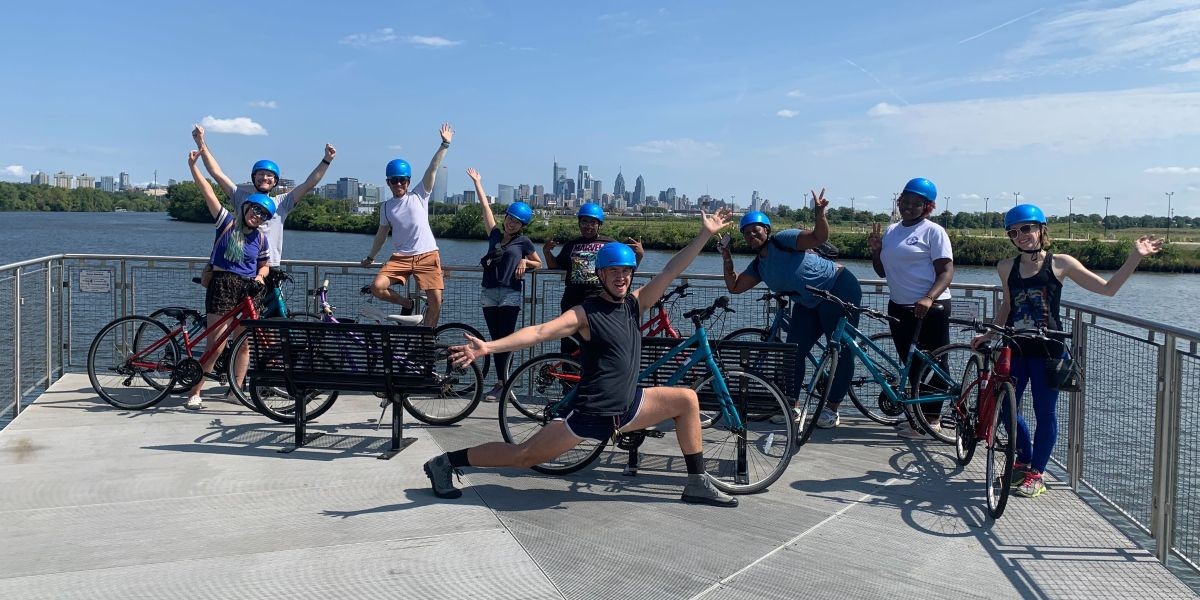
Meanwhile, nearby nonprofits are gearing up. Bartram’s Garden and the Bicycle Coalition of Greater Philadelphia already offer lessons in cycling and bicycle repair and run a bike hub that offers free rentals and bike maps. The Bicycle Coalition has hired Mable Bakali as swing bridge ambassador. She’s been working with community activists and leaders to address Southwest neighbors’ concerns, and, once it opens, will help them utilize and enjoy the bridge. Bartram’s Garden has also been working with the Southwest Community Leadership Circle, a group of neighbors who advise the garden on local priorities. Parks is a member.
“The intent is to really give back to the community, connect with the community and bring awareness to the community,” Bakali says.
These initiatives are a start, but Southwest Philadelphians, many of whom feel like City Hall has neglected them for decades, want to see City leaders do more to protect them from green gentrification — especially since advocates are planning for more bike trails, says Ramona Russo Reed, vice president of the Eastwood Friends and Neighbors Coalition.
“Gentrification is coming regardless,” Russo Reed says. “What promises will the city have for us? What promises will they make to ensure that the maintenance is adequate and that our security is a priority?”
 MORE ON DELELOPING AND ENJOYING OUR GREEN SPACES