


This is the summer of watching together.
Almost a year ago, journalist Derek Thompson made a canny assertion that everything is television. His thesis is one of isolation: Social media, podcasts, even AI image generators all converge on the same end state — an endless flow of video made by people we don’t know, watched alone, the play button doing the work that friends and family used to. Like a hammer to nails, Thompson sees all screens as things that pull us apart and inward.
Listen to the audio edition here:
But this summer, the screens didn’t isolate us — they assembled us. The Knicks finals. The FIFA Fan Fests in cities across the country. They turned watching into placemaking and vice versa. Toy Story 5 (five!!) had a stupendous weekend opening. And the Las Vegas Sphere — which made Knicks owner, James Dolan, even richer than he already was — is expanding from Nevada to Maryland and Abu Dhabi after selling 2 million tickets to The Wizard of Oz.
I often get sucked into reading Brad Hargreaves of Thesis Driven’s LinkedIn posts that promote real estate verticals you never thought of as profitable — porta-potties, post offices (okay, this is a parody, but you get the idea) — and I could see him selling us on this concept: Big fields with big screens. They could print money. FIFA Fan Fest in Philadelphia notched a record attendance of 55,000 people in one day and probably will see 1 million people total before the end of the World Cup.
Watching TV, together
So here’s my amendment to Thompson: It’s not just that the screens are TV now. Urbanism is too.
People are clearly loving watching a screen together. It’s been fun to read all the hyperbolic joy of the NBA finals in New York City. My favorite account: Matt Choi’s Watch-Party Urbanism which revels in how the Knicks’ finals transformed the city, and how in turn the experience transformed NYC residents. Here’s an example from Choi’s experience after Game 5:
After the win, I emerged red-eyed onto Smith Street and engaged in a lot of hugging and jumping around. I probably said “I love you” to 15 people. We maneuvered onto the Brooklyn Bridge to see the skyline lit up in orange and blue and hype up some passing cyclists. I thought I’d make it into midtown to party all night, but I was drained. I leaned against the bridge’s railing and looked up at its gothic arches, before heading home and, like millions of others, falling asleep for the first time a winner.
I’ve learned not to minimize the parasocial benefits of sports. I’ve felt them myself. But what’s interesting is how parasocial and true social connection are recombining in a new formula these days through shared watching experiences.
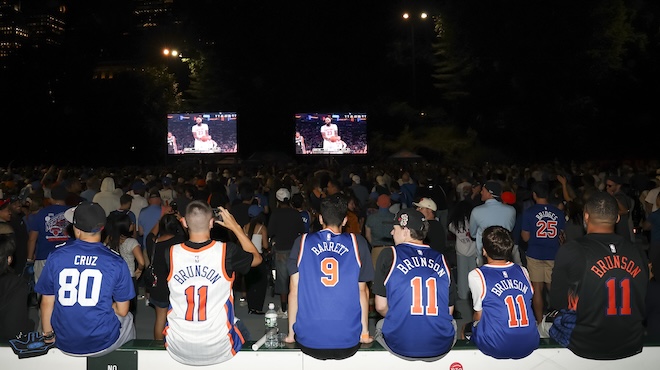
At a time when our social skills have atrophied so much that everything — from hosting dinner parties to dating to even just talking to each other — seems hard, watching a screen has become the great common denominator. It’s just about the only thing we can do together. (And frankly, it’s just about the only thing most people can afford to do these days.)
You don’t have to talk. You can just yell. If you don’t know how to look someone in the eye, or summon the gumption to kiss your date, don’t worry. At a screening of a FIFA game or even a Sunday football game, there’s still the prospect of physical and psychological connection — a shared chant, a high-five, maybe even a bro-y side hug.
At the movies, you don’t even need to do that — you can watch in silence, in the dark, in a Twizzler-induced trance. The screen gives us permission to be together without requiring us to be social. It’s communion with all the icky parts — the social friction, the navigating the nuances of social norms — removed.
The idea of big spaces for big gatherings is not new. After all, there were piazzas that served as the central backyard and commercial center for entire neighborhoods once before. But the piazza decentralized the activity — it scattered people into conversation, into a hundred small encounters happening at once.
What we’re craving now is the opposite: synchronicity.
Everyone doing the same thing at the same time, facing the same direction. The piazza turned us toward each other; the jumbotron turns us all toward the screen.
And yet — I don’t want to read this only as loss. In a world where everything feels fractured, where no one shares a feed, there’s a tremendous appeal to seeing the same content at the same time with a lot of people. The watch party or the opening weekend movie showtime takes the pervasive FOMO that we all have from our endless scrolls and instead converts it into security: proof that you’re doing exactly the right thing at exactly the right moment. That’s not nothing. People are genuinely starved for the certainty of the shared moment, for feeling part of something.
So, several things are true at once. The Fan Fest crowd is a kind of antidote to Thompson’s lonely scroller — and it may also be masking our antisocial tendencies. But maybe it’s also a necessary step in rehabilitating our social muscles after the pandemic injured them.
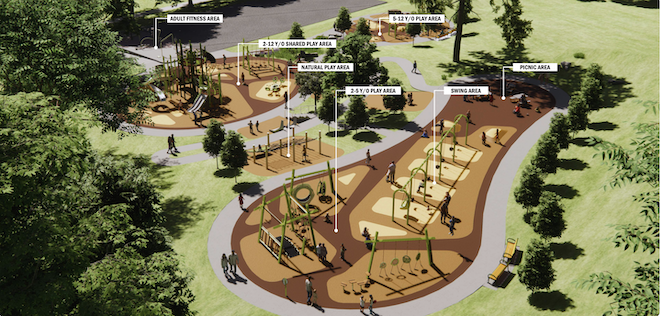
In Philadelphia, once the FIFA Fan Fest at Lemon Hill is over, the fields that once hosted thousands will get a slew of improvements. They will dramatically update a beloved but previously under-maintained park. As far as I can tell, there won’t be a jumbotron permanently installed.
While I want a beautiful playground and picnic spot, I also think a centralized public space where people can watch a screen together makes a certain kind of sense these days.
After all, everything is TV.
Diana Lind is a writer and urban policy specialist. This article was also published as part of her Substack newsletter, The New Urban Order. Sign up for the newsletter here.
 MORE FROM THE NEW URBAN ORDER
