


For students, the Covid-19 pandemic marked a pivotal moment for many reasons: school shutdowns, online classes, heightened social isolation. While this was the case for Naples, Florida middle schooler Natasha Agarwal, now a rising sophomore at Penn, the nationwide lockdown was significant in another way too: Quarantine turned her into not just an avid reader, but also an avid reader who’d go on to be an extremely avid sharer of books.
As she devoured book after book, Agarwal was shocked to find out that students nearby struggled to find books to read in their daily lives. “My bookshelves had always brimmed with all my favorite books and new ones that I could explore, but I learned that kids even 10 miles away didn’t have anything to read,” she says.
Of course, the phenomenon was not unique to Southwest Florida. “Book deserts,” low-income areas lacking in access to printed reading material, have helped contribute to the nation’s “reading recession” and declining literacy rates that reinforce structural inequalities. Here in Philly, according to the nonprofit Read by 4th, 71 percent of our fourth graders can’t read at grade level.
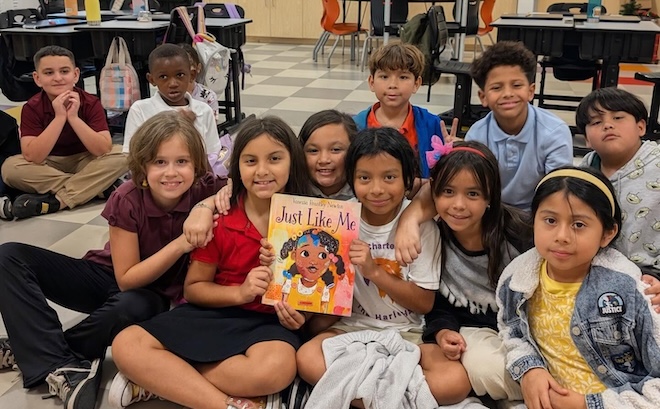
By eighth grade, Agarwal was back to learning in-person and on a mission to help kids get books. Agarwal’s first school book drive — originally planned as a one-time project — ended up collecting 3,000 books for The Guadalupe Center, a local early childhood learning center.
Flash forward just five years, and Agarwal’s youth literacy nonprofit Believe N Books has reached 25,000 young people. On July 1, the organization will celebrate a milestone of 250,000 books donated, having expanded beyond Florida, across the country, and into Africa.
Starting (and growing) a nonprofit
Agarwal calls her first book drive “quite the process.” For one excruciating week after she put donation boxes in the hallways of her school, those boxes remained empty. But by week three, they were filled to overflowing. Teresa Brook, a teacher at the independent Canterbury School that Agarwal attended, was impressed. Agarwal “was very passionate about [Believe N Books] from the get-go, very dedicated to it, rounding up her friends to do videos on YouTube, reading out loud for kids — just very dedicated” says Brooks.
Today, the drive is an annual school tradition. “For the kids that give, it’s a very good feeling,” Brook says. “That’s what makes this end of the project really meaningful, when you see a group of students excited to bring books to the school to give to kids, it’s pretty powerful.”
The next year, Believe N Books’ success spread. Nearby students and neighboring schools co-hosted drives. Agarwal developed a system: Find a dedicated student or faculty member to take the lead, help them get the word out, set up dropboxes, and, finally, sort and pack the books before delivering them. Although the organization collects books across genres up to age18, preschool and elementary books are in highest demand.
As Believe N Books has grown, Agarwal has formed partnerships with students, educators, and community leaders across the country. “The initial school that I distributed the books to did a really great job connecting me with other Title One schools, other shelters, hospitals, educational facilities, tutoring centers in need of books,” she says.
She also began to work with students at Florida Gulf Coast University, a partnership that she describes as crucial. “They’ve been involved from start to finish,” she says, “Even when I didn’t have high school volunteers.” Since then, Believe N Books has worked with organizations like Boys and Girls Clubs, Room to Read, and the Golisano’s Children’s Hospital.
The momentum that Agarwal found in Florida pushed her to expand her mission past her home state and into New Jersey, Georgia, Louisiana, California and Pennsylvania. She grew the effort by networking with fellow student leaders. Floridian-turned-Georgian Sanjana Uppaluri helped create the Georgia location, by leading book drives and coordinating with the transitional and affordable housing nonprofit New Transition to Success.
Uppaluri says Agarwal’s enthusiasm is contagious. Before getting involved with Believe N Books, the rising UC Berkeley freshman hadn’t thought a lot about books or literacy. Now, she’s all in. “Books tell stories, and they teach,” she says.
Believe N Books comes to Philly
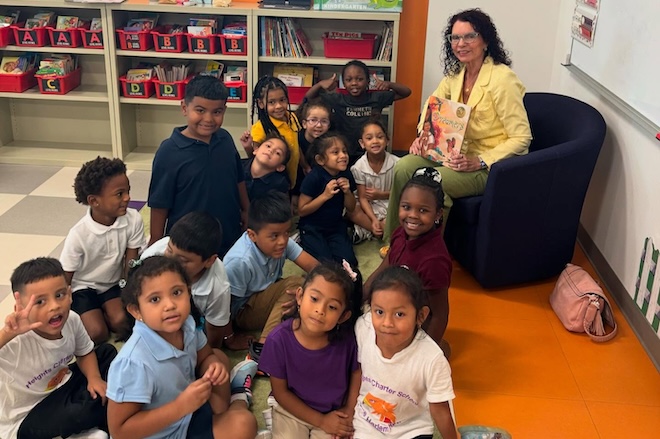
As a student at the University of Pennsylvania, Agarwal has been focused on increasing Believe N Books’ local impact. So far, she’s established five regional book donation sites, including at Wilmington Friends School and Penn Charter. Agarwal is also partnering with Penn’s Netter Center for Community Partnerships to donate books to the Title One schools they serve and has donated books to Pennsauken, NJ-based Book Smiles and West Oak Lane’s Philly Book Bank, based in MLK High School.
Her work here is especially relevant. Despite a recent $25 million investment meant to improve the city’s public school reading curriculum, literacy rates have actually dropped. In an interview with Chalkbeat, educational advocate Laura Boyce of Teach Plus, called Philly’s current rates of reading proficiency “extremely troubling,” adding the downward trend “doesn’t bode well for our future workforce or our city as a whole.”
Agarwal has faced her own challenges. She’s struggled to recruit a consistent and reliable volunteer workforce to run and scale up book drives — in particular, public transit-using Penn, Drexel and Temple students haven’t been able to help drive books where they need to go, and she’s had to rely on family for rides. In time, maybe even in this school year, she’d like to find a stabler, longer-term transportation solution.
Agarwal has also had to adapt to a new nonprofit landscape and challenges reaching individual schools as quickly as she could back in Florida. She’s learned to adapt, however, learning (and practicing patience) as she goes.
Believe N Books goes abroad
Agarwal isn’t just a distributor of free books. She’s also written one. In 2024, after learning about the lack of opportunities for girls in too many African nations, she wrote and self-published Tales of African Women Trailblazers. The 94-page volume highlights 21 African-born women, like professional soccer player Asisat Oshoala and entrepreneur Fatoumata Ba, who overcame adversity and emerged as national and industry leaders.
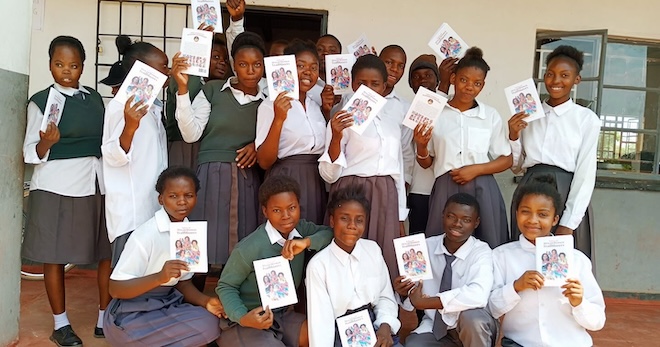
The book is free to download and available on Amazon and Barnes and Noble; 10,000 copies have been distributed across Ghana, Rwanda, Kenya, Uganda, and Zambia. Instead of distributing books the traditional way, Believe N Books has instead raised money to print out copies closer to the students themselves.
The goal, the author says, is to expose young African readers, especially girls, to “different possibilities for themselves … to show them what’s possible in terms of job opportunities.” She wants them to “dream big.”
Although Believe N Books has gone global, Agarwal plans to celebrate the organization’s milestone back at her old school. It’s fitting, she says, “because the same place where we collected the first book is also the spot where we collected the 250,000th … It’s very full circle.”
Correction: The Guadalupe Center is an early childhood learning center.
 MORE CITIZENS OF THE WEEK
