



State Representative Liz Hanbidge did not start out life as a reader. She was late to discovering the joy of words — and worlds — on a page, until a savvy librarian at her Montgomery County elementary school offered her a time-traveling mystery called Magic Elizabeth, involving the search for a lost doll.
“It wasn’t even good,” Hanbidge recalls now. “But it was the first book I read from start to finish. Now I’m a sucker for books and how expansive they are.”
Like Hanbidge, there are thousands of children in Pennsylvania who are late to reading. More worrisome, there are thousands of PA children who never learn how to read. According to the PA Literacy Coalition, more than 50 percent of PA adults cannot read proficiently. Statewide, only 49 percent of third graders read at grade level. In Philadelphia it’s even worse: Only 35 percent of third graders are grade-level proficient. And among low-income Philadelphians, that number falls to just 29 percent.
Perhaps unsurprisingly, those are also households that often lack a resource which makes reading more accessible: books.
That’s why Hanbidge, who has a masters degree in education, is pushing for the state to send a free book a month to every PA child from birth to age 5 — about 683,000 kids every year. HB1663, her bill to that effect, co-sponsored by State Representative Tarik Khan and seven other Democrats, passed the House with bipartisan support in December; that bill and a companion are awaiting votes in the Senate Education Committee.
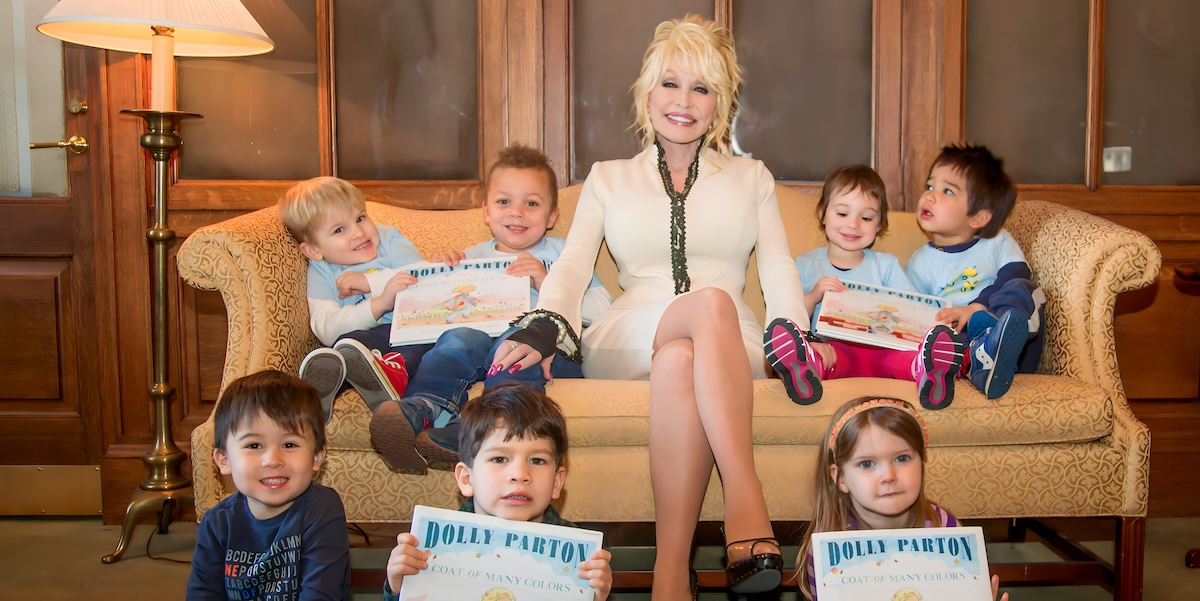
Hanbidge’s bill is modeled after those in 22 other states, and sets up PA to partner with America’s greatest literacy hero: Dolly Parton. Over the last 30 years, the country music icon’s Imagination Library has sent more than 318 million books to over 3 million children in the U.S., United Kingdom, Canada, Australia and Ireland.
“The idea is to get kids to read early,” says Khan, who himself could read 40 words by the time he was two, according to family lore. “One of the great things about having books is kids take care of them, and are more likely to read if it’s their own. When we expose kids to reading and books, those connections are going to be formed and they will be lifelong readers.”
“The seeds of these dreams are often found in books.”
Parton launched her Imagination Library in 1995, in her home community of Sevier County, Tennessee as a tribute to her father, who could not read or write. “When I was growing up in the hills of East Tennessee, I knew my dreams would come true,” Parton says on her nonprofit’s website. “I know there are children in your community with their own dreams. They dream of becoming a doctor or an inventor or a minister. Who knows, maybe there is a little girl whose dream is to be a writer and singer. The seeds of these dreams are often found in books and the seeds you help plant in your community can grow across the world.”
“This isn’t controversial. If we’re able to get kids to read and give them their own books, it’s just such a win.” — State Representative Tarik Khan
Five years later, Imagination Library expanded beyond Tennessee; today, one in six American children under five are receiving her books. That includes children in Delaware, which launched the program in 2020 under then-Governor John Carney, from whom Hanbidge learned about it in 2023. About 63,000 children in PA participate in small versions of the program, including in Pittsburgh, Chester County and West Philly, where the West Philadelphia Alliance for Children (WePAC) has partnered with Imagination Library to send books to 500 kids.
Here’s how a statewide program would work: The Commonwealth would contract with Imagination Library — or another similar group — to offer every parent with a child under five the opportunity to sign up to receive books in either English or Spanish. The state would pay for half the cost, about $10.7 million a year to cover the state’s 650,000 young children. A local nonprofit partner would pay the other half, with the support of philanthropy. (Lauren Wirt, regional director for the Dollywood Foundation says one of her roles is to help find the funders.) For groups already running this program, like WePAC, that can mean doubling the number of kids who participate.
Parton contracted with book publishers to print low-cost, high-quality copies of children’s books, which get increasingly more challenging as the years go by. Eventually, with a library of 60 books, the hope is that children will have learned to read, or at least to recognize their letters, by the time they get to kindergarten. Ninety percent of brain development happens by age five, and children unable to identify letters by then are already behind. Children who can’t read by fourth grade are four times more likely to drop out of school, six times more likely if they are low-income — which the Literacy Coalition equates to $113 billion a year in lost revenue.
“We want kids to have success from the very beginning,” Hanbidge says.
Imagination Library research across five countries has found remarkable results. With just 10 books, children in the program were at least four times more likely to “demonstrate stronger emerging literacy skills — such as vocabulary and phonological awareness — compared to children not in the program.” American children in the program were nearly three times more likely to “demonstrate concepts about print” and five times more likely to be interested in reading than those not in the program.
“This is one of those small interventions that have a big impact,” says Khan. “If I was a billionaire, I would do it for every state.”
“When we expose kids to reading and books, those connections are going to be formed and they will be lifelong readers.” — State Representative Tarik Khan
The biggest concern of the representatives on the House Education Committee, which passed the books legislation with bipartisan support in December 2025, was the cost of the program. But Wirt, at the Dollywood Foundation, points to Syracuse as an example of just how appropriately easy it is to get everyone on board with the expense. In 2013 and 2014, the city conducted a survey of students starting kindergarten, half of whom had been participants in the Imagination Library for the previous three to five years. The students who had books sent to them were 28.9 percent more prepared for kindergarten based on their Letter Naming Fluency, an indicator of the chances for reading failure or success. When legislators saw that data, they voted to expand the program to all Syracuse babies and throughout Onondaga County.
“Dolly wanted to inspire a love of reading and books, but once they are in the home, so much more happens,” Wirt says.
Plus, as Khan points out, the $11 million annual price tag is a mere fraction of the state’s $50 billion budget. And, he points to research that shows that for every dollar spent on early reading, the state sees $4 to $9 in savings — not to mention the increase in income (and associated taxes) that would recoup to the state with a more literate, better educated populace.
“The Commonwealth of Pennsylvania spends so much money on K-12, but there’s nothing before that,” says Wirt. “This is a great insurance policy — a little investment, a large return on investment.”
A Senate bill introduced by West Chester’s Carolyn Comitta and co-sponsored by six Democrats and two Republicans is awaiting a vote in the Education Committee. To become law, it must pass the full Senate by the end of November, or will need to be reintroduced in the next legislative session. Whenever it gets a hearing, the bill has one defining advantage that transcends politics.
“Dolly Parton is beloved, and that’s helpful,” Khan says. “This isn’t controversial. If we’re able to get kids to read and give them their own books, it’s just such a win.”
 MORE ON IMPROVING LITERACY