

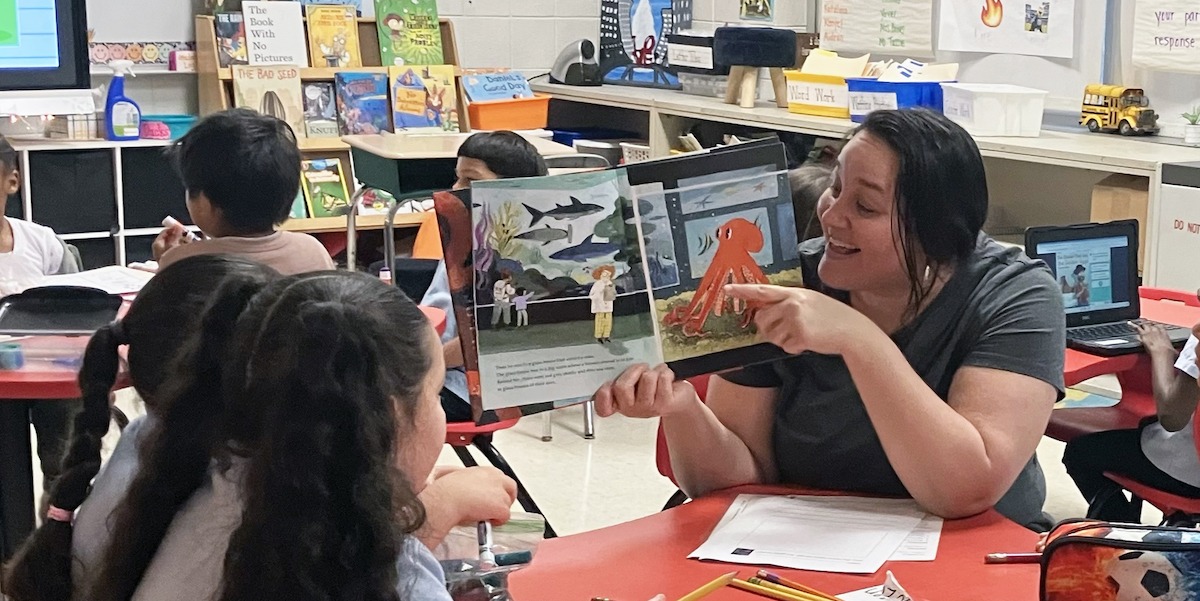


It’s the last month of the 2024-2025 school year, and most students are daydreaming about the fast approaching summer break. In Ms. Bowes’ classroom at Julia de Burgos Elementary, however, four students sit with rapt attention as their classroom literary assistant Tassie Rivera reads from The Octopus Escapes by Maile Meloy.
As Rivera narrates the octopus’ encounter with a new object, one kindergartener points to the illustration and identifies the item: “Guante!”
Rivera nods affirmatively before asking, “How do you say that in English?”
When the student struggles to answer, a classmate helps out: “Glove!”
By the time the story concludes, the initial student gains the courage to switch from Spanish to English. He happily declares, “I like that story.”
As a new school year gets underway this week, that moment stands out as a highlight in the work Rivera is doing to address the literacy crisis that plagues Philly: teaching bilingual students to read in English, to help them succeed in school and beyond.
“Past the literacy, it brings our community closer; it makes our parents feel welcomed. We are creating future teachers within our community.” — Julia de Burgos Elementary School Principal Biana Reyes
A literary crisis
In Philadelphia, only 17 percent of fourth graders can read proficiently. In Fairhill, a neighborhood on the east side of North Philadelphia, the reading proficiency rate is even lower. According to Kerry Roeder, executive director of nonprofit Historic Fair Hill, “at some of our schools it’s closer to 10 or 11 percent.”
Fairhill hosts the city’s largest Hispanic and Latino populations. It is a vibrant and musical neighborhood, home to El Centro de Oro: the golden block. It is also one of the highest poverty areas of the city and has high rates of crime. “It’s been historically underserved for many, many years,” explains Roeder.
Historic Fair Hill was originally established to restore a Quaker burial ground in the area. For the past nine years, it has also been operating a classroom literary assistant program. The program pays six bilingual school parents to be part-time reading assistants in kindergarten, first grade, and second grade classrooms. These assistants work with students — 85 percent of whom are Latino, and 33 percent of whom are English language learners — on letter recognition and reading comprehension. They also serve as a bridge between the school and the students’ parents, most of whom are also Spanish speaking.
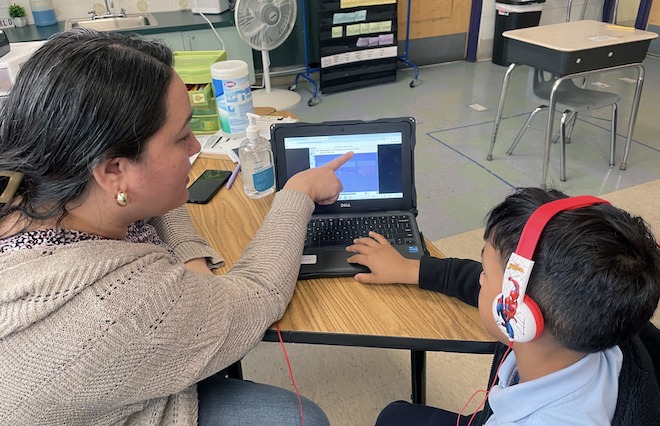
While the burial ground and literacy may seem like disparate causes, Roeder sees them as unexpectedly linked. “Abolitionists were buried [here], and so the way in which we see our connection to literacy is really through thinking about literacy as liberation,” she says. As a former English teacher and librarian, Roeder knows firsthand how transformational literacy can be.
“It’s not just about reading books for fun,” Roeder says. “There’s so much [more] — being able to read a contract, being able to do research and understand your rights as a renter. [In] thinking about how we can help our Black and Brown neighbors get the resources they need and hopefully break some cycles of poverty, literacy just feels like such a crucial part of that.”
Modest gains in reading, with benefits
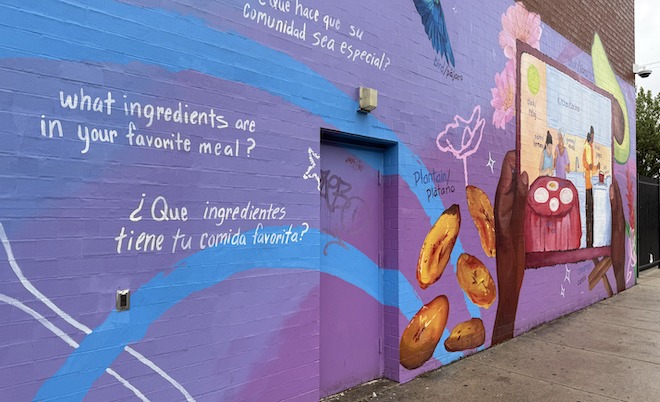
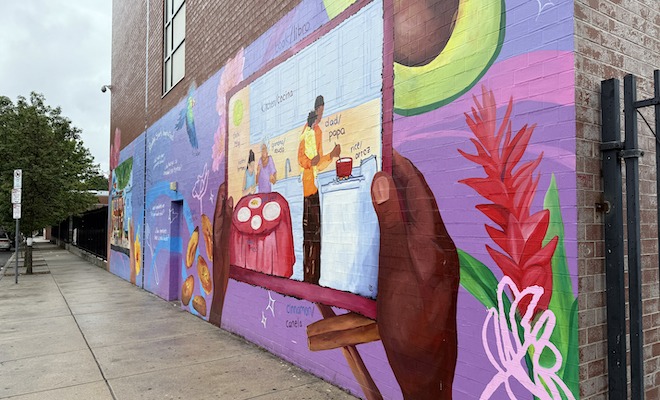
The exterior of Julia de Burgos Elementary is adorned with a beautiful mural by De’von Downes featuring exquisitely rendered avocados, plantains, parrots, and toucans. It also includes many words and phrases, all of which are written in both Spanish and English. The mural embodies two central ideas for the bilingual school: celebrating Latino culture and increasing childhood literacy.
Angelica Alicea, a second grade teacher at de Burgos, has seen how difficult it is for children to learn to read, let alone when English is not their first language. “It gets very confusing for the students when, in Spanish, the vowels have one sound. And we’re like, Oh, well, in English, those vowels have multiple sounds,” she explains.
Over the last decade, the program has made modest improvements: the school’s reading levels increased by 2.2 percent from 2023 to 2024, and increased an additional 1 percent in 2025. While the reading scores still have a long way to go, in midyear and end-of-year surveys conducted by Historic Fair Hill, 100 percent of teachers reported that most or all students showed reading improvement, that assistants were helpful in providing literacy support, and that they wanted to work with the same assistant again next year.
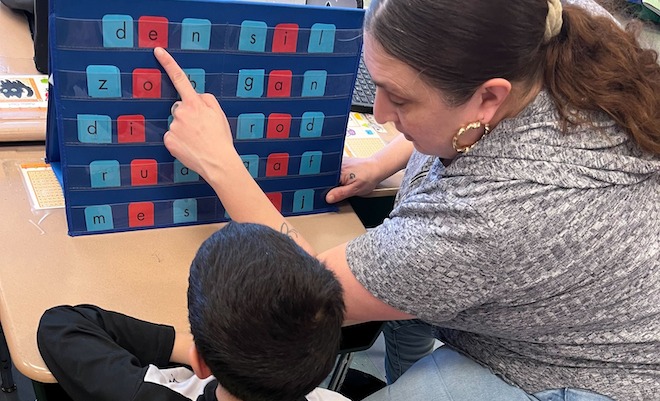
One of the reasons for the positive data has been the individualized attention that the program offers students. Research shows that children who have important nonparental adults in their lives have better educational outcomes, and also do better in psychosocial and behavioral domains.
The classroom assistants can be that nonparental support for students. “There are so many children in our schools that really could benefit [from] and need one-on-one attention, and they’re not getting that due to lack of resources,” says Martina Barbour, literacy director at Historic Fair Hill. “Every day our [students] are seeing [assistants] come back again and again, and each day still being interested in them, still caring about them, and still caring about their literacy.”
A win-win for assistants
Angie Voulasitis is the program’s lead classroom literacy assistant and has been stationed in Ms. Hart’s room for as long as the program has existed. At one point, Voulasitis worked with a student who was not speaking due to trauma. After Voulasitis worked with her for months and slowly developed a trusting relationship, the student started to speak.
Voulasitis’ life has also changed because of the program. She saw results, first, in her son’s literacy. “My son got a teacher’s assistant in his class when he was in first [grade], and right now he’s in seventh grade. And he reads at a ninth grade level. I think it was the help that he got when he was in first grade,” says Voulasitis.
Her own education journey has been affected as well. Voulasitis dropped out of high school after ninth grade. Now, she’s enjoyed working as a classroom assistant so much that she decided to enter a GED program. She is on track to obtain her GED by the end of the year and, after that, she wants to go to college to become a teacher.
Her students at Julia de Burgos are inspired by her commitment to learning. “My kids in first grade, they said, Ms. Angie, you go to school too? I said, Yes! I go to school too, and I passed my first test. It took me almost a year. It was very hard, and when I passed it, my whole class wrote me a congratulations card saying that they are so proud of me. So I feel like I motivate the kids too,” she says.
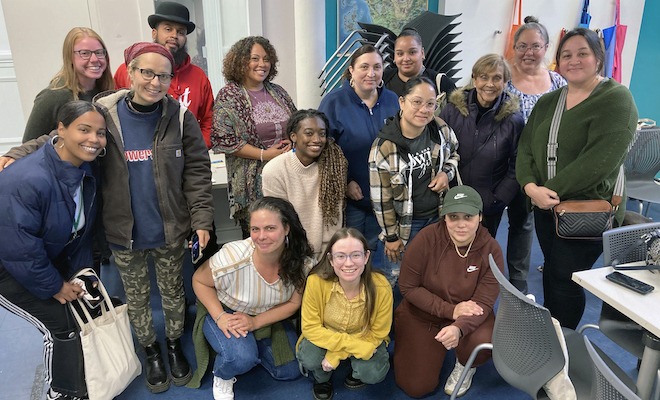
Classroom assistants Tassie Rivera and Beatrice Mejia have also seen the program improve their lives. The flexible hours of the part-time job allow them to spend more time with their own children. And, because they are more aware of what goes on in the classroom, they can better help their children with their homework. “You take what you do at school [and] bring it home to your children,” Rivera says.
Their increased knowledge about the school is by design, Roeder says. “There is often an ‘us vs. them’ dynamic with schools. [Parents] think: Oh, they’re doing this, or, They don’t care about this. To have somebody in the school who knows how hard those teachers are working and can see the positive things going on is really important to be able to communicate that [with the community.]”
The higher the students’ reading proficiency, the more they succeed in other areas of school, like social studies, math and science. And for countless students, more than just grades hinge upon their literacy. Many students help their Spanish-speaking parents to translate bills. They’ll even teach their parents to read and write.
“Our classroom assistants were able to communicate with families and … let them know that we’re going to protect your kids and we’re taking care of them.” — Kerry Roeder, Historic Fair Hill
“It’s a community-builder,” says Principal Bianca Reyes. “Past the literacy, it brings our community closer; it makes our parents feel welcomed. We are creating future teachers within our community.”
The relationships that the classroom assistants have developed with their students’ parents has been transformative too. Roeder notes that family engagement is critical to academic success, but parents who struggle with English often lack the confidence to interact with their children’s teachers. “Part of the way we look at the classroom assistants is them acting as bridges to make sure that all of the families in the school are feeling seen, heard, and valued, and they all feel like they have somebody that they can reach out to,” says Roeder.
Classroom assistants will often make calls to parents to inquire why a student is absent but has not called in sick. Over the last year, those relationships have been key as fears around ICE raids have heightened. “Some of our classroom assistants were able to communicate with families and work to alleviate some of those fears and let them know that we’re going to protect your kids and we’re taking care of them,” Roeder says.
The only complaint teachers and assistants have is that they wish the program was bigger. “There’s a reason why enslaved people were not allowed to read and write,” says Roeder, drawing back to Historic Fair Hill’s abolitionist roots. “[Reading] just opens up the world. It’s so important to us to make sure that our kids are getting that power, and getting a chance to navigate the world effectively. We have such smart, brilliant kids. And we want to give them every opportunity they can get.”
 MORE ON LITERACY FROM THE CITIZEN