





In the past decade, California has enacted more than 100 housing laws to address the state’s housing shortage and affordability crisis. But which of these bills actually moves the needle and helps build more housing – and specifically, more affordable housing?
While I was out in Sacramento a few weeks ago, I attended the Housing California conference and saw Colin Parent, CEO of San Diego-based Circulate Planning & Policy, present some findings from a new report: Win-Win Bonus: How California’s Bonus Law Quietly Transformed Housing Approvals.
The report makes the case that two bills have been particularly helpful in building more housing: AB 2345, a 2020 statute that gives a 50 percent bonus for affordable homes, and AB 1287, which in 2023 provided a second stackable 50 percent bonus, if a project includes even more affordable homes. Together, these bills enable projects to grow to twice the size of their zoning capacity, if they include affordable units.
The report finds that these two laws, known as “Bonus Law” have become the most widely used streamlining laws tracked by the California Department of Housing and Community Development. According to the report, Bonus Law has been used to approve:
- More than 140,000 homes overall
- More than 69,000 deed-restricted affordable homes
- In 2024, 47 percent of all homes approved in multifamily projects
- In 2024, 78 percent of all homes in 100 percent affordable projects, and
- In 2024, ten times more homes than every other tracked streamlining law.
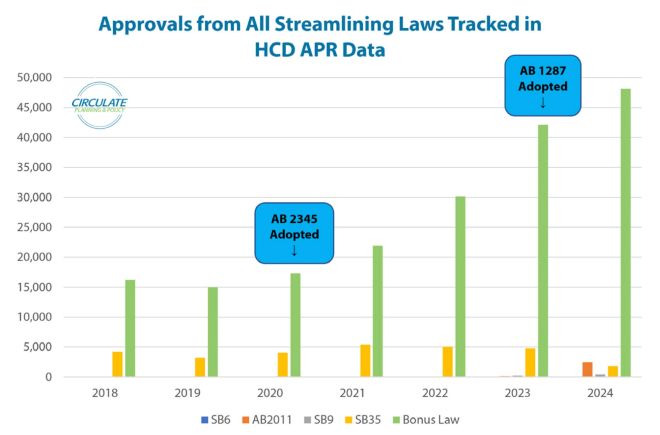
It’s that last bullet that I find so compelling and worthy of more analysis. Why is Bonus Law so successful, and what aspects of it can be replicated elsewhere?
Inclusionary zoning could actually work
Inclusionary Zoning (IZ) requires developers to reserve a specific portion of their housing units at below-market rates. IZ has gotten a bad rap over the years as some research has shown that mandated affordable housing results in very few units getting built — often because municipalities offer an option to pay into an affordable housing trust fund instead of building the affordable units. In cases when developers do build the units, the market rate units can cost more to offset including affordable units.
Bonus Law in California essentially rescues inclusionary zoning from its own problems in two ways. First off, it gets the numbers right. From the report:
Bonus Law offers a set of benefits that are conditioned on providing affordable homes, but are more than sufficient to offset those added costs. While adding more affordable units would create further losses for a project, Bonus Law compensates by providing an increasing scale of benefits….Assembly Bill 2345 increased the amount of development capacity a project could receive from 35 percent to 50 percent. That new bonus level would also require an increase for affordable housing set-asides from 11 percent very low-income units, to 15 percent. Pro forma analyses were used to determine the amount of bonus that would be necessary to create a real win-win, and more than offset the costs of providing affordable units. The pro formas showed that the 15 percent threshold ate up some of the proposed surplus, but not all of it. It accurately predicted that many future projects would use the new policy.
But secondly, it provides no option of in-lieu fees. Given that some 170 municipalities in California already have some inclusionary requirements, using Bonus Law makes a ton of sense for projects already in progress:
Bonus Law has no option for in-lieu fees, so with few exceptions, any project taking advantage of it must build affordable units on-site. Courts have held that affordable units under Bonus Law can be used to satisfy local inclusionary obligations. For projects subject to local inclusionary mandates, the use of Bonus Law becomes an easy decision. The costs of the affordable on-site units are already baked into their pro forma, so using Bonus Law does not generate additional costs. Bonus Law then becomes a win-win. The local jurisdictions get the affordable units they require, and homebuilders receive offsetting benefits to help the financial feasibility of their projects.
Here are four more key takeaways on why Bonus Law has been successful:
Boosting Already Dense projects
The report notes: “A key reason why Bonus Law produces more approvals than other recent streamlining policies is that it provides an incremental boost to an already-large baseline of multifamily approvals.” In other words, when you improve a policy that already touches tens of thousands of units annually, even modest percentage gains produce large absolute numbers. Adding more units to already big projects — though not of the current Missing Middle zeitgeist right now — is definitely a successful way to get higher numbers of units built.
Thinking Beyond Density
These incentives are called Density Bonus in both statute and in common parlance, but the report argues that calling it “density bonus” is both misleading and politically counterproductive. Projects can use Bonus Law without taking any extra density at all. Indeed Bonus Law allows developers to take advantage of waivers and incentives (overriding parking minimums, height limits, setbacks) that are sometimes more valuable to infill builders than the density increase itself. Over 19,000 units were approved using Bonus Law with zero extra density taken. The report actually recommends renaming it entirely, since “density bonus” invites opposition from people who’d otherwise support the affordable housing goals.
City to State Policy
San Diego had been running its own version of the 15 percent affordable / 50 percent bonus formula since 2016, giving advocates concrete data to take to Sacramento. During the AB 2345 negotiations, some advocates pushed for a 17 percent affordable set-aside instead of 15 percent, thinking more affordability requirements meant more affordable units. The pro formas — informed in part by the San Diego experience — showed that 17 percent would have killed the financial calculus. San Diego’s track record gave reformers the confidence to hold the line at 15 percent.
The Law Didn’t Enforce Itself
The report documents more than 20 legislative fixes over the past decade — many of them passed specifically to close loopholes that resistant cities had exploited. Courts consistently ruled against local governments that tried to add new conditions or creative workarounds. California’s Attorney General formed a Housing Strikeforce in 2021 and threatened to sue cities that ignored their obligations; HCD has issued over 100 advisory letters related to Bonus Law alone. The takeaway for anyone watching state-local housing battles elsewhere: a good law on paper is just the opening move. The report’s implicit argument is that Bonus Law’s success is inseparable from the decade of legislative patch jobs, judicial reinforcement, and executive enforcement that backed it up. States that want to replicate California’s results will need to replicate that infrastructure too, not just the formula.
Diana Lind is a writer and urban policy specialist. This article was also published as part of her Substack newsletter, The New Urban Order. Sign up for the newsletter here. MORE FROM THE NEW URBAN ORDER