




In the 1980s, gated communities began to proliferate throughout U.S. suburbs. By tucking housing and private amenities past a gatehouse, these enclaves were a way for the middle and upper-middle class to flee from cities, their crime, their concrete, and their undesirables.
Listen to the audio edition here:
As Edward Blakely and Mary Gail Snyder wrote in their 1997 book, Fortress America, gated communities marked a notable retreat from civic society:
Millions of Americans have chosen to live in walled and fenced communal residential space that was previously integrated with the larger shared civic space. Civic space is more than a political or jurisdictional construct. It is a manifestation of society, culture, and the shared polity.
As if the pendulum of privacy had swung too far, trends shifted in the early 2000s as cities became safer and came to epitomize a different kind of good life — the opposite of a fortress. People lived in cities for rich experiences and exposure: to new ideas and interesting venues, to people who weren’t like them, to financial and social opportunity.
Even if urban elites found ways to separate themselves — private schools instead of public, weekend homes instead of a YMCA membership — they still sought out ways to see and be seen around town. Getting the right reservation, seeing the talked-about show, joining the fancy gym were the ultimate status symbols. But so was getting on the board of important nonprofits and being part of serious civic conversations.
The retreat … isn’t about city services or housing costs … It’s about a declining appetite for inconvenience and for time spent with people outside one’s immediate social circle.
Gating off community
Today, something else is happening. The pendulum is swinging back, and people are gating up — but without physical gates.
Some see the issue as a matter of lifestyle arbitrage. Certainly, as people work remotely and can live farther from their jobs, they are taking their urban salaries to the suburbs and even rural areas (more on this in my March 2026 piece on migration trends).
Richard Florida wrote a piece for the Wall Street Journal, entitled “What Is a City When Its Wealthiest Leave?” noting that the wealthy are moving to lifestyle tax havens such as Miami, Austin, and Dubai that “combine low or no income taxes with warm weather, luxury amenities and easy access to global networks.” Because the 1 percent are no longer tethered to one place, Florida argues that they are no longer interested in “loyalty, civic investment and philanthropy — the long-term commitment that built private schools, museums, hospitals, universities and cultural institutions. When people stayed, they fixed what was broken because they had no alternative.” But the problem may actually not be about staying in one place, so much as spending time in a new kind of gated community in any city.
The retreat I’m talking about has nothing to do with high crime or taxes. Indeed, American mobility is at record lows, suggesting very few people are moving at all.
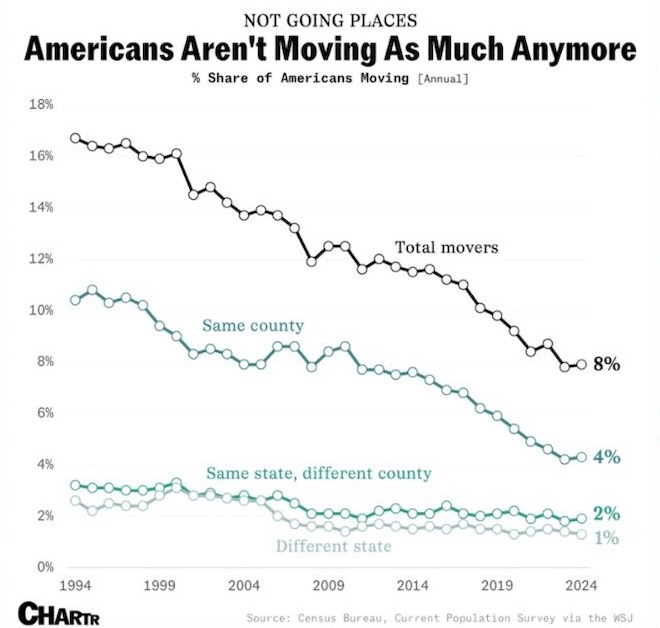
Instead, they’re retreating from regular people and inconvenience by staying home.
The rise of stay-at-home culture
As I’ve noted in this Substack before, I am writing a book about this shift from spending time in public life to incrementally more life spent at home. I recently read a new bit of research showing that remote workers in Canada now spend 80 percent of all their time just in one place — their primary residence!
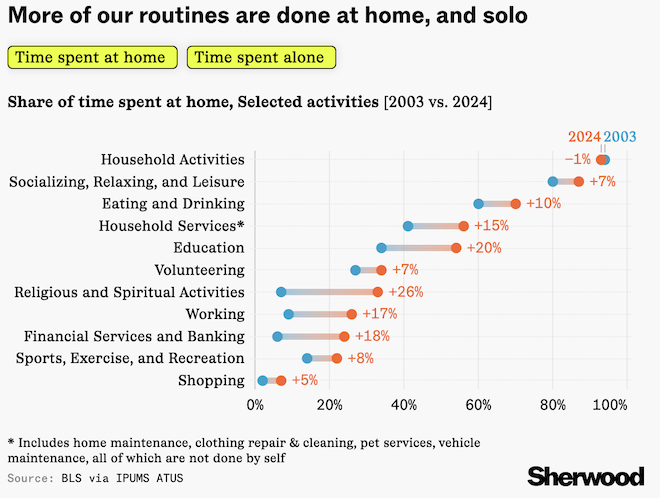
But it’s not just work time that is increasing at home, it’s downtime, like meals at home. Today I thought I’d write about how we’re eating and drinking more at home. Eating and cooking at home could be healthier and less expensive. But that’s not quite what’s happening.
I thought about writing this piece after I read a New York Times article on personal chefs gearing up for a summer in the Hamptons.
The piece illustrated how we’ve flipped the script on two previously social experiences — restaurants and food shopping. In the article, one subject calls restaurants a “nightmare” and another asks “who wants to go shopping anymore?” While I’d personally love a personal chef (!), it’s this mindset that social activities outside the home are to be avoided that stunned me. Granted, people go to the Hamptons to spend time at their home and their friends’ homes — but these comments speak more broadly to the idea that the wealthiest are recreating formerly public spaces — like restaurants with chefs — in their homes.
The gated communities of today don’t have physical gates … Instead, people are opting for more commonplace “bourgeois bunkers” in their homes.
And it’s not just the rich. There have been a slew of articles about people spending too much of their income on food delivery. Philly is partly to blame. We are the city that helped launch GoPuff. And Morningstar reports, DoorDash customers from households earning less than $75,000 spent about $31 per order in 2023 — not significantly less than the $39 typical of households earning more than $75,000, and lower-income customers were actually more likely to order more than once a month. People are paying a premium not to go out and have a meal with friends — but to stay in and eat it lukewarm, probably alone.
The gated communities of today don’t have physical gates. The lifestyle havens aren’t far-flung places. Instead, people are opting for more commonplace “bourgeois bunkers” in their homes.
Much of the conversation about urban decline focuses on people moving out of cities — a seemingly solvable problem that can be addressed by mobilizing public and private resources to improve quality of life and retain residents. But the retreat described here isn’t about city services or housing costs, though those can be part of the problem. It’s about a declining appetite for inconvenience and for time spent with people outside one’s immediate social circle.
No rezoning fixes that. No transit investment bridges the social moat around our houses. Gated communities in the past kept the city’s ills out by offering people calm suburban isolation. Now technology and new social preferences are keeping people in their homes, no matter the location.
Diana Lind is a writer and urban policy specialist. This article was also published as part of her Substack newsletter, The New Urban Order. Sign up for the newsletter here.
 MORE FROM THE NEW URBAN ORDER