


Last week we witnessed a major step forward for state-level zoning and housing reform in Pennsylvania, with two bipartisan bills passing out of the state House Housing and Community Development committee.
The two bills would allow homeowners to build accessory dwelling units (ADUs) in residential neighborhoods, and limit municipal powers to cap how many unrelated people can share a single home. The latter bill was nicknamed the “Golden Girls bill” by its sponsors, after the classic 80s sitcom about four retirees sharing a Miami house — the kind of arrangement that is technically illegal across most of Philadelphia, where the zoning code caps a single household at three unrelated adults. While the bills still have a long journey ahead before becoming law, they already represent a sea change in housing politics inside the Capitol.
State lawmakers have grown increasingly comfortable with the idea of state zoning standards bills — legislation that sets minimum zoning requirements every municipality must follow — as a necessary precondition for switching PA’s sluggish rate of home-building onto a faster track. PA ranked 44th nationally in the rate of housing built from 2017 to 2023, according to a March 2025 Pew brief.
Before the 2023–2024 legislative term, the acceptable scope for state housing policy thinking in Harrisburg was limited. Lawmakers mostly confined themselves to funding affordable housing, blight-fighting ideas, and various tax credits, and mostly ignored the local zoning and permitting rules that ultimately determine whether housing is actually built.
Just two years ago, House Republicans on the Local Government Committee opposed two thematically-similar bills (HB2045 and HB1976) on a party-line vote, with one House Democrat defecting too. A bipartisan Senate zoning reform bill, SB 1126, attracted early support in 2024 but failed to advance out of committee, and the bipartisan spirit in the Senate didn’t carry over to the House.
This session, the two House zoning reform bills passed with unanimous Democratic support and a plurality of the committee’s Republican members. Seven committee Republicans still voted no, but five voted yes, and both measures passed 19–7.
The “affordability” juggernaut and its limits
Voters’ intense single-minded focus on cost-of-living concerns in 2026 has every elected official at every level of government scrambling for ideas to show citizens they’re doing something to reduce living costs.
There are a lot of new ideas being tossed into the mix and — maybe more commonly — electeds are engaging in some ‘now more than ever-ism’ and revamping their existing policy priorities with a pro-affordability rhetorical gloss. Any halfway-coherent idea — and many an incoherent one — that purports to reduce the cost of living has more political traction than usual in this moment, and it can be hard to separate the wheat from the chaff.
The PA Housing Choices Coalition and its allies have a whole platform of evidence-based pro-housing policy ideas, drawing on best practices from places like Austin and Seattle — places that have passed broad zoning and land-use reforms and subsequently seen housing permits explode. Many of those ideas are represented in a package of bills from Representatives John Inglis and Tarik Khan and collaborators.
These reforms would override — in legal terms, “preempt” — some of the main rules that block housing at the municipal level: mandatory off-street parking, single-family-only zoning, outright bans on accessory dwellings, and caps on unrelated roommates. These are competing for lawmakers’ attention with other packages of voluntary reform bills that borrow the same problem diagnosis and rhetoric about over-regulation, but stop short of doing anything with real teeth.
Many state politicians want to be seen as on the side of affordability, but they’re still politicians, and as a cohort, they don’t generally enjoy grappling with hard trade-offs or making choices that upset some voters and interest groups.
Voters just want somebody to fix this
Real housing reform is popular, according to recent polling from YouGov, prepared for the PA Housing Choices Coalition — a coalition of over 50 organizations from across the ideological spectrum supporting pro-housing legislation in Harrisburg. It’s most popular with urban residents, who by a wide margin support building more housing, even when it conflicts with other priorities like local control or preserving neighborhood character.
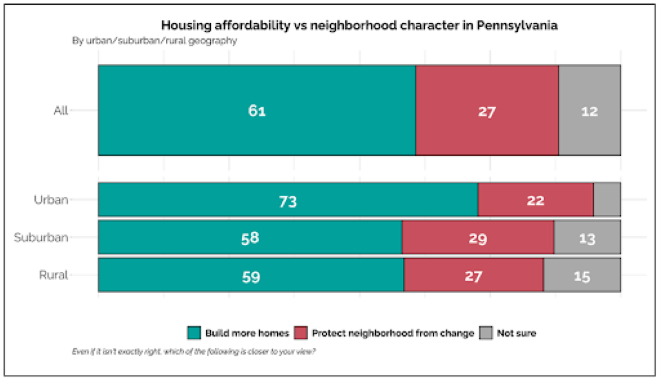
What makes housing reform so politically devilish, however, is that while the benefits of building more housing are broad-based, they’re also spread thin, while the downsides are more concentrated. It’s no fun living next door to a construction site, and people are worried about traffic and parking and all the other very localized annoyances that come with more home-building activity and population density.
While it’s true that Philadelphia’s rate of housing construction has vastly outpaced our suburban neighbors’ since the 2010s, the idea that we can meaningfully shift Southeast PA’s housing growth track while cutting the entire city of Philadelphia out of any permitting-reform deal is self-defeating.
Nearly every piece of the current planning system in PA — from the state, to the counties, to municipal government — is set up to allow more weight to the concerns of hyper-local aggrieved parties, about everything from parking to overcrowded schools, rather than the interests of the general public in having abundant housing.
That’s one reason why PA ranks 44th out of 50 states in the share of new housing stock constructed between 2019 and 2023 — there’s excessive “stop” power written into every layer of the system, with vanishingly few sources of “go” power in support of more building. One way of understanding the state zoning reform agenda is that it’s about reversing this dynamic and removing sources of “stop” power from the various places they live.
PA’s regulatory costs are high … and rising
The builders’ own data makes the cost of this regulatory drag more concrete. A 2024 study by Home Innovation Research Labs, commissioned by the PA Builders Association, found that government regulation accounts for 29.5 percent of the price of the average new single-family home in PA — $212,700 on a $721,600 home, and significantly higher than the 23.8 percent national average. In the five-county Philadelphia region, various regulations account for 29.2 percent of the price of a new home, and the region reported the highest regulatory burden in the state. Building code changes over the past decade and municipal architectural design mandates were cited as sources of more recent cost growth.
According to the survey, from the moment a builder files a zoning application it takes an average of 23.2 months before site work can even start. And for every $1,000 added to a new home’s price, another 2,640 PA households are priced out of the for-sale market. The trend is accelerating. That same study found construction code changes added 4.5 percent to a new home’s cost between 2014 and 2019, and then nearly doubled to 9.1 percent between 2019 and 2024.
And yet: Senate leaders are reportedly trying to carve Philadelphia and Pittsburgh out of the reform bills, even though the two metro areas are where the regulatory share of a new home’s selling price is highest.
Why Philly zoning politics need a state rescue
This is particularly important for Philadelphia, where because of councilmanic prerogative — the unwritten but ironclad rule that the City Council district member gets the final word on any land-use decision within their district — it’s become almost impossible in practice to pass citywide housing laws anymore.
The way Council approaches zoning “overlay districts” — neighborhood- or district-specific zoning additions to the city code — is not normal relative to the rest of the state. The usual idea with an overlay is to create density bonuses or other incentives to achieve some policy goal (like more affordable housing). But in Philadelphia, overlays are most often used to nullify broad-based changes in certain areas.
Since 2019 — when then-Councilmember María Quiñones Sánchez passed the Mixed-Income Housing density bonus, the last major citywide housing law Council has enacted — overlay districts have mostly been deployed in the opposite direction, to peel Council districts out of anything their members don’t like. That pattern scaled up sharply with Bill No. 210078-A in April 2021, which simultaneously created new district overlays in the 4th and 8th, banned ADUs across the 4th, 5th, 8th, and 9th districts’ rowhouse zones, and entrenched this corrosive dynamic more officially.
As one example of the type of dysfunction this governing dynamic produces, the section of the code for rowhomes — Philly’s most ubiquitous housing type — now contains at least 13 different sets of dimensional rules for how to build one, depending on which Council district or neighborhood the proposed home happens to sit in. So now we have one base code, plus a dozen district- and neighborhood-specific overlays that modify height, setbacks, lot coverage, or minimum lot area.
Accessory dwellings — small secondary homes a homeowner can build in a backyard, basement, or above a garage — are another good example of the problem. They’re one of the lowest-impact ways a residential neighborhood can quietly add housing, and they give homeowners a way to house an aging parent or adult child while bringing in some rental income that helps cover the mortgage. The House committee voted to legalize them statewide this week. But in Philadelphia, they’ve been banned outright in four City Council districts since 2021, and across most of the Northeast. The more suburban-style neighborhoods where ADUs make the most sense are mostly off-limits, and there’s no practical local path to changing that. If a state bill makes it to Governor Shapiro’s desk and he signs it, accessory dwellings will be broadly legal by-right, meaning an owner can build one without needing special permission from the Zoning Board.
The only realistic way we can get back to passing citywide housing laws again is for the state government to step in and directly legalize certain housing and building types, putting the blocking power outside of City Council’s reach in more cases. The Councilmanic Prerogative toolbox will still have plenty of tools in it even if state-level reformers somehow win this round of Whack-a-Mole, and the idea that state reform could end Prerogative is seriously overblown. But it’s also the most workable idea anybody’s come up with yet for how to disrupt these dynamics in practice.
Other bills badly needed in Philly and now under consideration at the state level, or slated to be, include a transit-oriented development (TOD) law making it easier to build housing near high-quality transit service; a law allowing mixed-use and multifamily housing on commercially-zoned sites like malls, office parks, and downtowns; and laws reforming off-street parking minimums and use regulations.
Unfortunately, while the Inglis House bill package intends to include Philadelphia and Pittsburgh — the only two PA cities not regulated by the state’s Municipalities Planning Code like most other jurisdictions — the Senate looks to be headed in a different direction.
Nearly every piece of the current planning system in PA — from the state, to the counties, to municipal government — is set up to allow more weight to the concerns of hyper-local aggrieved parties, about everything from parking to overcrowded schools, rather than the interests of the general public in having abundant housing.
A bipartisan group including Senate Republicans Greg Rothman (the PA GOP party chair) and Dan Laughlin, and Democrats Nikil Saval and Tim Kearney, has been working on its own package of zoning and housing reform bills similar in spirit to the Inglis package. So far, they’ve released a co-sponsor memo for their own version of an accessory dwellings bill — broadly compatible with Inglis’s — with more bills supposedly on the drawing board.
Another bipartisan group, including Republican Senators Jarrett Coleman, Dave Argall, Elder Vogel, and Democrat Nikil Saval, has introduced SB 1239, which would allow residential buildings in commercially-zoned areas.
The Rothman/Saval bill’s first draft allegedly included Philadelphia and Pittsburgh just like SB1126 did last term, but according to sources, Rothman has signaled he intends to remove them at the request of others. The Coleman bill leaves both cities out as written.
It’s still unclear exactly what is happening on the Senate side, or why, but sources closer to the talks say some combination of Senate Republican leadership, Urban Affairs and Housing Committee staff, and Senator Joe Picozzi of Northeast Philadelphia is the vector for exempting the two biggest cities from these laws. To accomplish this, the Senate bills would amend the Municipalities Planning Code — the state zoning enabling law governing most PA towns but not Philadelphia and Pittsburgh — instead of Title 53 of the Consolidated Statutes, which applies more broadly. The choice of statute is what determines whether Philly and Pittsburgh are in or out. I reached out to Senator Picozzi, who declined to comment for this article.
Why would a Northeast Philadelphia state senator want the city carved out of a statewide zoning reform? The answer likely starts with what Northeast Philly voters are used to. For 40 years, their Councilmember Brian O’Neill has held one of the tightest grips on municipal zoning anywhere in the city, and has spent much of his career stripping apartment zoning out of the Far Northeast, and keeping it out. O’Neill’s 10th Council District routinely issues among the fewest building permits in Philadelphia, and he has been perhaps the most effective policy entrepreneur behind Philadelphia’s planning governance crisis writ large. Voters in that part of the city are accustomed to a Councilmember who can and does say “no” to housing proposals their neighbors don’t like — and state preemption, in the areas it reaches, would take that veto away more often.
There’s another wrinkle that could cut Philadelphia out of these bills by accident, separate from whatever the Senate does on purpose. The House Inglis bills amend Title 53 of the PA Consolidated Statutes — a grab-bag of laws where some sections cover Philadelphia and Pittsburgh (like the law establishing Business Improvement Districts) and others don’t. The bills apply to “municipalities generally,” which the sponsors believe covers both cities. But “Cities of the First Class” is how PA law typically names Philadelphia, and “Cities of the Second Class” is how it names Pittsburgh. Without that specific language in the bill text, the claim that the big cities are covered rests on interpretation rather than a plain reading of the bill text, and after months of asking people close to the action, I haven’t found anyone able to answer the question with absolute legal certainty. If that ambiguity isn’t cleaned up before final passage, Philly could end up excluded by default, even without the Senate lifting a finger.
For all the reasons above about planning dysfunction in Philadelphia, cutting the city out would be a serious mistake. And from a fairness standpoint, letting the two biggest cities off the hook for changes everyone else would have to comply with is a sure-fire way to poison the politics of the whole project. The entire essence of the proposition reformers are offering is that a little bit more housing everywhere solves the problem. Once you create the precedent of exempting the heavy-hitters, other towns will start asking for exemptions too.
Returning to the point about evidence-based policy, a bill that excludes the two biggest cities simply won’t come close to resolving PA’s housing shortage. According to Governor Shapiro’s own Housing Action Plan, the Commonwealth needs to build 450,000 new homes by 2035, and the five-county Southeast region alone accounts for 206,839 of those units — roughly 46 percent of the statewide need, and more than double any other region’s.
The Shapiro administration’s plan also specifically calls for both of the reforms the House committee just passed. It recommends that the Commonwealth “limit restrictive occupancy limits targeted at unrelated individuals” (the Golden Girls Law) and expand “Elder Cottage Housing Opportunity programs” (accessory dwellings).
While it’s true that Philadelphia’s rate of housing construction has vastly outpaced our suburban neighbors’ since the 2010s, and that some catch-up growth outside the city is long overdue, the idea that we can meaningfully shift Southeast PA’s housing growth track while cutting the entire city of Philadelphia out of any permitting-reform deal is self-defeating.
The strangest thing about this effort to carve out Philadelphia is that a solid bloc of Philly’s own House delegation is firmly on the record in support. Five of the 14 Democrats who voted Yea on the committee represent Philadelphia districts — Morgan Cephas, Roni Green, Amen Brown, Rick Krajewski, and Ben Waxman. Another half-dozen Philly-area House Democrats cosponsored one or both bills, including Tarik Khan (the lead sponsor on the Golden Girls bill), Malcolm Kenyatta, Jared Solomon, Keith Harris — all from the city — plus Ben Sanchez of Abington and Gina Curry of Delaware County.
Last term, in Senate District 5, Senator Picozzi’s Democratic predecessor Jimmy Dillon was a cosponsor of SB 1126, the Senate’s 2023–24 zoning omnibus. Dillon’s departure flipped one of Philadelphia’s Senate voices from pro-reform to the person reportedly now most interested in exempting the city.
This isn’t over yet. If you live in Philadelphia, tell your state representative and state senator — especially Senators Hughes, Street, Haywood, Tartaglione, Saval, and Williams — that you want Philadelphia included in any state housing reform bills. If you live in Northeast Philadelphia, tell Senator Picozzi you don’t want Philadelphia exempted.
 MORE ON SOLVING OUR HOUSING CRISIS FROM THE CITIZEN
