


It was inevitable. About a month ago, Uber Eats robots arrived in Philadelphia, zooming down sidewalks with tiny red flags in the air, like defenseless matadors. Then, on March 31, a couple of guys kicked the crap out of one in a parking garage, cow-tipping it over.
Listen to the audio edition here:
Vandalism is hardly the main obstacle in the way of Uber Eats robots fanning out all over the city. In order for that reality (or hellscape) to reach fruition, the robots will need a lot more than our kindness. For starters, Uber’s technologists have to solve a mess of issues, ranging from navigation errors to energy demands to privacy concerns. And then there’s the sociopolitical conundrum of whether we, as a city, can accept the loss of human jobs as we chase economic modernization.
But none of that matters unless a far more elemental obstacle is addressed first: sidewalks.
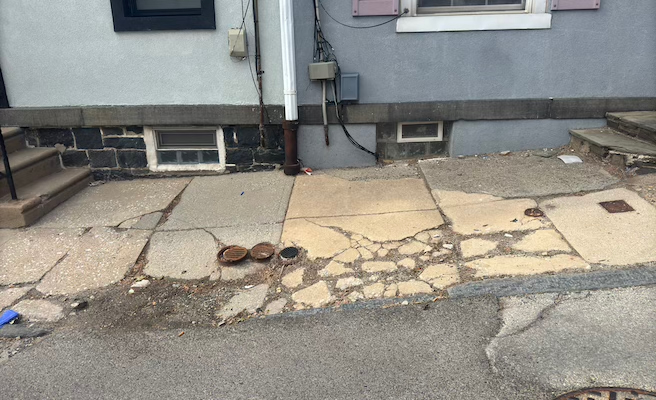
Across the country, one of the biggest threats to robot deliveries — and a range of other “smart city” ideas that aim to create more mobility and better health — is the poor condition of city sidewalks. Philadelphia is no different. People in wheelchairs and kids in strollers share in the struggle of unreliable or nonexistent concrete. While Philly consistently ranks highly in various “walkability” rankings (which are typically calculated based on things like walking distance to amenities or public transit), our sidewalks tell another story — varying dramatically from neighborhood to neighborhood, block to block.
The truth is that poorly maintained sidewalks impede the safety and mobility of everyone. If you consider that nearly every cab ride and rideshare dropoff begins and ends on a sidewalk, it’s clear why the breadth and quality of pedestrian walkways is imperative. The Governors Highway Safety Association estimates that about 65 percent of all pedestrian deaths occur in places without sidewalks.
Though sidewalks have traditionally received far less attention than roads or bike lanes, the ground appears to be shifting.
“I think it’s really surprising to see how many gaps exist,” says Cassidy Boulan, the associate manager of the Office of Transit, Bicycle, and Pedestrian Planning at the Delaware Valley Regional Planning Commission (DVRPC). “Sidewalks play a critical role in multimodal transportation networks and more importantly, in healthy places.”
For years, Boulan has overseen a range of DVRPC projects and tools, including a regional sidewalk inventory, designed to improve our collective understanding of the state of sidewalks locally. Their team estimates that roughly 230 miles of city streets in Philly don’t have any sidewalks at all, because they were never built in the first place.
Let that number sink in. It excludes all highways, in addition to any blocks where sidewalks exist on one side of the street (which, in plenty of cases, don’t satisfy the requirements of the Americans with Disabilities Act). The amount of sidewalk-less streets is enormous — about 10 percent of all Philly streets — and yet it says nothing of the real epidemic, which is all of the shattered, buckled, and eroded stretches of concrete in front of people’s homes.
“Philadelphia had fewer gaps on the whole than the rest of the [surrounding] counties,” says DVRPC transportation planner Baxter Barrett, who did the data analysis. “But where there were gaps in Philly, they were really highly scored.” In other words, streets without sidewalks in the city, compared to those elsewhere in the region, were more likely to impact people with disabilities, seniors, and children who walk to school — a few of the factors that go into their Sidewalk Priority Score.
What makes Philly an outlier, increasingly, is not the condition of our sidewalks but the lack of a comprehensive strategy for fixing them. The past few years, city halls around the country have committed (or recommitted) to programs and ideas for strengthening sidewalks — and for good reason.
“You really need that political will to work with property owners and to make the case,” Boulan adds. “It’s hard, but places certainly have done it.”
Concrete solutions
Though sidewalks have traditionally received far less attention than roads or bike lanes, the ground appears to be shifting.
Citizens are the ones igniting change in some cases, too. A public campaign arose in Denver, Colorado in 2021, after an artist there named Jonathan Stalls went viral for posting TikToks about the decrepit condition of city sidewalks. The following year, Denver voters approved — with 56 percent in favor — an ordinance that rewrote the legal landscape for sidewalks and enabled a robust, public sector-led plan to take shape.
Prior to that ordinance, Denver sidewalks functioned according to similar rules as the ones currently in Philly: Property owners were responsible for the repair and maintenance of pedestrian pathways abutting the street. Denver had north of 300 miles of streets with no sidewalks at all. “The [old] system doesn’t work,” local city planner Geneva Hooten told Governing magazine last year.
The 2022 ordinance enabled a straightforward deal: The City of Denver assumed all responsibility for sidewalks in exchange for property owners’ financial support. Denver began collecting a $150 annual fee from property owners and putting it towards citywide sidewalk maintenance. Last summer, Denver announced $75 million in repairs and construction from that fund.
Denver is a bold example, but it’s not alone. In many cities, residents don’t have to shoulder the full burden of sidewalk repairs. Chicago has a popular “shared cost sidewalk program” that has been running for decades and uses City resources to incentivize property owners to repair pedestrian walkways. Citizens pay a maximum of $2,400 — and typically around $1,000 — to participate, costs which are comparable to what a private contractor would charge. Cities like San Jose, NM and Memphis, TN have similar shared-cost programs.
And then there’s Washington, D.C., where a 6-year, $115 million effort to improve sidewalks is underway. The local government established a goal of building 8 miles of new sidewalks each year and repairing up to 40 miles of existing ones — work that aims to satisfy both the Vision Zero initiative and the Office of Disability Rights’ Olmstead Plan. In D.C., the land between a property and the curb is publicly owned, making it easier for the government to intervene. But the decision to prioritize sidewalks and enact a cohesive plan are actions that every city could seek to emulate.
“There are a bunch of good models that we can learn from, even if making a change would be hard,” says Boulan.
Sidewalks are everything
In her 1961 classic The Death and Life of Great American Cities, Jane Jacobs highlighted the importance of sidewalks to the very lifeblood of cities:
In real life, only from the ordinary adults of the city sidewalks do children learn — if they learn at all — the first fundamental of successful city life: People must take a modicum of public responsibility for each other even if they have no ties to each other. This is a lesson nobody learns by being told. It is learned from the experience of having other people without ties of kinship or close friendship for formal responsibility to you take a modicum of public responsibility for you.
Well, the first step in restoring and reinvigorating this human connection is to make sure our sidewalks are physically in good shape — though it’s a role that Philadelphia City Hall has been reluctant to step into in the past.
For decades, property owners with sidewalk violations have hardly had to fear enforcement from the City. Though the Streets Department issued 2,718 notices for defective sidewalks in 2025, no penalties or fines were attached to them. In fact, the department’s inspectors are not authorized to impose penalties. (Instead, the threat of a personal injury lawsuit is typically the motivator that gets a private property owner to do something.)
The Streets Department currently responds to citizen complaints of tripping hazards or missing sections of concrete, but lacks the bandwidth or mandate to do much else. “We do not have inspectors actively looking for defective sidewalks,” says a department spokesperson in an email. “Residents can report potentially dangerous or defective sidewalks through 311.”
“Sidewalks play a critical role in multimodal transportation networks and more importantly, in healthy places.” — Cassidy Boulan
Things looked plenty different a half-century ago. In the 1960s, the Streets Department would notify property owners whose sidewalks had fallen into disrepair and give them a set amount of time to fix the problem. If they failed to meet the deadline, the City would step in — hiring a contractor to complete the repairs, calculating the cost, and then selling that debt to a collection agency.
Did that protocol skirt the edges of legality? Probably. But it created improvements. On the other hand, when the local economy declined in the 1970s and unemployment climbed far above the national average, many Philadelphians could no longer afford even basic expenses, let alone sidewalk repairs, so the policy went by the wayside.
Mayor Cherelle Parker’s administration recently hired a Sidewalk Coordinator in the Office of Transportation and Infrastructure. Writing in an email, a spokesperson from the Managing Director’s Office said the coordinator will develop a master plan for sidewalks — reviewing best practices from peer cities, researching funding mechanisms, and exploring potential pilot programs for sidewalk repair. “The Plan is currently in the initial development phase,” says a spokesperson, adding: “there is no dedicated funding for sidewalk repair at this time.”
If the administration is unwilling to rewrite the laws or impose penalties — a valid concern in a city with a 20 percent poverty rate — there are other options for improving sidewalks. One strategy would be to focus on point-of-sale interventions. This is when a municipality requires a property’s sidewalks to be fixed, meeting the Americans with Disabilities Act (ADA), before a new owner can obtain an occupancy permit for moving in.
Smaller cities like Pasadena, California have utilized point-of-sale programs to upgrade their sidewalk networks in equitable ways. Property owners don’t incur any costs or obligations until they choose to sell. At that point, they are responsible for repairing the damaged sections of sidewalk directly in front of their property — and then recoup those costs once the sale goes through. “You don’t have to overburden folks who might already be having a problem maintaining their house,” says Boulan.
Of course, point-of-sale sidewalk fixes don’t solve uneven or cracked pavement in front of the homes and businesses of the people who remain. But it’s a start, and as Jane Jacobs and most urbanists would tell you, repairing essential infrastructure in one spot opens the door to improvements elsewhere — even if just by a crack.
 MORE ON OUR CITY’S INFRASTRUCTURE
