


Six years ago, we shut down cities across the world. In the first three years afterward, a full rebound felt possible with enough effort. By years four and five, the indicators were slowly but steadily improving — more people on transit, more people in the office. But 2025 was a hard year, and 2026 has gotten off to an even worse start.
Now, six years in, I worry ground is being lost again. Transit agencies such as Philadelphia’s SEPTA and San Francisco’s BART are sounding dire alarms about their fiscal situation, while Minneapolis and Washington, D.C. have been pummeled by Trump administration actions. Still, office buildings are being reinvented for the better and arts-centered revitalization strategies are taking hold in downtowns.
Here are six trends shaping where we are six years after Covid.
Some cities are struggling more than ever
Washington, D.C. was already among the hardest-hit cities from pandemic-era remote work. But that disruption paled against what the Trump administration has since inflicted — the intense ICE and National Guard presences, the attacks on tourism anchors like the Smithsonian and the Kennedy Center.
According to a recent Brookings report, the D.C.-Maryland-Virginia region now leads the country in job loss, with employment down nearly 1.7 percent in December 2025 compared to the prior year.
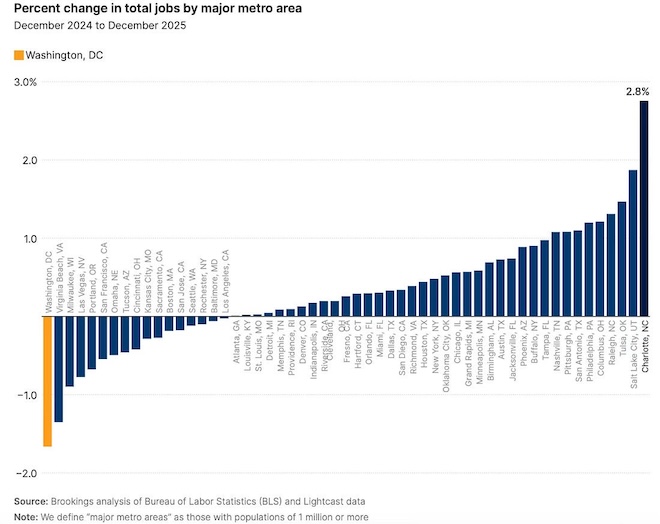
Federal workforce cuts resulted in a 14.3 percent employment decline, but private sector stagnation is making it worse. The net result: 56,000 jobs gone, with unemployment rising across every county in the region, falling hardest on women and workers of color.
D.C. is an extreme case, but it’s not isolated. Minneapolis reported that a single month of intensified immigration enforcement — with up to 3,000 federal agents deployed into neighborhoods — cost the city more than $200 million in economic impact, factoring in losses to commerce, community livelihoods, mental health, and basic food and shelter security.
A new case for city self-interest
A year after it started, New York City’s congestion pricing program has been a success, and it points toward a broader shift in how cities think about their relationship to the surrounding region. Cities absorbed the worst of Covid — economically, epidemiologically, socially — while suburbs often benefited from the resulting dispersal. Remote work let higher-income residents exit without severing their economic ties, effectively decoupling suburban prosperity from urban investment.
In that context, regional-collaboration arguments can start to feel like asking cities to subsidize the flight of their own tax base. A different logic is emerging: If you want to benefit from the city, you need to invest in it.
Cities such as New York and Philadelphia have historically taxed people who work there but don’t live there, and newer examples such as Seattle’s Jumpstart tax employers to support affordable housing. But in a work-anywhere economy, this may not be so smart.
Instead, cities may turn to protecting leisure for locals. Tourism taxes have taken hold in European cities, and Barcelona plans to phase out all Airbnbs and short-term rentals by 2028. In the U.S. we may see more nativist strategies to ensure a city’s cultural assets aren’t only for tourists but grow local audiences. A recent survey of museums found that still half have lower attendance than in 2019. Some museums, such as The Metropolitan Museum of Art and Detroit Institute of Art, charge different rates depending on whether you’re local or not. As Covid has changed how often people frequent downtowns, we might expect more cities to prize local activity and reap the financial rewards of one-time visitors.
Bets on the creative class are back
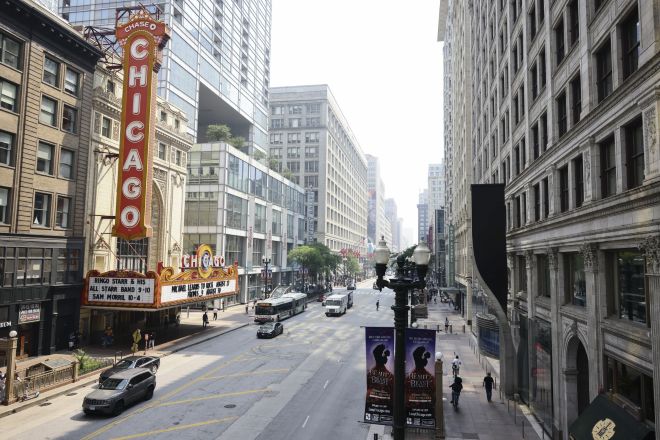
Cities are turning to the creative economy again. The Chicago Loop Alliance recently announced a plan to create a new arts district within the Loop, linking Millennium Park to the Chicago Riverwalk and elevating cultural institutions within the Loop. This comes on the heels of Chicago’s 2025 launch of the “cultural stadium” concept, linguistically linking the arts to the already successful sports-entertainment industry (I see what you did there!). Meanwhile, Philadelphia is committing $150 million to a new streetscape along its already established but mid-feeling Avenue of the Arts.
The creative class thesis — that arts investment attracts talent, which attracts employers — was already out of vogue prior to the pandemic. But now the goal may no longer be about talent so much as just foot traffic and arts-based economic activity.
Office vacancies are more opportunity than crisis
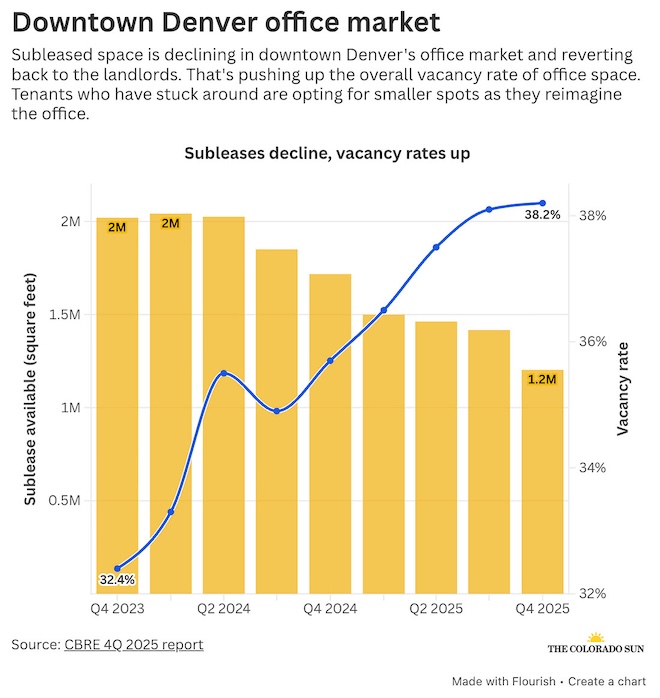
Downtown Denver’s office vacancy rate has hit a new high of 38.2 percent. Portland and Seattle have also recently notched records. And yet the number of buildings being converted to other uses is also at unprecedented levels in many other cities. In Pittsburgh, a recent study found that 45 percent of people living downtown had lived in a different neighborhood just a year ago, proving that these conversions don’t just remix existing populations but add new people to a city’s core. In Philadelphia, the city’s largest office complex is slated to become a hotel and up to 500 apartments. Meanwhile several medical office buildings that were part of the downtown Hahnemann Hospital have been permitted to convert into more than 800 apartments.
These buildings are trading at deep discounts right now, but with significant capital going in, their property values will rise again. More importantly, they’re adding new uses to places that once existed solely for office workers. In the long run, this makes downtowns more interesting — and more resilient.
If you want to benefit from the city, you need to invest in it.
The doom loop is happening at the state level, not the city level
One of the pandemic’s most-predicted urban consequences— the doom loop — hasn’t materialized the way the forecasters expected. While yes, some cities are facing really bad budget deficits — see Mamdani’s set of unenviable options in New York City — the fiscal stress is instead showing up at the state level.
Last year’s passage of HR1 (the Big Beautiful Bill) resulted in changes to a host of state run programs and projects. The reduction in federal support for Medicaid and SNAP means states have to pick up these bills if they want to continue these programs. According to a piece in Governing: “New Mexico, for example, estimates new recurring costs related to federal Medicaid and SNAP will total about $620 million in fiscal 2027 and rise to just over $1 billion by fiscal 2029. As those obligations climb, the state’s overall bottom line shifts from a modest surplus in fiscal 2026 to a projected $2.1 billion deficit in 2029.”
The key is to dissociate the urban doom loop with current budget troubles in states across the country, from the coasts to states like Nebraska. New Jersey — a state best known for its dense suburbs — is facing a serious budget crunch, even as northern New Jersey contains two of the only five remaining sellers’ markets for housing in the country.
The return of real life
Every week, I get tagged in posts or texts from friends about how people are pushing against the digital world and toward one that values in-person experiences since I write about this subject a lot!
I loved this LinkedIn post by Phil Levin about how Dick’s Sporting Goods is a top downloaded app at the same time as Claude and Gemini.
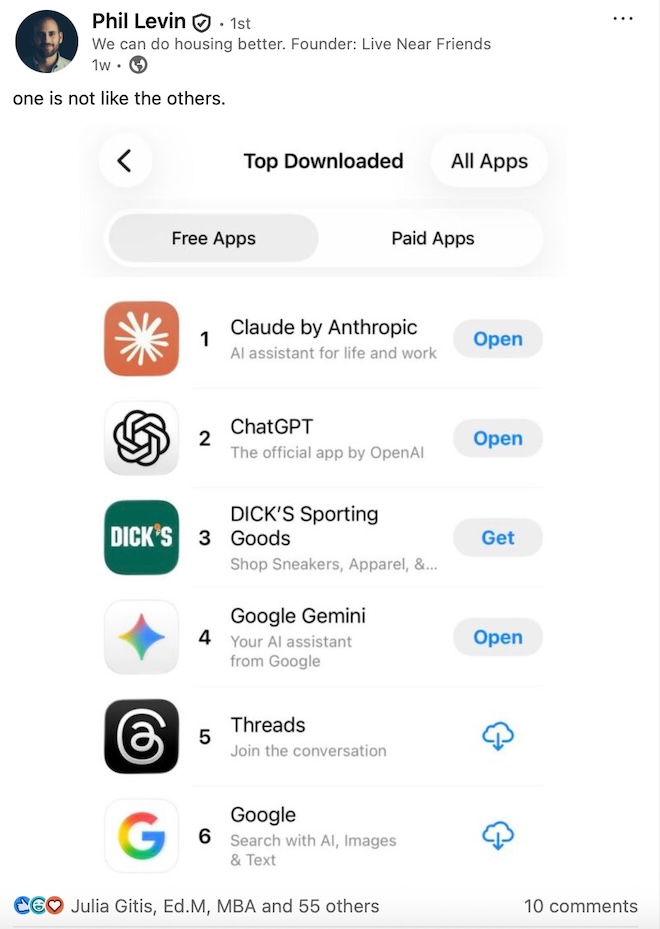
This perfectly encapsulates how a significant portion of the population is doubling down on in-person experiences, like sports. People are realizing that doing things in community makes them happy— and that is showing up not only in the App Store, but in the data.
Aziz Sunderji wrote in a recent piece in his Substack Home Economics about how a University of Chicago study shows the predictors of happiness in America have quietly shifted since Covid: “income, education, and class matter less than they used to. Socializing and participating in a community matter more.”
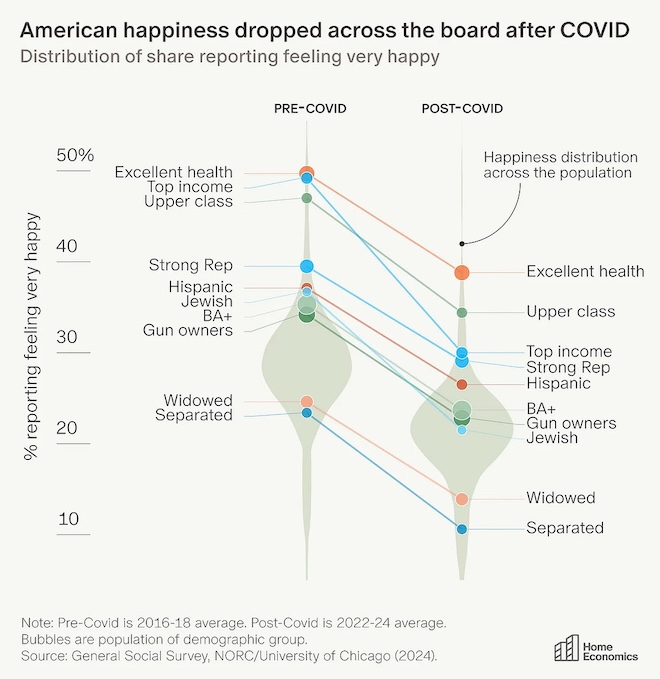
This finding is exciting because community and connection are things most people have genuine agency over — more so than income or educational attainment. Even with pandemics, wars, political uncertainty, and economic disruption as background conditions, we have real control over how, where, and with whom we spend our time. Six years later, that might be the most important thing cities have going for them.
Diana Lind is a writer and urban policy specialist. This article was also published as part of her Substack newsletter, The New Urban Order. Sign up for the newsletter here.
 MORE FROM THE NEW URBAN ORDER
