



Forty drills sitting unused in 40 basements is a private storage problem. A drill that is maintained, cataloged, insured and shared by 400 neighbors is a public resource. The object is the same. The system around it is not.
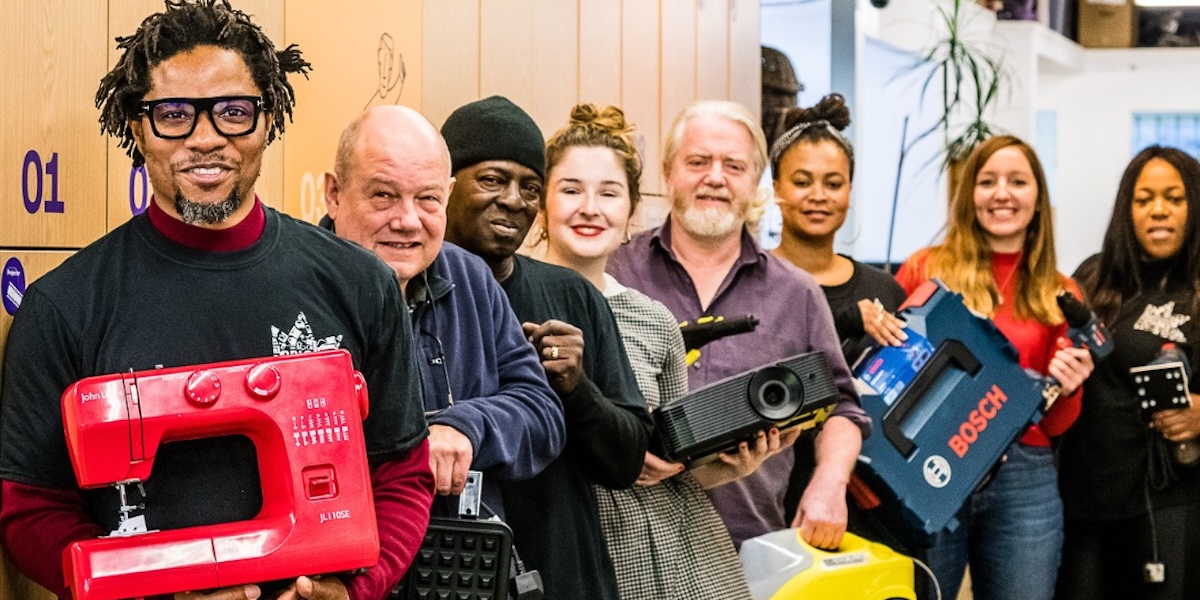
London’s Library of Things is built on that distinction. Residents reserve useful household items online, pick them up at a nearby location, use them for a short period and return them for the next person. Drills, carpet cleaners, sewing machines, projectors, steam cleaners, camping gear, sound systems — the kinds of things people need occasionally but not every day. In other Library of Things and tool-library models, borrowing may be free, membership-based or pay-what-you-can.
The idea began as a challenge to the assumption that every household needs to own every object it may occasionally use. The Guardian was writing about Berlin’s “borrowing shop” more than a decade ago. In 2014, London launched its Library of Things and began to show how the concept could work at neighborhood scale. It has since grown to 22 locations across the city, more than 34,000 members, self-service lockers, online reservations and a pricing model designed to keep the service running. After a small one-off joining fee, members pay rental fees that vary by item and length of borrowing — £10 a day for a cordless drill, £5 for a popcorn maker. Its 2025 impact report estimates 423 metric tons of electrical supplies reused and £8.6 million saved by members.
But borrowing does not work just because useful objects sit on a shelf. Someone has to maintain the inventory, clean and repair items, price them, insure them, manage reminders, handle broken tools and keep the service convenient enough that people choose it over buying. Without that operational work, a lending library is just a donation closet with better signage.
Philadelphia already has the bones of this idea, and the opportunity is to connect them.
The network that already exists
In West Philadelphia, the West Philly Tool Library has been lending tools since 2007. It now has 1,300 members and more than 4,500 tools, with sliding-scale memberships starting at $20 a year. It is the only tool library in Philadelphia. When its lease on 47th Street was not renewed last year, the organization crowdfunded to move, and reopened in December at a new home in Grays Ferry. That a citywide reuse anchor had to survive by community scramble rather than institutional transition is the civic infrastructure question this piece is about.
Meanwhile, in Kensington, The Resource Exchange keeps reclaimed materials in circulation for artists, teachers, homeowners and makers. Fishtown’s Philly Fixers Guild creates spaces where repair knowledge is shared. Circular Philadelphia, the local zero-waste nonprofit, is working to make the regional reuse ecosystem visible and connected.
And the city now has resourcePhilly, a free search engine launched by The Resource Exchange and Circular Philadelphia to help people find places to recycle, reuse or repair items they might otherwise throw away. The Citizen recently covered its launch as a directory. That is accurate, but it understates what resourcePhilly is — the closest thing Philadelphia has to a map of its upstream waste-prevention ecosystem.
A city serious about waste cannot only manage the pile after it exists. It has to start bending the curve of how much material enters the system.
If a resident has a broken lamp, leftover tile, a dead laptop, an old stroller, a box of art supplies or a chair they no longer want, the next move is often unclear. ResourcePhilly tries to make that move visible. Once it is visible, the item may become a repair, a donation, a resale, a borrowed substitute or material for someone else’s project.
Taken together, these are not pieces waiting to be centralized. They are pieces waiting to be connected into a working network — lending, repair, reuse, materials circulation and public information, each doing a different job in keeping useful things from becoming waste.
Why this is housing preservation
In a city where housing preservation is integral to its mayor’s affordability policy, borrow-and-repair networks are maintenance infrastructure.
Philadelphia is an old rowhouse city. Small repairs become expensive failures when residents lack the tools, money or confidence to act early. A borrowed drain snake, moisture meter, carpet cleaner, ladder, sander or masonry tool can mean the difference between a manageable fix and a repair that becomes a crisis.
For households with the least storage and least spare cash, owning every occasional-use tool is its own cost. Borrowing lowers the cost of maintaining the homes Philadelphia already has.
Why this is economic development
Philadelphia’s waste debate is often framed as an economic issue, measured by costs to collect, haul, burn, bury or process what residents dispose of. A circular economy asks a different question: How much value are we discarding before we ever count the cost of disposal?
A broken appliance is repair work for someone. Leftover building material is inventory for a builder, carpenter or do-it-yourselfer. An unused tool sitting in a basement has capacity that a neighbor could use tomorrow. A borrow-and-repair ecosystem keeps things in use longer, but it also puts people to work. It could support repair labor, materials resale, equipment maintenance and the workforce training that feeds all three.
The Citizen has already highlighted reusable cups for stadiums as an idea Philly should steal. A borrow-and-repair network asks the same question at household and neighborhood scale. What if reuse were built into ordinary life, not only major events?
The opportunity is to stop treating these as charitable side projects and start treating them as a neighborhood economic sector. Philadelphia already has salvage businesses, thrift stores, reuse retailers, vintage shops and secondhand networks that keep materials in circulation commercially and informally. What remains unsupported is the nonprofit lending, repair and directory infrastructure underneath that activity.
The convenience test
None of this works if borrowing is harder than buying or than putting something on the curb. The curb is often the real competitor. If a lending network is only open a few hours a week, or only reachable by car, it will remain a niche service. To work as infrastructure, it has to reduce friction. That means predictable hours, neighborhood pickup points, a searchable catalog, reminders, clear rules and enough locations that borrowing does not feel like a special trip.
Convenience is also an equity question. If borrowing requires a car, a long trip or a narrow pickup window, the people who could benefit most will be least able to use it. A serious borrow-and-repair network would have to meet people closer to where they already go, whether that is a library, a rec center, a commercial corridor, a school, a CDC or a neighborhood reuse hub.
In London, Library of Things works through self-service lockers placed inside public libraries, leisure centers, shopping centers and even a residential block — so borrowing fits into existing routines. Residents reserve online, receive a code, collect the item from a locker and return it clean for the next borrower. Outside London, the model varies. Some locations use staffed handoff, volunteer hosts or manual pickup from a reuse shop.

The Free Library may offer a useful design lesson. Libraries already know how to circulate shared assets across neighborhoods. The Free Library already lends instruments, birding kits, exercise equipment, cake pans … That does not mean a system designed to circulate books can move carpet cleaners and drills. But it suggests a question Philadelphia should be asking: What would a shared civic circulation system look like if useful household items, repair kits and specialty tools could move between trusted neighborhood access points?
What a Philadelphia borrow and repair network could look like
This does not need to be one new nonprofit trying to do everything, or an app pretending logistics are easy, or a municipal program that absorbs every shelf and tool into city government. It can be a new civic network, built from what exists.
West Philly Tool Library as a mature lending anchor. ResourcePhilly as the directory layer. Circular Philadelphia as the field-building and policy table. The Resource Exchange as the creative reuse and materials partner. Philly Fixers Guild as the repair and skills layer. The Free Library, rec centers, community schools, CDCs and neighborhood organizations as possible access points.
A citywide network would also need neighborhood anchors in places that do not currently have anything like West Philly Tool Library.
The job for city government is to make this ecosystem easier to sustain. That could mean a small prevention fund, access to underused public space, insurance support, procurement flexibility, public promotion and a decision to treat resourcePhilly as civic infrastructure rather than a useful tool the city benefits from but has not committed to sustaining.
Why now
Philadelphia’s waste disposal contracts expire July 1, 2026. Councilmember Jamie Gauthier’s incineration bill — to prevent our trash from being burned in and harming our neighbors in Chester — and the Parker administration’s concerns about cost, logistics and landfill capacity have forced a necessary debate about where the city’s trash goes next. The Citizen has already reported on the limits of Philadelphia’s current trash and recycling contract structure.
That debate is necessary. Chester residents are right to object to carrying the burden of Philadelphia’s waste. The city’s contract decisions matter.
But the entire argument is about what happens after something becomes trash. More frequent collection, which the administration has begun piloting in dense neighborhoods, can help manage visible waste. The Citizen has also reported on the limits of cleanups and expanded collection as a response to volume. Too much material is entering bags, bins and streets in the first place. More pickups do not change the volume. (Nor do they seem to have made streets, sidewalks or public spaces cleaner.) Prevention is missing from the central debate.
A borrow-and-repair network will not resolve the incinerator fight. It will not replace sanitation contracts. A borrowed drill is not going to reduce this summer’s tonnage. But a city serious about waste cannot only manage the pile after it exists. It has to start bending the curve of how much material enters the system. That work takes years to show up in the numbers, which is why it is so easy to underfund. Philadelphia spends millions managing waste after it exists. The infrastructure that keeps useful things from becoming waste still operates on small budgets and no durable commitment.
The waste contract fight has forced the city to look at the end of the consumption chain. The better question is what Philadelphia builds at the front.
Borrow before we burn. Repair before we replace. Share before we buy.
That is an idea worth stealing.
Amanda Soskin is a Philadelphia-based consultant who writes about civic infrastructure and neighborhood systems at Neighborhood Fundamentals.

MORE CIRCULAR ECONOMY IDEAS FOR PHILADELPHIA