



Silvia Lucci, owner and co-founder of Philly’s LUHV Foods, has long operated her business based on three pillars: health and wellness, environmental impact and ethical sourcing.
Her company sells nutritious vegan food in its three stores in Point Breeze, Reading Terminal Market and Hatboro, and to retailers like Whole Foods. Veganism in and of itself is good for the environment: Plant-based diets can reduce an individual’s carbon emissions by 75 percent. But Lucci wanted to do more to mitigate the nearly one trillion pieces of disposable foodware the U.S. sends to landfills each year.
So a few years ago, she signed onto ReThink Disposable, a program of the national environmental nonprofit Clean Water Action, to bring reusable takeout containers to her restaurants. For a $5 fee, LUHV customers can buy a reusable container, get it filled with a black bean burger, and bring it back to refill it with empanadas.
Some patrons have been good about it, but for many, remembering to bring back refillables has proved difficult. Some end up just buying more each time they visit, stowing them away in cabinets, never-to-be-used again or worse, tossed out.
“Cultural changes are very hard,” Lucci says. What would make it easier? A city-run program like the one Seattle has that has gotten everyone from mom-and-pop shops to Starbucks to encourage reuse instead of single use. Reuse Seattle, an initiative of Seattle Public Utilities, is now eyeing a policy to require dine-in operations that use disposable dishes and serverware to offer reusable dishes for their customers. Slowly, the city is making a dent in the massive waste we create when we eat out.
Change the food code, change consumer behavior
Until a few years ago, most coffee shops would fill washable mugs or to-go cups, but Covid changed that. (Remember wiping down your groceries with Lysol?) During the pandemic, shops, if they were open at all, went 100 percent disposable.
This is a terrible habit. Each year, Americans toss out 50 billion disposable coffee cups — and recycle basically none. But, for some reason — maybe because we all now tote around reusable water bottles — it’s easier to get folks to remember to carry refillable coffee cups.
In 2022, Washington state updated its Food Code to clarify that cafes and coffeeshops could accept personal cups. Soon, the Reuse Seattle team got to work communicating that message to residents and businesses.
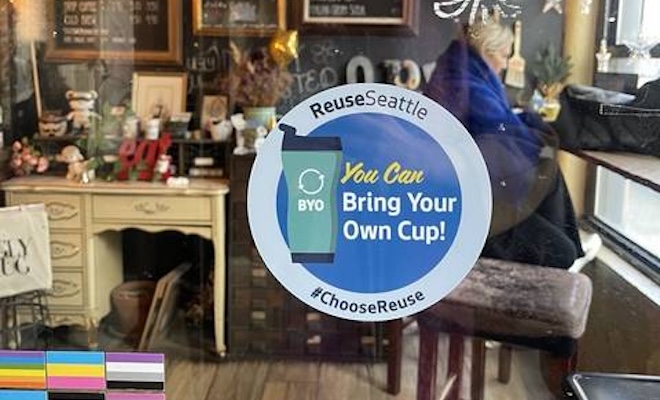
They started by reaching out to the city’s green business network and offering coffee shops stickers that let patrons know they could bring their own cups. Then, they listed all the businesses that allowed patrons to BYO cup on a digital map. The map — which now features more than 90 cafes — also showed the shops’ incentives, like getting 10 cents off your drink, for BYOing. Starbucks, founded and flagshipped in Seattle, came on board to the program in January 2024, and also announced they’d accept refillable cups at all 17,000 stores and drive-thrus nationwide.
To help consumers get back in the habit of BYOing, Reuse Seattle also worked with local artists on online public awareness, running ads in English, Spanish, Chinese and Vietnamese.
“It was a very positive campaign. … You love your cup. You love your coffee. Find a cafe that loves your cup as much as you do,” says McKenna Morrigan, an advisor for Seattle Public Utilities. “It’s an easy way to do a good thing for the environment and the community.”
It’s difficult to track how much waste Seattle’s BYOCup campaign has diverted, but Morrigan says their website receives between 6,000 and 10,000 visits each month. Every little bit helps.
“If just 10 percent of cafe customers are remembering to bring their own cup, we know that that can reduce the number of single-use cups getting thrown away by millions a year,” Morrigan says.
Making restaurant reuse easy
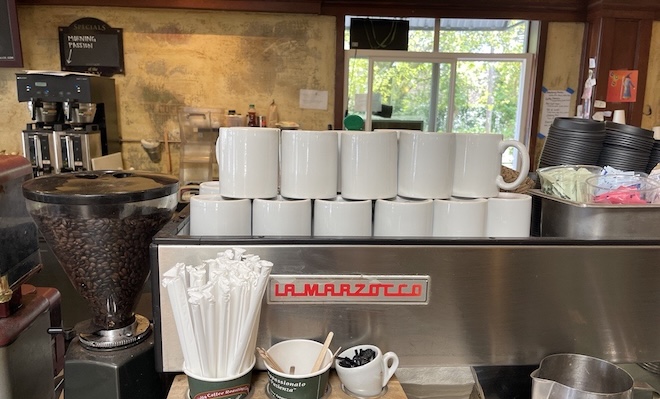
Restaurants and cafes using disposables for dine-in customers face a different hurdle: the expense — an estimated $600 to $2,000 — of buying reusable serverware, plus the expense of employing a person and purchasing a machine to wash dishes. So, in 2024, with $225,000 in funding from Seattle’s Office of Economic Development, Reuse Seattle offered individual restaurants and cafes grants of up to $500 each to offset the purchase melamine and ceramic plates, cups, bowls and such.
In doing so, they helped these businesses save on disposables, which cost between $3,000 and $22,000 a year, says Alisa Shargorodsky, director of Philly’s ECHO Systems, a circular economy nonprofit. These savings create a big impact. “A lot of food sector businesses are already operating with narrow margins. They have high operating costs. They have to pay their staff. They have to pay their rent,” Shargorodsky says.
The Seattle program has helped 100 food service organizations — including restaurants, hospitals, nursing homes, anywhere that serves food — switch to washable wares. One grant recipient, Harborview Medical Center, saved $10,250 and eliminated 69,771 pieces of single-use plastic just four months after implementing the program. As a next step, Seattle is looking at adopting an ordinance that would require restaurants to have reusable dishware for dine-in customers.
Can Philly figure out reuse?
Seattle’s push for reusables worked because they provided clarity in their food code, educated restaurants about the environmental and health risks, provided funding to support the transition, and launched a public awareness campaign.
For something similar to work in Philly, our city would need to do better. One month after the Indian food takeout specialist Tiffin launched a reusable-centered Tiffin2Go program in spring 2021, the City shut them down for not filing a $255 variance with the Department of Public Health. Although the City eventually reversed course that fall, the powers that be had already set a dangerous precedent that may have prevented other takeout operations from adopting reusables.
“Tons of businesses across our city still serve their eat-in customers on disposable wares,” Shargorodsky says. “Philadelphia spends $48 million a year on mitigating garbage … we need to look upstream.”
“The community in Philly is really ready for reusables,” says Mercedes Forsyth, a Clean Water environmental health organizer.
Although Clean Water Action no longer offers grants of $300 to $600 to businesses to purchase reusable wares through ReThink Disposable, the organization still talks businesses through the process of making the switch.
Other ways the City of Philadelphia could help: Offering a tax break to businesses to make the switch. They could adopt a policy like the one New Jersey just passed: Skip the Stuff requires customers to opt-in for things like single-use silverware when they get delivery or takeout.
“If we eliminate the single-use items, that’s less waste that the City has to deal with from a trash and recycling standpoint, which means less cost for the City,” says Candice Lawton, executive director of the nonprofit Circular Philadelphia.
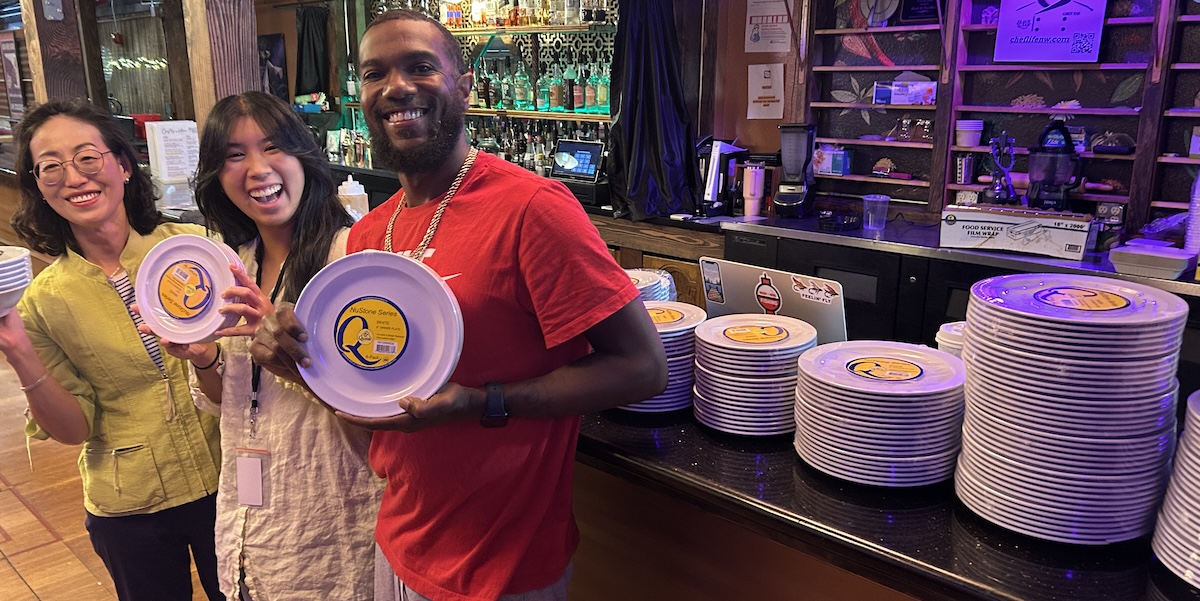
Until then, food service organizations can support one another in making the switch. This January, ECHO Systems released its Philly Unwrapped toolkit to help businesses calculate the costs and savings of switching to reusable dishware and to raise awareness of the health and environmental risks of single-use packaging, and, so far, more than 124 businesses have downloaded it.
ECHO is also looking into providing window plaques or decals and perhaps creating a digital map — two successful Seattle tactics — to help sustainability-minded consumers find them. They’re also planning five events to help promote the toolkit.
“We’d really like more businesses to come along with us on this road,” Shargorodsky says.
 MORE IDEAS WE SHOULD STEAL