

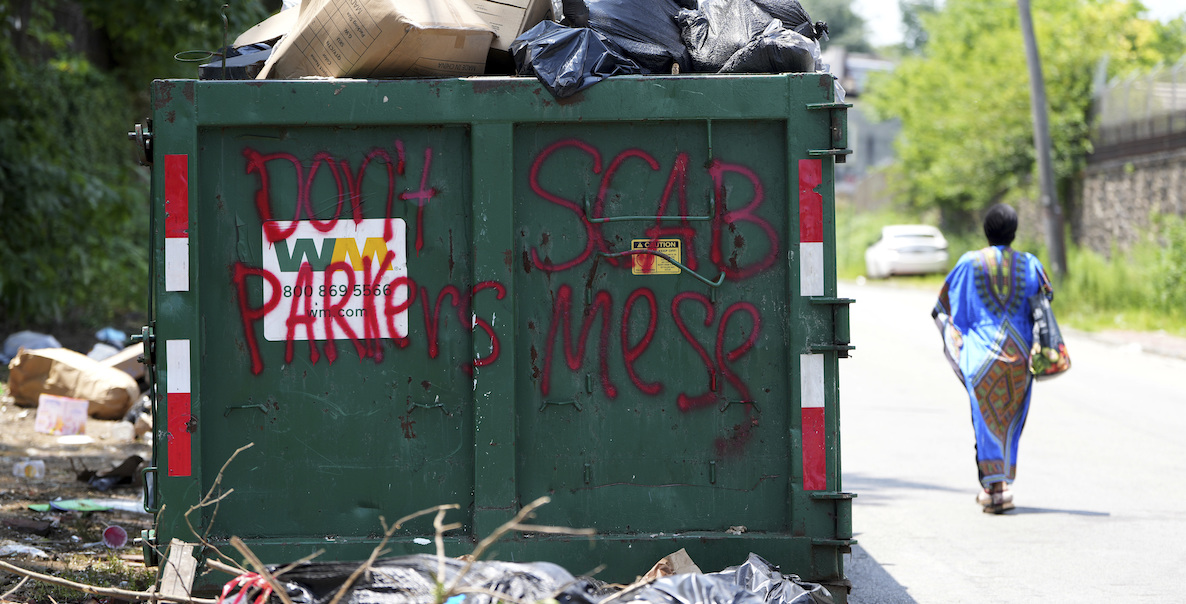


Let’s not kid ourselves. While our air has been fouled by the eight-day strike of DC 33 workers — whose 9,000 blue-collar City employees include those charged with keeping our streets clean — the issues in all the drama had nothing to do with quality of life problem-solving.
After all, Philadelphia has long led the league in dirtiness, a self-inflicted wound struck time and again for decades. About a month ago — weeks before the walkout — I got a text from a friend, a middle-aged longtime Center City resident: “Can someone write an article that says, so seriously what’s up with the trash?” Almost simultaneously, a prominent business leader called me: “I travel to cities around the country,” he said. “Tell me, why are our streets still the dirtiest?”
Listen to the special audio edition here:
It’s a common refrain, one I’ve voiced before. Not long ago, heading north on 20th Street, mere blocks from the Benjamin Franklin Parkway, a 7/11 Big Gulp came hurtling out of the driver-side window of the tinted-windowed car in front of me. I laid on the horn and considered giving chase — citizen’s arrest, anyone? — before cowardice, er, reality, set in.
About a month ago — weeks before the walkout — I got a text from a friend, a middle-aged longtime Center City resident: “Can someone write an article that says, so seriously what’s up with the trash?”
It’s not just me, right? We have a longtime — though easily curable — affliction: a cultural lack of pride in caring for our own shared public space. Data bears it out: Survey after survey over decades finds Philly’s streets to be amongst the nation’s most befouled. (At least our sister city, Pittsburgh, tends to be right up there with us.) It’s an ignominious and stubborn fact, particularly for the city that gave us the aforementioned Franklin, creator of the first street-sweeping program in history.
Many reasons contribute to our litterbug mindset, as Courtney DuChene brilliantly chronicled in The Citizen this week. At various times, there’s been the confusing and confused rules around pickup times and recycling; the lack or infrequency of street-sweeping; the shortage of bins; the fact that — if you’ve ever watched your trash get collected — those charged with doing so leave a good percentage of it blowing around (or leaching onto) on the ground.
But I want to zero in on the mother of all reasons, which came into sharp relief these last eight days: leadership, or the lack thereof.
“Pay the money, Cherelle!”
We finally have a Mayor who has made cleaning and greening the city a top priority, and a recent pre-strike Pew poll finds that 34 percent of Philadelphians think she can make a major impact on that score, while 41 percent predict she’ll have more minor success. Nearly 80 percent of respondents were either “very” or “somewhat satisfied” with their trash collection. (I suspect such numbers would be different after the last week of “Parker Piles” and their foul odors.)
That’s why it’s puzzling politically that Mayor Parker would choose a showdown with her own sanitation workers — she was playing with fire when it comes to one of her political strengths. Remember Eagle running back Ricky Watters’ infamous post-game excuse for not stretching out for a catchable ball, lest he get hit by an oncoming defender: “For who?” he said. “For what?”
Well, essentially channeling Watters was the Black, sweat-dripping Philly taxpayer on Action News, caught downwind of the Parker Piles, who stared into the camera and pleaded with his mayor: “Pay the money, Cherelle!” He may just as well have been asking: For who and for what had such a line been drawn?

Keep in mind that the striking workers make a paltry average of $46,000 per year and were seeking a bump to all of $53,000. Of course, in reality, it’s more complicated than that. With benefits, the lucrative specter of programs like DROP, and especially overtime — the streets department, 89 percent staffed, spent 151 percent of its allocated budget last year — the folks picking up your trash are likely not subsisting below a living wage, a phrase Inquirer coverage has repeated time and again.
But there certainly is some political disconnect going on when a liberal big city Mayor takes on her own underpaid blue-collar workers. Parker tried to frame her red line as one of preserving “fiscal stability,” but that’s a hard case to make when you’ve just adopted a massive $6.8 bill operating budget, the largest in history. You couldn’t find the shekels in all that scratch to take care of what ought to be part of your own base? No, Parker’s red line was more about a lack of priority than financial constraints.
Again: Strange, politically speaking. Until you recall that DC 33 did not endorse Parker in the 2023 primary; it stood with Jeff Brown instead. After its President at the time, Ernest Garrett, was booted from power, Parker seemed to favor Omar Salaam taking over. Salaam, of Sanitation Workers Local 427, had broken with DC 33 during the mayor’s race to endorse — you guessed it: Parker. Once she became Mayor, there was Salaam in his capacity as 33’s interim president on stage with Parker during press conferences having to do with snow removal and street cleaning.
But Salaam ultimately lost his bid to lead DC 33 to the Garrett-aligned Greg Boulware. All that background very well could explain the animus between Parker and Boulware these last weeks, including the peevish accusations about how much each was earning. (Boulware erroneously accused the Mayor of giving herself a hefty raise.)
During the strike, Democratic Party boss Bob Brady, known to have successfully mediated labor disputes in the past, complained that Parker hadn’t responded to his offers to help and indicated, as have others, that the dispute was essentially personal between Parker and Boulware. (Parker claimed not to have received his messages.) He went one step further on 6abc’s Inside Story, providing a roadmap for how impasse turns to win/win in labor standoffs: A leader lures the principles into a room with cold pizza and warm beer, he said, and locks the door. No one leaves until there’s a resolution.
Did we see that kind of “lock the door” leadership here? Hardly. For all of Parker’s oratorical gifts, not only didn’t she explain the stakes to her city, her administration didn’t exhibit the inside game chops to avoid a shutdown. And it’s awfully hard for a mayor to benefit politically when there isn’t a compelling public rationale to take a strike.
Rather than seeming to fight her frontline workers over their meager wages, Parker could have used the strike to amplify, not diminish, her brand as a “clean and green” mayor. That would have required more creativity than her administration has exhibited thus far. For example: Why not say: OK, we’ll grant you your compensation requests — but only if it’s tied to performance. Sanitation workers, you’ll get bonuses per some tonnage of trash collected. 911 operators, you’ll get paid more commensurate with the shortening of response times. (To be fair, 911 response speed has vastly improved under Parker.)
Because DC 33 ultimately settled for less than they’d been seeking, The Inquirer and others have called the resolution of this strike a win for Parker. In medialand, there’s no story without winners and losers. But are there really any winners here?
The union talked tough, but turned out they weren’t exactly Lech Walesa’s Solidarity movement, failing to tolerate missing even one paycheck. Parker’s claim to be making a stand for fiscal responsibility rang hollow. And City Councilmembers like Jamie Gauthier, in their rush to pander and call on citizens not to cross the picket line — by, for example, not taking your own trash to dropoff points and avoiding the July 4th Parkway concert — added more noise than clarity in a crisis. And as for us, there we were again, Philly, on national TV amid footage of trash-strewn streets. Not exactly the look we want to project to the nation, eh?
How to actually win the trash wars
One reporter referred to Parker as conducting a “victory lap” upon the strike’s end. If accurate, that would be a mistake. In fact, Parker ought to waste no time in seizing on this moment to double down on being a quality of life mayor. How? By thinking outside the box and carping some diem when it comes to the politics of trash. How about, I don’t know, gamifying city cleanup? Partner with the sports teams for neighborhoods to compete against neighborhoods — with the winners sitting courtside at a Sixers game. (Tickets will be available.)
That’s what the City of Memphis did a couple of years ago with their NBA team, the Grizzlies. They created a “Slam Dunk Litter League” — for sponsorship prize money, teams of residents competed over who could collect and dispose of the most trash. The winners took in a Grizzlies game from the mayor’s box. City officials said it was the game, not the cash, that motivated people to beautify their own neighborhoods.
Imagine our 67 Wards heeding the Mayor’s call — made alongside, say, Tyrese Maxey or, better yet, Jalen Hurts — to compete against one another by helping to make their streets cleaner. Think that might sell in this sports-crazed town?
Or imagine Parker taking a page from the playbook of the charismatic new (and, actually, former) mayor of Manila in the Philippines, Francisco “Isko” Moreno Domagoso, who, on his first day in office June 30, laid down the law, declaring a health emergency. His city’s streets had been left filled with garbage after trash collection contractors the previous administration had hired went unpaid. Isko is a one-time trash collector himself, as well as a former actor turned politician with a slogan of, you guessed it, “Make Manila Great Again.” This is from the New York Times:
On Monday, a new contractor worked through the night to pick up trash, free of charge as a favor to Mr. Domagoso, he told local media, and water trucks followed the garbage collectors, hosing down the streets. On Friday morning, he posted photos of cars and motorcycles running unencumbered on two major thoroughfares finally clear of waste.
See what Isko did there? It took him all of four days — the first of his mayoralty — to reverse a health emergency. More to the point, Manila residents saw their government at work — for them. Talk about announcing your presence with authority.
Parker tried to frame her red line as one of preserving “fiscal stability,” but that’s a hard case to make when you’ve just adopted a massive $6.8 bill operating budget, the largest in history.
There are other examples of government changing litterbug culture. In Texas, the slogan “Don’t Mess With Texas” started as an anti-litter campaign and was so successful it became a state-wide catchphrase. For all his problems in New York, Mayor Eric Adams hired a first-ever cabinet-level Rat Czar and the city’s “Don’t Do New York Dirty” ad campaign is explicit about turning city pride into cleaner streets. The campaign is the product of the city’s Sanitation Foundation, a nonprofit partner of city government. Maybe that’s a model for Philly?
In 2019, 6abc President and General Manager Bernie Prazenica and I convened the major sports teams and media outlets in town. We partnered with marketing guru Bob Aretz of Paragraph, Inc. and presented a series of PSAs under the tagline, “We Talk Trash. We Don’t Trash Philly.” The Sixers gave us Allen Iverson, the Phillies provided Rys Hoskins, and the Flyers hooked us up with a couple of dudes I’ve since forgotten to get the message out. And, in a town where sports punches way beyond its weight, a number of news outlets started running promos designed to urge fans to do better civically. (Research shows, by the way, that young men are our most egregious litterers.)
Alas, the pandemic hit, the world went crazy, and the campaign was short-lived. But a mayor who has just done battle with her sanitation workers taking to the airwaves with sports stars to unite a city — “one city,” as the Mayor is wont to remind us — and proclaim that cleaning up after ourselves is ultimately up to us? That mayor really could become the clean and green mayor who turns around a chronically dirty metropolis.
 MORE POLITICAL ANALYSIS OF CITY GOVERNMENT