

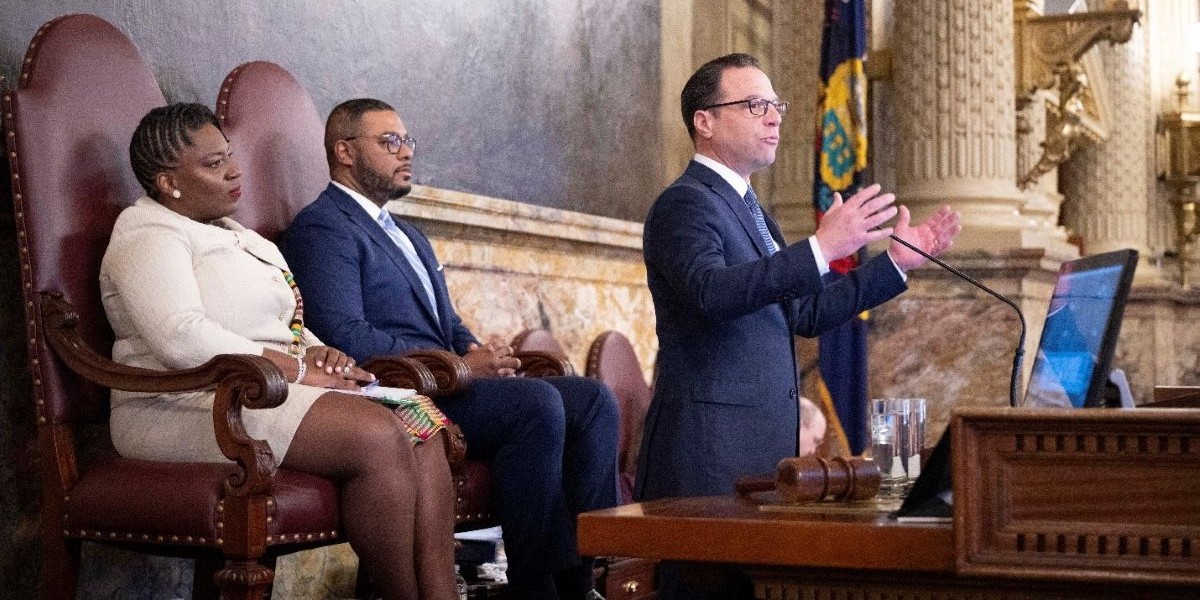


On July 11, 2026, Pennsylvania lawmakers approved the fourth budget of Governor Josh Shapiro’s administration. The $50.8 billion General Fund budget for fiscal year 2026-27 is about $1.8 billion, or 3.7 percent, more than last year’s available funding, and roughly 60 percent more than the state appropriated a decade ago.
The General Fund is the main way PA pays for its core functions: schools, health coverage for low-income residents, public safety, and the agencies that regulate daily life. It does not include the billions in federal grants PA receives each year, or what county and local governments raise and spend on their own. It is funded primarily through the income and sales taxes paid by Pennsylvanians.
The enacted budget spends roughly $3,900 per Pennsylvanian this fiscal year. But most of that spending is not discretionary. Nearly half the budget goes to just two things: health insurance for low-income residents through Medicaid, and funding for K-12 public schools. The rest is divided among prisons, universities, workforce programs, state parks, and dozens of other services.
Following the release of the Governor’s proposal, the House and Senate Appropriations Committees held public hearings before lawmakers negotiated a final bill. The process concluded 12 days after the June 30 deadline — much earlier than last year, when the budget was not enacted until November, four and a half months after the deadline.
To better understand PA’s new budget, we broke the budget into major categories, divided those totals by the state population, and compared the enacted per-person amounts for fiscal year 2026-27 (FY27) with available funding for fiscal year 2025-26 (FY26). After the chart below, we provide some of the main highlights from this year’s budget.
Here are some of the most substantial takeaways:
- Four categories account for nearly two thirds of the entire budget. Medicaid (24 percent), K-12 Core Funding (22 percent), Justice & Public Safety (9 percent), and School Pension Obligations (8 percent) together account for 62 percent of the enacted budget. The remaining 23 categories divide the other 38 percent.
- Nearly half the budget is in categories the state is legally required to fund. Medicaid is legally required for anyone who qualifies. School Pension Obligations are set by formula and legally guaranteed. Treasury & Debt Service payments are required to avoid default. Special Education funding is mandated by federal law. Child Welfare runs through federally mandated programs. Together, these five categories total about $1,620 in per-person spending, or 42 percent of the enacted budget.
- More than half of the $140 per-person increase comes from categories with limited discretion. Medicaid enrollment and cost growth (+$57), School Pension Obligations (+$10), Treasury & Debt Service bond payments (+$8), and Justice & Public Safety (+$1) together account for about $75 of the total per-resident increase.
- State spending in several large categories is matched by federal dollars, making cuts more consequential than they appear. Several of the largest categories, including Medicaid, Special Education, Child Welfare, and Intellectual Disabilities & Autism, draw significant federal matching funds. Cutting state dollars in these categories does not just reduce state spending, it also forfeits the federal match. For example, the federal government covers 56 cents of every dollar, so a $1 state cut reduces total program funding by about $2.30.
- Higher Education receives no federal matching funds, and enacted funding declined slightly. Unlike most other large categories, every dollar in Higher Education is entirely state-funded with no federal match. Funding for higher education decreases by about $46 million, or roughly $3 per Pennsylvanian, in the enacted budget.
- Economic & Community Development’s 12 percent cut is far smaller than the 46 percent reduction Governor Shapiro proposed. Enacted spending falls from $45 to $39 per Pennsylvanian. Lawmakers retained the five programs the Governor proposed to eliminate, although Community and Economic Assistance was reduced by $42 million and Keystone Communities by $2 million. Governor Shapiro has proposed eliminating these programs in each of the past three budget cycles, and lawmakers have restored funding each year.
Source: Pennsylvania’s 2026-27 Enacted Budget General Fund Appropriation
Figures represent enacted funding in fiscal year 2026-2027 for Pennsylvania’s General Fund budget, adjusted for the state’s population using the latest available data. Per-person spending totals are compared to the prior year available funding for fiscal year 2025-26.
Nick Hand is a data scientist and public sector technologist. He was director of the City Controller’s Finance, Policy and Data unit during Rebecca Rhynhart’s tenure.
 MORE ON STATE GOVERNMENT