


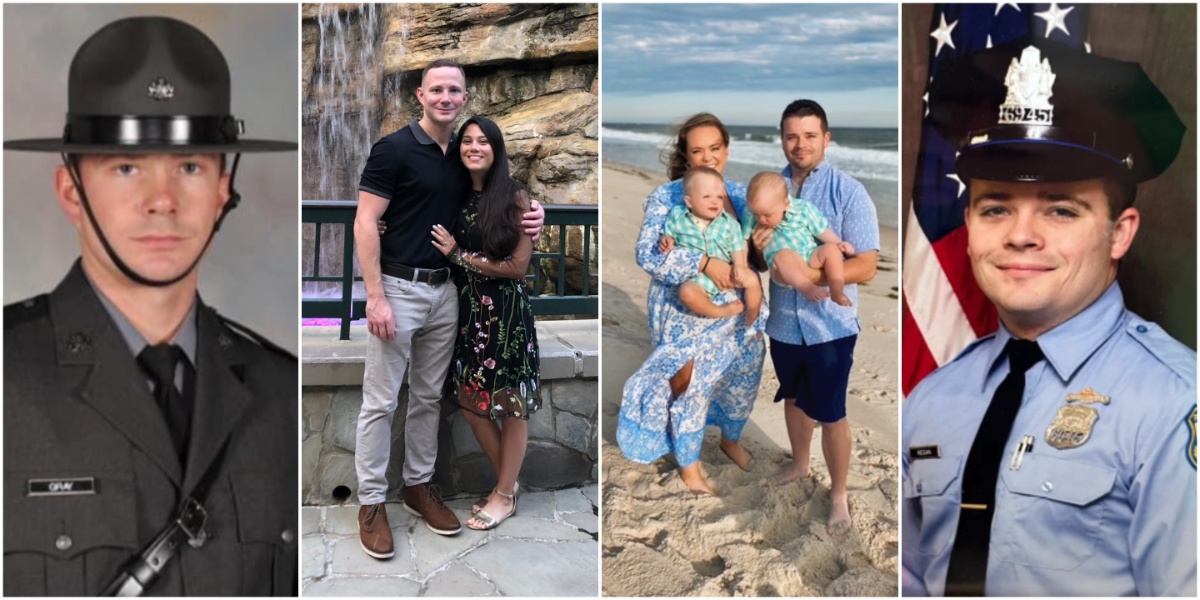


Emily Chau Gray remembers clearly the events of January 2024. It was a time of new life, sudden death, and a rude awakening.
Gray and her husband, Bryan Gray, were parents of an 15-month-old daughter when they learned they were expecting a second child. Days after receiving the good news, Bryan, a trooper with the Pennsylvania State Police and a former Green Beret, took his own life. He was 36.
Gray believes her husband’s suicide was due to post traumatic stress stemming from years of witnessing fatal accidents — including the killing of two of his fellow troopers and a pedestrian by a drunk driver. Bryan’s death thrust Gray into the middle of a public conversation about the disturbingly high rate of suicide among emergency first responders and whether such deaths should be accorded in-the-line-of-duty status, which would provide financial benefits like health insurance and pensions to grieving families.
[This story was originally published by The Trace, a nonprofit newsroom covering gun violence in America. Sign up for its newsletters here.]
Because PA, like most states, does not consider suicides to be line-of-duty deaths, Gray has been pushing to change the law so that families like hers can be eligible for benefits. Her efforts led to the introduction of bills bearing her husband’s name in both houses of the state legislature. Gray also, earlier this year, testified at a hearing held by Philadelphia’s City Council, which is also weighing whether to change city law to aid first responder families.
“I had to throw my pain into something positive,” said Gray, 36, who lives in the Philadelphia suburbs.
“Throughout his years on the force, he did see the worst of the worst,” she said of her husband, who was stationed in Philadelphia. “He saw dead bodies all over the highway — people in pieces. He saw people killed in DUI accidents. He saw somebody jump off a bridge and die by suicide in front of him.”
First responders and suicide
Minnesota and New Hampshire are the only states that provide death benefits to families after first responder suicides. Chicago was the first city to enact a measure in June 2022. Philadelphia is among a handful of other cities considering similar laws.
“Every day in the city of Philadelphia, first responders put their lives on the line to protect the safety of our residents,” Philadelphia City Council President Kenyatta Johnson said during a February hearing on extending benefits for suicide. “They are called to the scenes of violence, tragedy, and crisis without hesitation. Repeated exposure to traumatic and life-threatening situations carries a heavy cause, one that increases the risk of PTSD, depression, anxiety, and suicidal intentions.”
There were 145 first responder suicides last year across the nation, a decline from 163 in 2024, according to First H.E.L.P., a nonprofit organization that works to prevent such suicides. The most suicides in the past 10 years occurred in 2019, with 256.
“When it comes to the mental health of our first responders, no number should be too high. These are the people that we count on every day.” — Councilmember Jim Harrity
Despite the decline, first responder suicides remain more prevalent than suicides among members of the general public. The suicide rate is 17 per 100,000 for police officers and 18 per 100,000 for firefighters, according to a study by the U.S. Fire Administration. Meanwhile, the rate for the public is 13.5 per 100,000.
Firearms are used in 69 percent of first responder suicides compared to 44 percent of non-first responder suicides, the same study found.
Nationally, more than 27,600 people died by gun suicides in 2024, which accounts for about 60 percent of all gun deaths, according to the Centers for Disease Control and Prevention. In PA, just over 1,000 people kill themselves with a gun each year, according to Everytown, a nonprofit that advocates stricter gun laws. (Through its nonpolitical arm, Everytown provides grants to The Trace. You can find our donor transparency policy here, and our editorial independence policy here.)
The link between first responders and suicide has become fertile ground for researchers in recent years. Studies have found numerous contributing factors, including repeated exposure to life-threatening and stressful situations, the strain of shift work on sleep and relationships, ready access to firearms, and prior military experience. Also, a majority of law enforcement officers are white males, a group already at elevated risk of suicide.
“The overwhelming majority of first responders that I have talked to never even realized they needed help because abnormal experiences have become so normalized,” Katherine Boyle, host of Beyond the Uniform with The LT’s Daughter podcast, said during February’s City Council hearing.
“The culture, the toughen-up mentality, and the normalization of compounded trauma are some of the culprits,” said Boyle, whose father was a Philadelphia cop. “‘I don’t need help; I am the help’ has become so ingrained in the standard that they are silencing their own very human needs.”
A Ruderman Family Foundation study reported that in 2017, more police officers and firefighters died by suicide than in the line of duty. Two years ago, the CNA Corporation, a think tank, analyzed First H.E.L.P.’s data on 1,287 suicide deaths of law enforcement and correctional officers between 2017 to 2022. CNA found that the average number of suicide deaths per year during this period was nearly 184. All but a small percentage of officers took their lives while off duty. More than three out of four shot themselves.
Bryan’s Law
Gray’s lobbying efforts have been embraced by lawmakers from Pennsylvania’s biggest city, Philadelphia, to the capital, Harrisburg, where Bryan’s Law — legislation named for her husband — is under consideration.
Gray said she had to begin coping with the financial fallout of losing her husband on the day that he died — when she received a phone call from a PA State Police representative.“‘So sorry for your loss, but you will not have healthcare insurance after today,’” Gray remembered the caller saying. “‘He didn’t die in the line of duty.’”
When asked about the call, a State Police spokesperson said benefits are negotiated between the state and employee unions. Regarding the proposed Bryan’s Law, the spokesperson said the agency “does not take positions on bills.”
Convinced that her husband’s suicide was the result of on-the-job trauma, Gray said she was incensed that she and other families are being left without financial support at their time of greatest need.
Gray, who works in media planning, said she started investigating first responder suicides and found research showing that many had suffered work-related trauma that was never treated before their deaths. First responders often avoid mental health treatment because of the stigma attached to it.
She also discovered that President Joe Biden had signed the Public Safety Officer Support Act of 2022. The law provides coverage to families of first responders whose suicides are linked to workplace trauma, as well as to responders who are disabled as a result of traumatic self-inflicted injury.
“When tragedy happens and someone is lost to the weight of trauma, we have a duty to support the loved ones of those who protected us.” — State Senator Camera Bartolotta
Gray said she applied to the program — which this year provides a one-time lump sum payment of more than $460,000 — but has not received a response. While the federal program is generous, it falls short of providing families with the same death benefits and financial support as those whose loved ones died while working.
Using the federal law as a model, Gray started drafting language for a PA bill to aid families like hers. “I emailed every single senator in the state,” she said. “I told my story to them l and asked for their help.”
Last March, legislators introduced Bryan’s Law in the state Senate and House. If approved, the bills would provide benefits to the survivors of first responders whose suicides were the result of a condition diagnosed before their death or, in cases where no diagnosis was made, where their death occurred 45 days after a traumatic event.
Gray has found support from fellow survivors, including Regan Falk. Her husband Kevin Regan, 30, an eight-year veteran of the Philadelphia Police Department, took his life in October 2022, the same week he was diagnosed with post-traumatic stress.
“Kevin didn’t get post-traumatic stress sitting on the couch with me and the kids. He got it from ailments of the job,” said Falk, 34, who is raising the couple’s four-year-old twin sons and running a foundation she created in her husband’s honor to support first responder families affected by suicide.
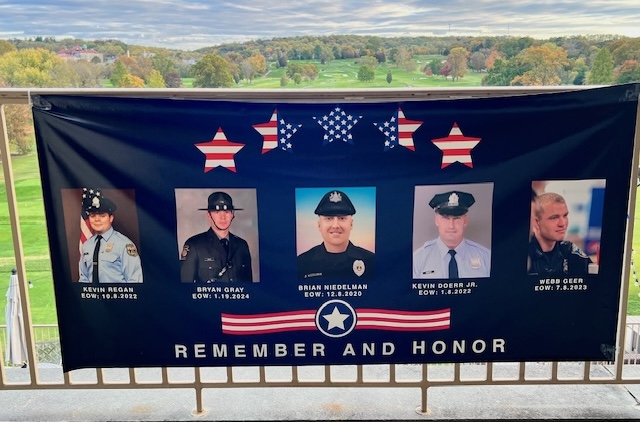
“There were no problems at home. We had a beautiful home. We had money. We had healthy, wonderful children. We have families that love us. We have friends that love us,” said Falk, who recently moved to Florida to be closer to her parents. “The only problem was the job.”
Supporters of Bryan’s Law hope the measure will pass soon. “When tragedy happens and someone is lost to the weight of trauma, we have a duty to support the loved ones of those who protected us,” State Senator Camera Bartolotta, who co-sponsored the Senate bill, said in a statement to The Trace. “If we cannot help these heroes before it is too late, we must at least make sure their families are cared for.”
Philadelphia takes note
In February, Philadelphia City Council’s Public Safety Committee held a daylong hearing to consider whether the City should classify first responder suicides as in-the-line-of-duty deaths.
Gray’s testimony received positive responses from Council members, but officials representing Mayor Cherelle Parker’s administration said a new City law is not needed because existing employee health and financial benefits are sufficient.
“I would say that we support individuals, but creating a line-of-duty death classification for these employees, we do not support that because we already have benefits for these employees,” Sharolyn Murphy, the City’s risk manager, testified.
She noted that, under current state law, the Workers’ Compensation Act precludes benefits for intentionally self-inflicted injury or death, unless certain criteria are met in a “chain of causation test” that establishes that the death resulted from workplace trauma. The test has led the city to pay only two claims in the past 41 years, the last in 1989, Murphy said.
Kevin Regan was one of five Philadelphia police officers to die by suicide in 2022, the most in recent years, according to data the Department provided to The Trace. There was one suicide in 2021, two in 2023, and none since then.
“It’s a significant issue, and I say significant because any time a department loses even one person it rocks the entire department,” said Susan Farren, founder and executive director of First Responders Resiliency, Inc., which works to combat post-traumatic stress with education and training programs.
“The No. 1 word that I hear from law enforcement isn’t depression or anger — it’s numbness,” said Farren, who supports efforts to reclassify first responder suicides as line-of-duty deaths. “They begin to stop feeling, and I believe that’s a big part to what could contribute to suicidal ideation — when you don’t feel alive anymore because you’re so worn down.”
The City estimates that the average cost to pay a suicide claim stemming from the death of a married police officer with two minor children would be nearly $1.7 million, and nearly $1.4 million for a firefighter.
Some Council members said the decision on whether the City should recognize first responder suicides as on-duty deaths should not be tied to costs. “I believe that whatever the cost is … when it comes to the mental health of our first responders, no number should be too high,” Councilmember Jim Harrity said. “These are the people that we count on every day.”
Mensah Dean is a staff writer at The Trace. Previously he was a staff writer on the Justice & Injustice team at The Philadelphia Inquirer, where he focused on gun violence, corruption and wrongdoing in the public and private sectors for five years. Mensah also covered criminal courts, public schools and city government for the Philadelphia Daily News, The Inquirer’s sister publication. MORE FROM THE TRACE