


Marie Gottschalk, the Edmund J. Kahn Distinguished Professor of Political Science at Penn, told the Chronicle of Higher Education that for 30 years she inspired her students “to practice careful writing and deep thinking, to develop nuanced arguments, to search books and articles for quotes that reflected the ideas they wanted to discuss.” None of these things, she believed, “lend themselves to a timed test.” But now because of students’ use of AI, she gives timed tests and requires that every piece of writing that students do, they do in class. “It breaks my heart,” she said. “AI breaks my heart.”
But there is hope for Gottschalk and other dedicated teachers right on the Penn campus. On October 6, the Graduate School of Education (GSE) launched the Penn GSE Living Laboratory for Human Agency and AI (Living Lab).
Planning for the lab goes back to 2024. Katharine Strunk, GSE dean since 2023, saw clearly that AI and the future of education were inseparable. An economist of education, Dean Strunk is not herself an expert on AI. As she said in an October 9 interview, “Technology breaks when it gets near me.” Nonetheless, she was committed to creating a research and teaching environment appropriate to the new AI world. So often, she says, vendors — those selling equipment — dictate the changes educators make. She is committed to “put education first.” To do that, she searched the nation for professors considered to be the top AI scholars in the country and hired them in tenure-track positions.
The Living Lab brings together educators and researchers with school system and industry partners to guide the future of AI in education. Designed not as a standalone center but as a network, the lab hopes to become a hub for innovation and collaboration on the future of learning. Its goal: Help educators and policymakers grapple with questions about the safe and responsible use of AI.
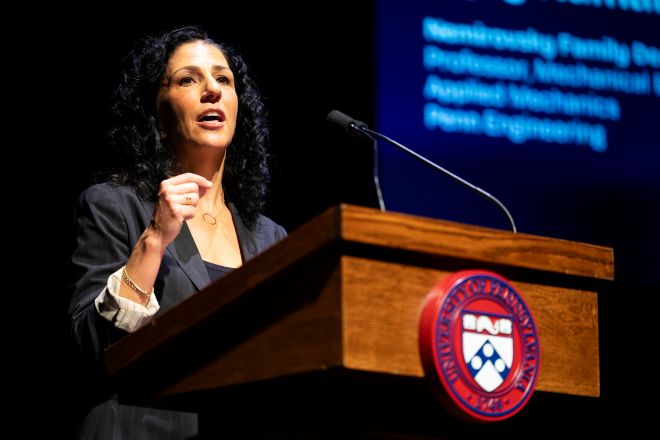
In the October 6 press release, GSE Associate Professor Bodong Cheng, founding co-director, along with Associate Professor Seiji Isotani, of the Living Lab, said, “Schools need more than predictions about what AI might do. We want educators and students to be the designers of AI in learning, not just users, and to build the evidence of what their designs make possible. That is how we keep learning human.”
The Living Lab has stated five priorities: people first; trust, safety, and ethics; practice-driven innovation; AI literacy and pedagogy; infrastructure for scale.
Even before the official opening of the Living Lab, GSE launched Pioneering AI in School Systems (PASS), a professional development pilot with the School District of Philadelphia (SDS). Funded by the Marrazzo Family Foundation, PASS provides opportunities for administrators, school leaders and teachers to consult with AI researchers on creative, innovative, and responsible uses of AI in classrooms. Betty Chandy, SDP Director for AI Initiatives, told The Philadelphia Tribune, “Not being afraid of AI, understanding how the technology works and knowing what’s under the hood are important so educators can feel confident about using it appropriately.”
Funding from Google has supported the expansion of PASS to New Jersey, Delaware, and other regions in Pennsylvania.
Why GSE’s AI work is important
The world has changed forever. We are in the midst of a revolution, far exceeding the industrial revolution of the 19th century, or, I would argue, any cataclysmic change since the discovery of fire. Our long-ago ancestors were wise enough to fear the destructive power of fire, but they also realized it was here to stay and they could figure out how to use it creatively to improve the human experience.
AI is not going away. We cannot and should not wish it away. That doesn’t mean we should support data centers’ consumption of energy at taxpayers’ expense or bend the knee to Big Tech and their co-conspiring politicians. What we can do is explore AI’s capacity to transform our own fields of endeavor in ways that will improve human life.
AI has the potential to be positively transformative in education, if we devote our energies to big systems questions. Reclaiming Purpose: the University in an AI World, by Paul LeBlanc with Tanya Gamby and George Siemens, is a guidebook to inspiring educational change made necessary by AI. LeBlanc writes about “the astonishing, puzzling, sometimes frightening world of AI and the opportunity to reinvent a model of education that felt to us increasingly broken, ill-suited for the new-world order, and out of reach of too many.”
The authors are right: Education must change from conveying information to “how we think about being human, in community, and in a world where we will coexist with knowledge machines far more powerful than we are.” Ever since facts have been available at the click of a key, we should have been moving away from education as information to education as understanding, wisdom, and action. We should also be individualizing education for learners’ differing needs. Some educators have made more progress than others in these areas. AI can help.
Tanya Gamby, the clinical psychologist working with LeBlanc, writes that AI may “free up time to teach and learn and interact differently — there will be more time for being human in a complex system, if AI is handling the mundane details, drafting our documents, doing our computation, etc.”
Some have already begun reorganizing curriculum and instruction to address this new reality. Internships and other hands-on experiences are essential. So is making sure that every college student graduates with a deep legacy of social capital — not only alumni connections but a compass for navigating professional and social worlds.
Like our brave ancestors who overcame their fear of fire to harness and use it creatively, we must use AI to transform ourselves into a more human world.
LeBlanc points out that historically Black colleges and universities have long been particularly effective in building social capital. I refer readers to Tayari Jones’ novel Kin for a stunning, although fictional, picture of how Spelman and Morehouse from their inception created social capital for their students and shaped Black upper-middle-class society in Atlanta and beyond. Colleges and universities today have much to learn from these examples.
In an AI world, effective education moves from the traditional classroom to the gym, art studio, stage, and laboratory — all places for team-building. Experience becomes more important than information. Already we see new, unexpected trends in employment. Natasha Singer wrote last year in her much-cited New YorkTimes article entitled, “Goodbye, $165,000 Tech Jobs. Student Coders Seek Work at Chipotle,” that the unemployment rate of recent computer science graduates is twice that of art history majors.
What are the jobs of the future in an AI world?
A savvy art history major may have done an internship with Alphabet exploring the next steps in AI, informed by the humanities. That sort of creativity will always be valuable — and employable.
As AI learns to better accomplish the tasks done in most white-collar jobs, and those jobs disappear, employment will remain, if not increase, in areas that require human interaction: health care and education. AI can provide excellent assistance in these fields, but only human beings can cuddle a crying baby and provide respectful, affectionate care for the elderly. Jane Goodall aside, only a human being can be a well-remembered and inspirational favorite teacher.
Right now our society has dangerous shortages in these human fields. We should start now to improve preparation for these essentially human professions — and treat them as professions, economically and socially.
Yes, that would be radically different, but it’s not utopian. It’s practical.
Like our brave ancestors who overcame their fear of fire to harness and use it creatively, we must use AI to transform ourselves into a more human world.
Note: As Paul LeBlanc says, “transparency in the use of AI is an ethical imperative.” I did not purposefully use AI in the writing of this article. I did Google topics like “AI, Penn, School District of Philadelphia,” and a BOT undoubtedly helped me to find relevant articles and information.
Elaine Maimon, Ph.D., is the author of Leading Academic Change: Vision, Strategy, Transformation. Her long career in higher education has encompassed top executive positions at Governors State University (IL), University of Alaska Anchorage, and Arizona State University West Campus, as well as distinction as a scholar in rhetoric/composition. Her co-authored book, Writing in the Arts and Sciences, has been designated as a landmark text. Her composition textbook, A Writer’s Resource (McGraw-Hill), is soon to be published in its eighth edition. She is a Distinguished Fellow of the Association for Writing Across the Curriculum.
 MORE FROM ELAINE MAIMON
