

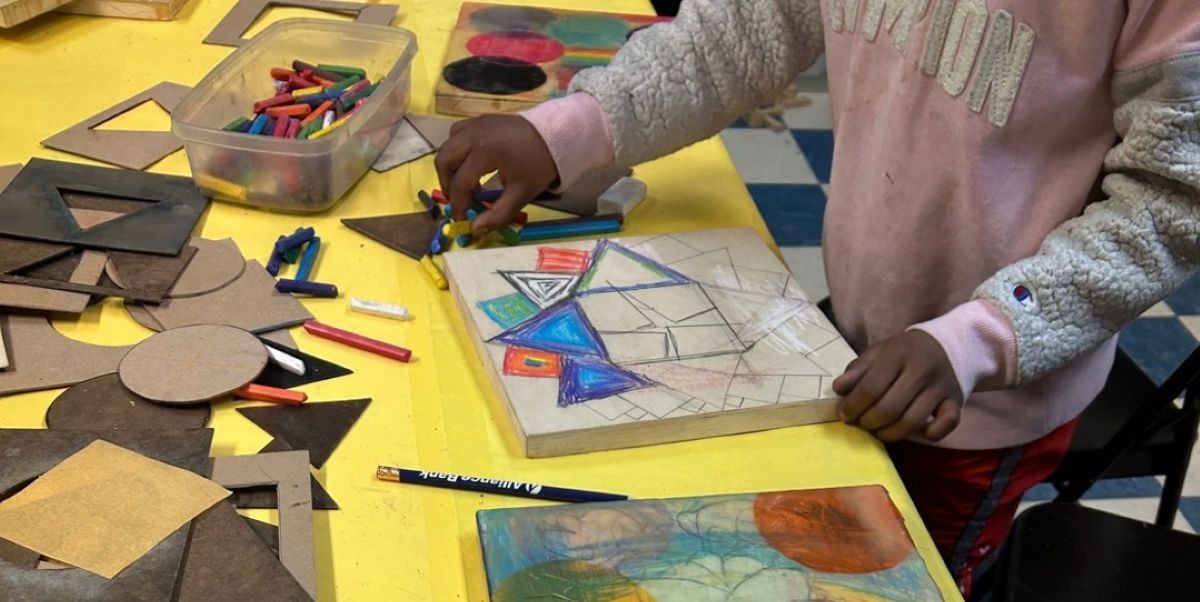


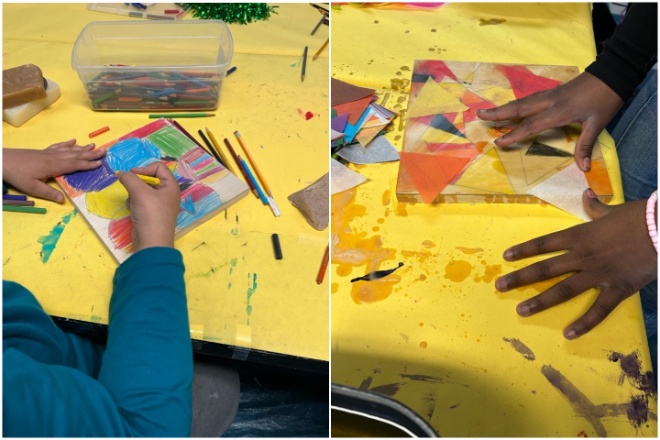
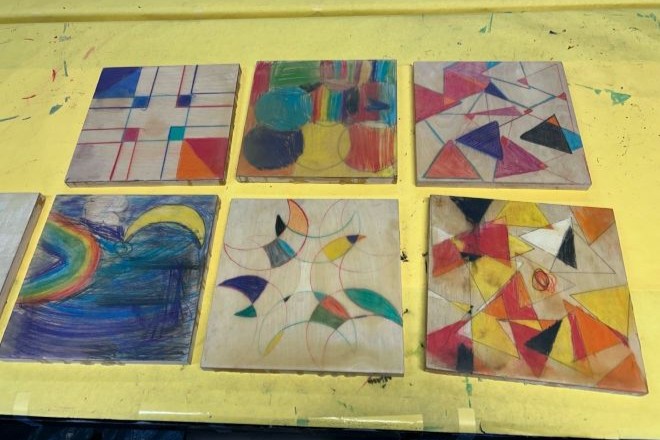
Warm beeswax melted into layers as middle school students taking part in a program at Roxborough’s Northern Children’s Services carved symbols into wooden panels, experimenting with colors, textures and shapes that held personal meaning. Teaching artist Tremain Smith hadn’t given the tweens and early teens specific instructions as to what their end goal is, only to take part in the creative process, in the hopes that the act of creating itself might spark inspiration or healing.
That scene, and 10 more like it, will soon return to Philadelphia after a long pause during the COVID-19 pandemic because of funding challenges.
From 1992 to 2020, the Center for Emerging Visual Artists (CFEVA)’s Hand-in-Hand Outreach Program paired teaching artists with children aged 2 to 17 who were facing housing instability, involvement in court-mandated programs, or limited access to arts education. The free workshops, held in shelters and social service settings like Northern Children across Philadelphia, provided a welcome opportunity to hundreds of — some years, more than 1,000 — Philly kids for whom art classes were all too scarce and all the more needed.
After a pandemic pause, thanks to a grant from an anonymous donor, the program is coming back, and hoping to stay. Philly kids, including the 1,044 who were removed from their home between October 2024 and October 2025; 2,421 who were living in dependent placement at the same time period, and 27 percent who live in poverty, have missed it.
Working Hand-in-Hand
For nearly 30 years, Hand-in-Hand operated on a mobile arts model, bringing short-form creative workshops into partner sites instead of operating as a fixed location, in order to meet their students where they were. Pre-pandemic, Hand-in-Hand operated approximately ten 10-week workshop series each cycle. While individual participants sometimes changed, the workshops were designed to provide a constant creative presence within those settings. CFEVA paused the program in 2020, in order to focus on other initiatives, including senior-focused community arts programming.
CFEVA’s executive artistic director Genevieve Coutroubis is very much looking forward to the program’s return. Incredibly unique in its flexibility and structure, designed around the realities of the communities it serves, Hand-in-Hand offers unusually fluid participation for youth who may not be able to attend all, or even more than one, workshop.
“It’s not cumulative the way other programs might be,” Coutrobis says. “You may have a young person who’s in a shelter or in a transitional situation one week, and then their family may leave and somebody else may come in.”
Hand-in-Hand workshops are also shaped by the backgrounds and artistic practices of the instructors leading them. One artist might focus on drawing. Another, like Smith, prefers more tactile, multisensory forms of expression.
“We ask the artist to really lean into their own practice when they’re teaching because I think it makes it more genuine, more fun,” Coutroubis says. “It’s much more about connecting the artist and their practice with the young people that we’re working with.”
Smith often introduced participants to encaustic painting, a technique that layers pigmented beeswax over wood panels. In her series with middle school students, Smith asked each student to choose a personal symbol to build layer by layer over several weeks.
She says the projects gave students room to experiment without worrying about creating something “right.”
“[My students] were really open to experiment and play with the materials,” Smith says. “There was no sense of needing anything to be a certain way. They were really open and present. It was really about engaging in a creative process and seeing where it took them.”
“It’s not cumulative the way other programs might be,” Coutrobis says. “You may have a young person who’s in a shelter or in a transitional situation one week, and then their family may leave and somebody else may come in.”
Over the years, the program partnered with 10 to 15 community organizations, including Northern Home for Children.
Happi Grillon, a social worker who currently leads Court Appointed Special Advocates (CASA) of Philadelphia, a nonprofit that serves and advocates for children in foster care, has worked in child welfare and nonprofit early childhood settings in Philadelphia for decades. She was running the Baring House Crisis Nursery program for children through Youth Service, Inc. (now HopePHL), where Hand-in-Hand held invaluable, flexible workshops for extremely young children.
“It’s just such an outlet to be able to express yourself in a way that’s not verbal … a new way that they maybe didn’t realize was possible,” Grillon says. She points out both children and adults took part and reaped satisfying benefits.
“A lot of people say, ‘I can’t make art,’ or, ‘I’m not an artist,’” she says. “But then the teaching artist comes in with materials and a project and a lesson that inspires them to be creative.”
The childhood benefits of art-making
Zab Johnson, executive director and senior fellow with the Wharton Neuroscience Initiative at the Wharton School at the University of Pennsylvania, says creative expression can provide children, especially children who’ve experienced trauma, with a way to community ideas and experiences that may be difficult to put into words.
Johnson points to a 2025 review of art therapy interventions that found evidence that such approaches can improve emotional well-being and reduce symptoms of anxiety and depression among children and adolescents.
“For children, this idea of empowering them to understand that there can be formal ways of making art, but also art as a means for communicating, or coming up with new ideas, or even just an outlet of having something fun to do with peers,” she says. “It’s a very natural process to them, and it’s less formal, less based on rules and structure. There’s a freedom to the creativity that I think is really empowering.”
Johnson also emphasized the communal nature for artistic expression. “I think there’s real joy in it. It doesn’t have to be a solitary enterprise.”
Next for Hand-in-Hand
As planning for the relaunch continues, Coutroubis says future iterations of Hand-in-Hand may draw from aspects of CFEVA’s senior arts initiatives, which focus on longer-term projects and sometimes result in permanent works displayed in community spaces.
The dream, says Coutroubis, is not just to reinstate Hand-in-Hand, but to expand it.
“The young people that we work with are incredibly creative,” she says. “When given an outlet to do the work, their creativity shines through.”
Grillon says it’s not just the kids who benefit. It’s their caretakers — and anyone who’s paying attention, really. Her favorite moment: When a child picks up their artwork and runs across the room, shouting, “Look, Mommy, I made this!”
 MORE ART FOR CHANGE