


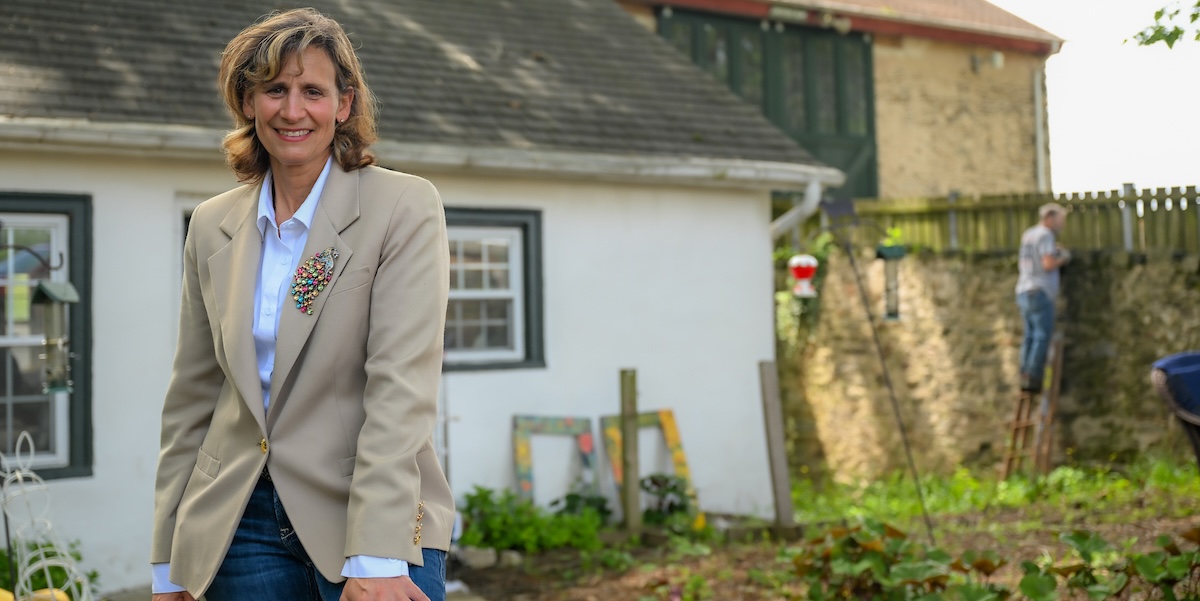


Dr. Mandy Manna expects Philly parents to raise an eyebrow when they find out she works in agricultural education.
Philadelphia is, after all, a city and — despite what Mayor Parker would like us to believe — we’re not exactly known for being green. Sure, we have our parks and a handful of urban farms, but they’re a far cry from the kind of industrial, corn-and-soy-bean-churning machines found in rural parts of the state.
But Manna knows there are plenty of career opportunities to be found on a farm. And as the principal and administrator for the Philly-based teaching farm, Fox Chase Farm, she’s seen her programs help students find jobs in ag, food science, trades, and other industries.
Agricultural science lessons help set up students to go to college and study STEM fields. Carpentry internships – building and repairing barns or installing new buildings on the farm – feed into apprenticeship programs. Other programs prepare them for culinary careers — and teach kids the importance of knowing where their food comes and spending time in fresh air.
In Manna’s 21-year tenure — first as a teacher and for the past eight years as principal — she has expanded the farm’s Pre-K-12th grade programming to include internships, special education classes, career and technical education pathways, and more.
Throughout, she’s remained a fierce advocate for students — applying for and winning $2.2 million in grants last year alone to expand the farm’s offerings. For her tireless and creative commitment to creating impactful learning experiences and career pathways for Philly students, Manna is one of this year’s Integrity Icons. She will be honored alongside her fellow winners during a June 3 celebration at the Fitler Club. (All are welcome and attendance is free, but you must register in advance here).
From hog farm to Philly schools
“We’re going to go for a ride,” Manna recalls her boss, Lincoln High School Principal Don Donnelly, telling her in 2006. Manna had returned to teaching after spending 10 years in marketing and agribusiness. Being an urban agriculture teacher, helping students learn about how food made its way to their tables and teaching them about career opportunities in agriculture, was her dream. She’d grown up on a hog farm near Gettysburg and studied agriculture education at Delaware Valley University.
But she’d struggled to find her footing at Lincoln. She was teaching science when the District came to her with a new plan for next year: Could she teach … English? At a different school?
Though she had the certification, Manna wasn’t interested. It felt too different from what she’d dreamed of doing. She was considering a return to her marketing career, when Donnelly asked her to go for a car ride with him. He’d brought in a substitute teacher to cover her class.
“I don’t think I even spoke more than two words on the whole ride, because it just seemed odd,” she recalls.
He wound the car through blocks of Philly rowhomes, onto tree-lined streets, until they arrived at Fox Chase, a 112-acre educational farm owned by the School District of Philadelphia, that straddles the line between Philadelphia and Montgomery counties. It’s one of two public school teaching farms in the city – the other is Walter B. Saul School in Roxborough — and they had an opening for an agricultural teacher.
It wasn’t a traditional teaching position, though; the farm doesn’t have “classrooms” or students who show up every day. Instead, she’d lead tours of the farm for elementary students, teaching them about the animals and about how the farm operates. For Manna, it was a perfect fit. She became principal and administrator in 2018.
The farm has grown from a field-trip-only operation that hosted 3,800 students each year to an operation with 16 academic programs, including farm therapy programs, educational field trips, STEM lessons centered around hydroponic growing and internships in welding, carpentry, culinary arts and more.
“I always say, everything happens for a reason,” Manna says. “All the challenges I’ve had to go through and try to figure out have always just led to more opportunity.”
Getting their hands dirty
When I visit the farm on a Friday morning in May, a bus load of preschoolers in green and pink rain boots tromp through the mud towards a sheep field, where they pet ewes and feed them grains out of their palms. Two high school special education students walk back from the chicken hutch after collecting eggs, which they will later wash and grade, either for sale or to send to culinary education programs around the city.
Manna arrives at the farm every day between 4 and 5 am. She spends the first few hours of her day catching up from the day prior, and getting set for the day ahead. Things change rapidly on a farm — a piece of equipment might arrive late or staff might need to delay planting a specific crop due to temperature swings. The farm has four full-time and 10 part-time employees.
“I feel extremely blessed in the opportunities that we can provide students when they’re here,” Manna says.
As principal, Manna manages both the production and the academic side of things. Her clothes embody that dichotomy: When I visit, she’s paired jeans and work shoes with a blazer and hot pink nail polish. She walks me through the farm’s fields and classrooms, talking animatedly about a “be a vet for a day!” lesson they had yesterday where elementary schoolers listened to bunny rabbits’ heartbeats and compared them to their own. We pass vermicomposting and hydroponic growing stations.
“All the challenges I’ve had to go through and try to figure out have always just led to more opportunity.” — Dr. Mandy Manna
Here, the lessons students learn aren’t just about growing food or raising livestock. Students learn about food science on the farm. Those who complete internships in the cafe and the store learn how to read profit and loss sheets.
“This farm provides tremendous opportunity for all levels of learners,” Manna says.
Manna has an indefatigable, Leslie Knope-esque energy. When she’s not on the farm with students, she is meeting with PA Secretary of Agriculture Russell Redding, elected officials and USDA employees to talk about careers in agriculture — and potential pipelines she can build for students.
“She is the unique combination of educator, coach, mentor and entrepreneur, and she leverages all of those attributes — regardless of the circumstances —every single day to the benefit of the students and families in Philadelphia,” says Oz Hill, deputy superintendent of operations for the School District of Philadelphia. “Not only does [the farm] touch on agricultural education, but it integrates sustainability environmental education, as well as many of our CTE disciplines. … I’m not certain that there is another work stream or instructional stream within the district that reaches as many students as she does throughout the year.”
She’s constantly expanding the farm’s lessons and educational programming. If she has an idea for “a program that she wants to bring to a school that she feels would benefit children … she’ll go out and seek the financial resources,” says Dr. Anh Nguyen, assistant superintendent for Learning Network 15 at the School District of Philadelphia. “She’s the grant master queen.”
You can’t measure joy
Principals across the District say that test scores — especially in science — increase with consistent visits to the farms. Waring Elementary sends fourth and eight graders weekly and reports an 11-point increase in test scores. Manna says that they see 100 percent attendance from the 50 to 75 students who have internships each summer — and that the students always arrive early.
Manna is good at rattling off the quantitative measures of the farm’s success, but what isn’t as easily measured, she says, is the joy the farm brings Philly students. She often sees students rolling down hills, petting goats, delighting in finding a worm in the garden.
“I have some teachers who, when they come up for a field trip, say, Can we reserve time just to sit on the grass?” Manna says. “I’ve gone into schools where I see that they don’t have grass! They don’t have trees.”
Spending time outside is linked to a whole host of health benefits: reduced stress, anxiety, and depression, better sleep, improved heart health, and an immune system boost. The students who come to Fox Chase Farm get to reap all these benefits — and it creates lasting memories.
“Students who come back as adults — who I would have had as little kids — are like, I remember when you taught us,” Manna says. “There’s an appreciation that the students feel when they’re coming here.”
Nationwide, young people have reported increasing struggles with mental health, including increases in the prevalence of anxiety and depression. Blame social media, the lingering effects of the pandemic, hyper-competitive college admissions, the general state of the world — or any number of other factors. There’s a lot stressing kids out these days.
Philadelphia students deal with additional stressors and traumas on top of all that considering our poverty rate, hovering around 20 percent. Homicides are down 39 percent compared to last year, but the city has still had 200 nonfatal and 43 fatal shootings in 2026. When students, their friends, or families are impacted by violence it creates lasting trauma.
Fox Chase Farm’s equine therapy program, using the farm’s donkeys, hopes to make a small impact on students dealing with trauma. Students in the program work with psychologists and the animals to hone social-emotional skills. It’s resulted in reduced suspensions, an 85 percent improved attendance rate, and fewer instances of mental health referrals for participating students.
“It’s pretty impactful,” Manna says. “Here, [students] feel a release.”
A model for the state?
Manna plans to continue supporting and advocating for Philadelphia students. Her team is in the process of planting a new garden (they’ll have strawberries this year!), building a new barn, and launching Maple Leaf Cafe, which will provide internship opportunities for culinary students. She’s working on a program that would bring hydroponic growing to schools that have open space.
She has new dreams for the farm, too. Philly has a host of new Michelin Star and recommended restaurants — if her plans to scale up mass growing in Philadelphia schools come to fruition, why can’t students help provide them produce? (She also hopes the produce they grow will go directly into schools). She’s also searching for grants to fund horticulture and woodland therapy programs since, in addition to the farm animals, the farm has a wide range of wild creatures and plant species.
Long-term, she has her eyes set on a project that’s a little bit bigger: expanding these opportunities to students across the state. PA has more than 6,600 preserved farms — and a dwindling number of farmers; what if we created more educational farms, like Fox Chase?
“You can take any one of our city schools and you can put them up against the most rural schools in Pennsylvania, and you’re going to find similarities,” Manna says. “You’re going to find food deserts, food insecurity. You’re going to find test grades to be identical. You’re going to find the same issues.”
She’s working with leaders in other school districts to show them the success Fox Chase Farm has had.
“How can we help communities flourish? How can we help support that career pathway for students? And how can we help them see the bigger picture of what’s out there? We can do it all through ag.”
 PREVIOUS INTEGRITY ICON CELEBRATIONS