

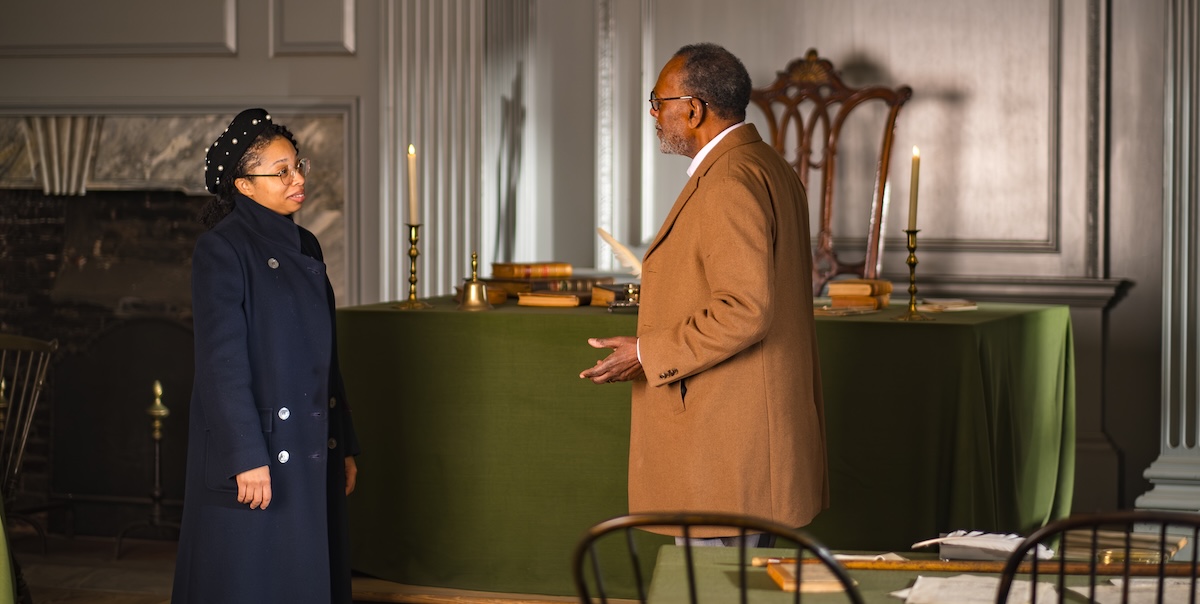


During a concert in Chris’ Jazz Cafe in Center City, a trombonist, saxophonist a drummer are awash in blue light.
There’s a run on the sax, a few piano chords. Over the music, a woman reads “The Grave of the Slave,” an 1831 abolitionist poem by Philadelphian Sarah Louisa Forten Purvis.
The poem is one of America’s earliest protest songs. During its era, the Black musician Francis Johnson set it to music. Johnson performed for white audiences, including at a ball in 1824 in honor of Marquis de Lafayette, the last surviving general of the American Revolution. The group at Chris’ performs a rendition of Johnson’s work as well.
The scene is from the new documentary Becoming American: Philadelphia’s Story. The film, spearheaded by Philadelphian Oliver St. Clair Franklin, explores the history of Black Americans during Philadelphia’s early days.
In doing so, it explores Philadelphia’s social history, and considers the lives of everyday people — and how they drove and were impacted by the Revolution and early Independence.
A different kind of 250 project
St. Clair Franklin, the film’s creator and executive producer, has “had an itch” to make a project for America’s 250th. A businessman, former deputy city rep for arts and culture, and at one time Philadelphia’s chief British diplomat, he’d gotten into film work when he was working with Penn Annenberg Center.
He wanted to create a film on the Revolutionary and early-American era that “left Independence Hall” and considered the roles of ordinary people, especially Black Americans. He’d watched more than 65 films during the research phase of the documentary and was struck by how nearly all of them “never went into the streets. They never talked about what was going on in Philadelphia during this. What was the social history? How many people were there? How many languages were spoken?”
How are we continually working to make America a more equal nation, in an attempt to make the ideal — all men are created equal — true for everyone?
“I was thinking about how do we create a film that can travel throughout our region to start a conversation about Philadelphia’s history and civic responsibility? Because these Africans participated in public life, they took their civic responsibilities seriously,” St. Clair Franklin says.
He was part of an Oxford University-made film on the slave trade. Through that project, he connected with the film crew at Bear House Media, a UK-based production company He then partnered with a number of Philly institutions — Mother Bethel AME, the Museum of the American Revolution, the Pennsylvania Historical Society, and numerous historians and archivists.
Students from Moore College of Art and Design got to work with the production team in the UK on some of the art scenes. Students at the Community College of Philadelphia, under the supervision of musician and producer Professor Paul Geissenger, worked on the sound design, voiceover recordings and in mixing an original score by New Jersey-based musician and Grammy Award-nominated songwriter Christopher Michael Stevens.
“We’re bringing in a lot of local talent,” St. Clair Franklin says.
A tale of two fires
The film traces Philadelphia’s history from William Penn’s arrival in 1682 to the Civil War. Along the way, it considers interactions between the Quakers and the Lenni-Lenape; the roles Black people, both freed and enslaved, played during the American Revolution; the 1793 Yellow Fever epidemic; the Haitian Revolution and Philadelphian’s responses; and Pennsylvania’s 1838 state Constitution, which ended voting rights for Black men in the Commonwealth.
Two notorious fires bookend the narrative: the 1666 Great Fire of London (which influenced Penn’s vision for how to plan a safer city in Philadelphia) and a mob of White, anti-abolitionist men’s burning of Pennsylvania Hall, home of the Pennsylvania Anti-Slavery Society, in 1838. It considers James Forten, a Black patriot and Philadelphia businessman who supported American Independence and rallied Black troops to fight in the war of 1812. (Forten’s daughter wrote the poem featured in the scene at Chris’.)
St. Clair Franklin acts as the viewer’s guide, taking them through archives in the Independence Seaport Museum, the University of Pennsylvania and the Pennsylvania Historical Society and out into the streets of present-day Philadelphia: cyclists popping wheelies, men fishing on the Schuylkill, people partying at Odunde, SEPTA buses passing our Mural Arts murals.
The juxtaposition of our current moment against this narrative from the past asks views: How did the Revolutionary era shape America today? How are we continually working to make America a more equal nation, in an attempt to make the ideal — all men are created equal — true for everyone?
“I didn’t choose this project. This project chose me. We want Philadelphians to understand that they’re living in the middle of all this.” — Oliver St. Clair Franklin
“We learn so little about the African American community during the Revolutionary era — and even before leading up to it,” says Dr. Kelli Barnes, a historian who is featured in the film. She is wrapping up an ACE Mellon Humanities Postdoctoral Fellowship, which stations PhDs at National Park Service sites.
“The Declaration of Independence and later the Constitution, really did not have them in mind, but they took it upon themselves — taking in those words — to do what they could for themselves and their communities to uplift themselves out of enslavement and to gain and right the vote.”
How to watch Becoming American
The film comes at a time when the federal government is actively trying to erase the stories it’s telling. In February, the National Park Service removed the “Freedom and Slavery in the Making of a New Nation” from Independence Mall. (After the City of Philadelphia sued, the exhibit was restored.)
But even before that removal — which resulted in public outcry — they’d been shutting down historical projects. Barnes, who’d been working on digital archive of primary sources focused on early Black Philadelphia at Independence Hall, lost her grant funding in April 2025, at the behest of the Trump administration. The project had been intended to support the School District of Philadelphia’s African American Studies courses. Barnes then became a volunteer historian for the Independence National Historical Park.
“It was to coincide with the curriculum development … for the 250th, for the School District celebrating their 20th anniversary of African American studies being a graduation requirement, and for it being the 100th anniversary of Black History Month.” she says.
“I didn’t choose this project. This project chose me,” St. Clair Franklin says. “We want Philadelphians to understand that they’re living in the middle of all this.”
St. Clair Franklin is hosting a local premiere of the film with WHYY at the Philadelphia Film Society on May 12. Studio 2 host Cherri Gregg will moderate a panel discussion with the filmmakers afterwards. You can also tune in to watch the film a few weeks later on when it airs on WHYY-12 on May 28. It airs nationwide (and becomes available for streaming via PBS) on June 15.
 MORE PHILADELPHIA HISTORY TO EXPERIENCE