

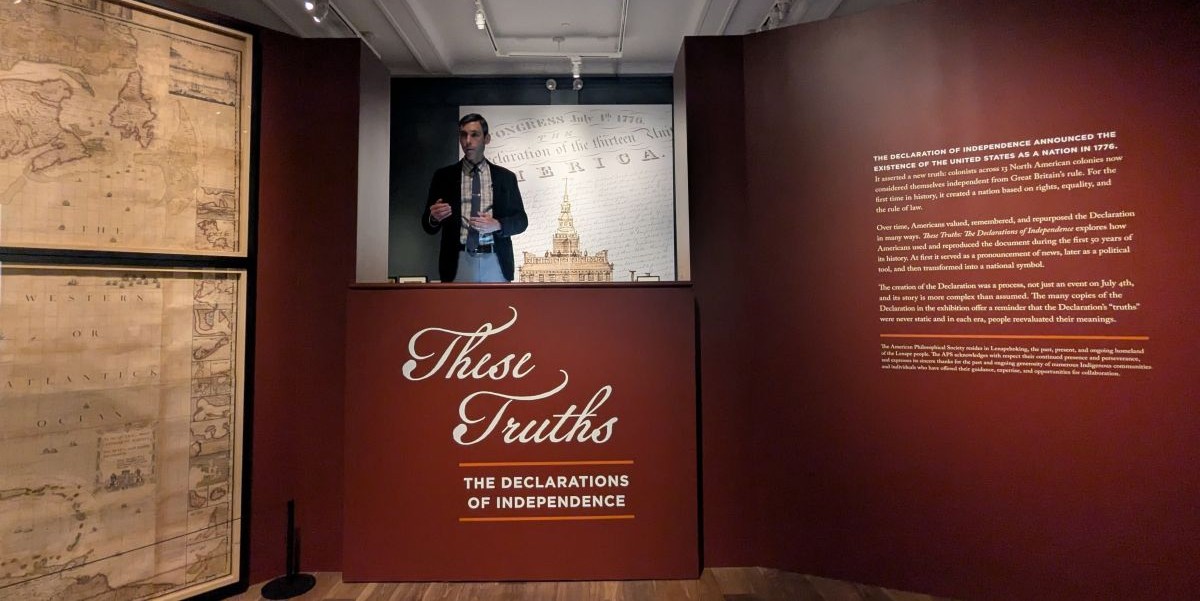


Walking into The American Philosophical Society Museum’s dimly-lit first-floor gallery, you are confronted by an eight foot square map of North America, purchased by Benjamin Franklin and hung in Independence Hall during the Second Continental Congress. The Popple Map, as it’s known, has been lovingly restored for its third ever appearance in public. To its right is the exhibit title in decorative script, These Truths: The Declarations of Independence. The title panel is just chest high, and behind it is a platform that evokes the stage that was set up in Philadelphia on July 8, 1776, when the Declaration of Independence was first publicly read to thousands of people gathered in what is today Independence Square.
Dr. David J. Gary, associate director of collections, welcomed the first guests at the new exhibit’s opening standing on that platform. “The Declaration is a process, we argue,” he said. “It’s not a singular event.”
That is the central theme of the new exhibit which opened at the American Philosophical Society (APS) this week, exploring the first 50 years of the document’s existence and how it transformed over that time. From the Revolutionary War into the Early Republic Era, the Declaration started as a state document printed and copied to spread the news of the rebellion, became a political tool in the midst of a fight over its creation between Jeffersonian Republicans and Hamilton’s Federalists, and eventually, turned into a unifying and essential element of our American identity.
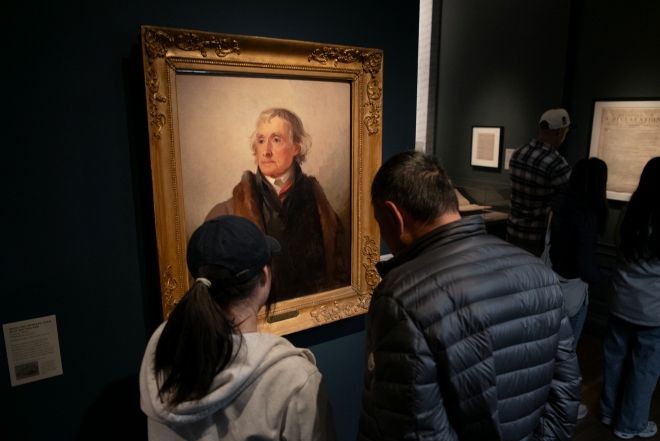
It takes balls of steel and a remarkably prescient understanding of the history they were making to begin a letter notifying the King of a revolt against him with the sweeping, weighty statement, When in the course of human events… Most of the men we call the Founding Fathers were younger than 40; Jefferson was just 33 years old when he penned the Declaration of Independence. Multiple early drafts and first printings on fragile paper, complete with notes, were saved for posterity. The official document that sits in the National Archives today was printed on expensive parchment, meant for long-term preservation, but so were many other early copies intended for saving into the future. They knew to hold on to these documents, that they would represent something far greater.
As Gary says, “They knew they did something very important.”
Say this next part with me, because we all memorized it in elementary school:
We hold these truths to be self-evident, that all men are created equal, that they are endowed by their Creator with certain unalienable Rights, that among these are Life, Liberty and the pursuit of Happiness.
In 1776, readings of the Declaration took place all over the country. Messengers carried copies to read out loud from horseback, from stoops of town halls, from balconies, from a particularly tall set of stairs. The reading of the Declaration in Philadelphia was a unique affair, as thousands of people were in town for elections, and this was the seat of power for the rebellion. After John Nixon, a Lieutenant Colonel in the Philadelphia militia, finished reading, bells ran out across the city into the night, and Philadelphians set an early precedent for how they celebrate.
A multitude of documents
“Declarations” is not a typo. There are 49 objects in the exhibit, and 19 of them are copies of the Declaration. They believe it’s the largest public display of early Declarations ever exhibited.
A highlight of the exhibit is a well worn, badly faded handwritten paper draft dated July 8, 1776, annotated by Virginia delegate to the Continental Congress Richard Henry Lee and his brother, diplomat Arthur Lee. In this draft, Jefferson denounced the slave trade and King George III’s complicity in what he called a violation of “life and liberty,” and a “cruel war against human nature itself,” though he stopped short of saying slavery would not continue in the new nation.
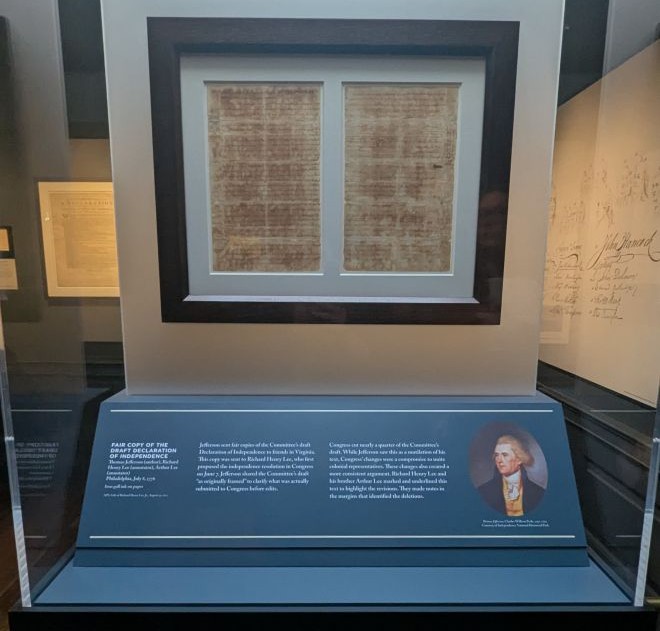
This passage was removed, of course, to ensure unanimous support for independence, foreshadowing the “compromises” made in the future Constitutional Convention of 1787 that ensured slavery would endure in the United States, at least for a time. It’s an example of the contradictory nature of our nation and Jefferson himself, who gave us the language to fight slavery later on, but over the course of his life enslaved over 600 human beings.
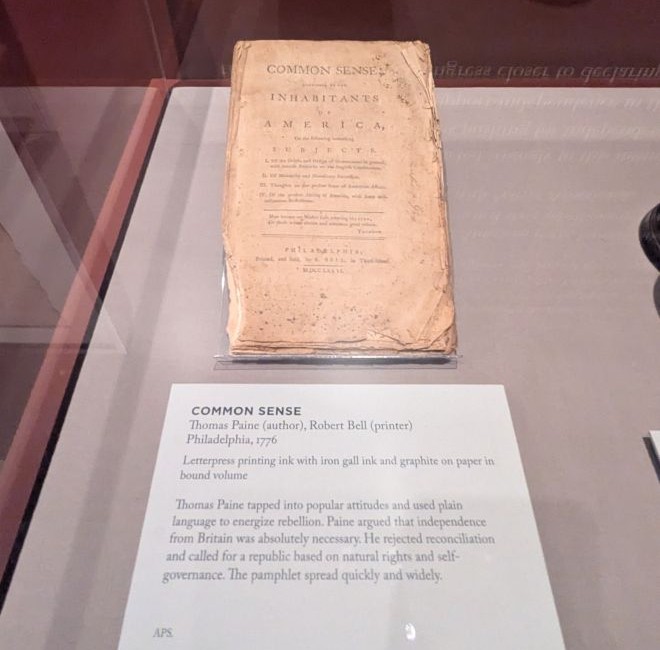
Other fascinating pieces include the proclamation from King George III declaring the colonies in rebellion against the crown, and the Continental Congress’s response. There’s a blank invitation printed by Benjamin Franklin to his July 5, 1779 Independence anniversary party in France. One of my personal favorite items in the collection is a 1776 printing of Thomas Paine’s Common Sense.
There’s a copy of Washington’s Farewell Address, first published on September 19, 1796. His words set our two-term precedent for the presidency, and famously warned against “foreign entanglements.” This copy, printed in 1810, was bound in a volume with a copy of the Declaration, as by this time they were becoming twin symbols of national unity.
“The Declaration changes over the first 50 years, and the way we’re talking about that change is through the many different copies of it.” said Gary. “It was not always the sacred text Americans view it as today.”
The War of 1812 was hard-fought; a difficult win. Our capital was burned, and in that conflagration we almost lost our founding documents. But we defended ourselves, again, a fledgling nation against the British Empire. What followed was our first post-revolution wave of nationalism. Americans reassessed the Revolutionary War and the Declaration of Independence as those veterans passed away and few signers still lived. Both Jefferson and John Adams died on July 4, 1826, also the country’s 50th birthday, signaling the end of the era of our Founding Fathers. With their passing, the people of the United States now owned the Declaration, and it was up to us to decide what it was about.
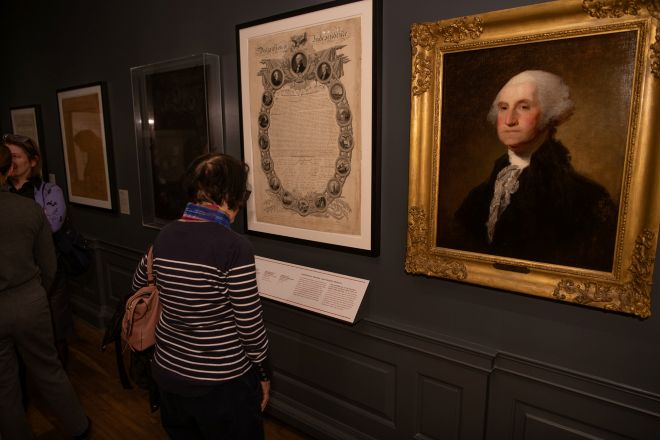
It is in this period that huge, ornate prints were created, a celebration and acknowledgement of the place in our national identity held by the Declaration of Independence. In 1819 the APS loaned John Binns, an Irish-born Philadelphia publisher, the famous portrait of Washington painted by Gilbert Stuart in 1797 to use in his extra large print of the Declaration. He rendered the text in calligraphy, surrounded by illustrations for each of the 13 colonies and the portraits of Jefferson, Hancock, and Washington. You can see that print and the copper plate used to create it in the exhibit.
The American Philosophical Society Museum
The APS was founded in 1743 by Benjamin Franklin and other “like-minded, enlightened figures,” according to Mary Grace Wahl, the museum’s associate director. Four of the five members of the Declaration’s drafting committee were members of the APS, including Adams, Franklin, and Jefferson, who was the APS’s president from 1797 to 1814. Fifteen APS members were among the Declaration signers. The APS Museum, which celebrates its 25th anniversary this year, welcomes 150 to 200,000 visitors annually.
The “stage” design of the entryway into the exhibit is also a nod to the role APS played in advancing what would become known as the American Enlightenment. In 1769, the APS joined an international effort to observe the transit of Venus across the sun, which occurred on July 3 that year. In addition to determining our distance to the sun and learning whether Venus had an atmosphere, the data points from around the globe finally allowed the calculation of longitude, essential for accurate maps and ocean navigation. This astronomical event happens twice, eight years apart, once every century. The previous opportunity was in 1761 during the Seven Years War, and scientists did not get the data they needed. So, the APS built an astronomical observatory in the Pennsylvania State House yard. Scientists achieved the precise observations of Venus needed, and established America’s place in science history. (If you want to know more about this quest for longitude and APS’s role in it, there is an excellent three part series by the podcast The Constant called Long Story Short.)
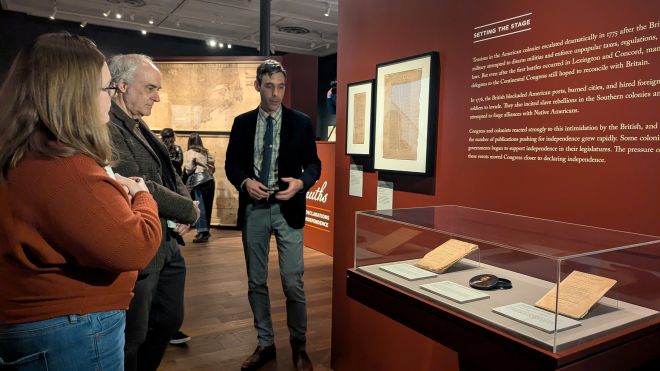
Among the thousands of historically significant artifacts, the APS holds one of the largest collections of copies of the Declaration of Independence in the country.
“It is fitting, then, that the APS Museum has mounted this exhibition drawn almost entirely from its own collection, which brings together these extraordinary versions of the Declarations for the first time in one room,” Wahl said at the opening.
Each copy of the Declaration tells a different story about the founding of our country: The demand for civil rights, rebellion against tyranny, enlightenment, war, unity. It is up to us to consider and interpret the history and ideals it represents 250 years later and into the future.
“Our politics are fraught, for a lot of different reasons now, and I think what this allows us to do is come together and have a conversation, or think about it,” Gary says. “And… maybe not. It might not change the world but I think this is a moment where we can all stop and take a break and think about something a little bigger than ourselves.”
These Truths: The Declarations of Independence is on exhibition at the American Philosophical Society, 104 S. 5th Street, through January 3, 2027. The museum is free and open to the public Thursday through Sundays from 10am to 5pm and also on Wednesdays between Memorial Day and Labor Day.
 MORE PHILLY HISTORY FOR THE SEMIQUINCENTENNIAL