




The adage Everybody has a story to tell? It’s true.
The cliche Don’t judge a book by its cover? Also true.
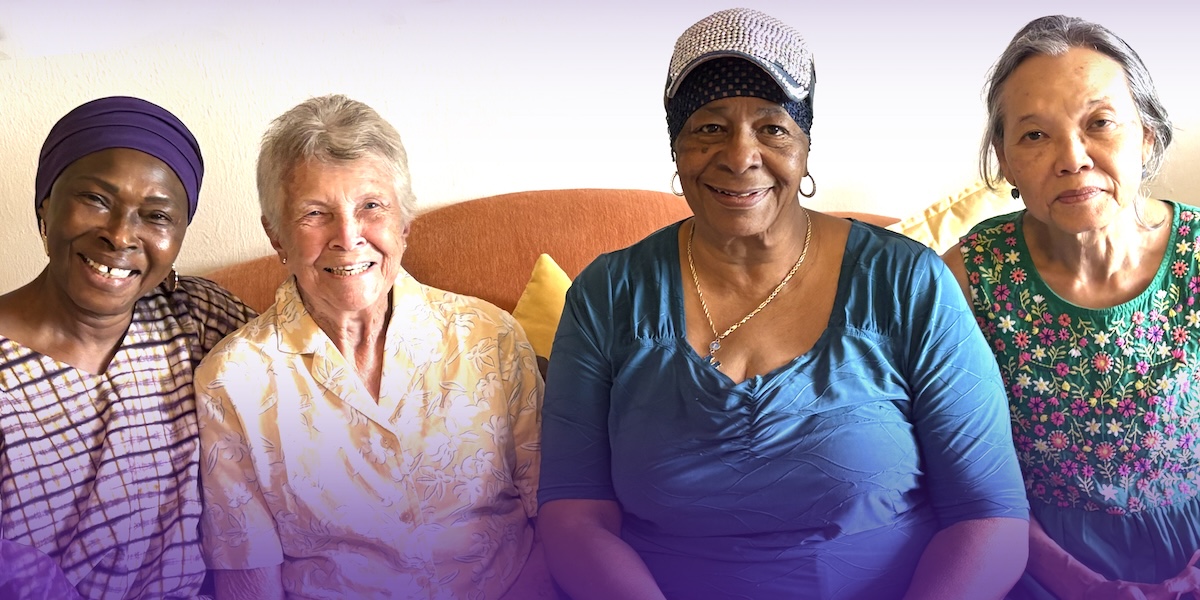
Consider Jean Coyne, 86, one of the six stars of GrandWomen, an upcoming Theater of Witness production during which the actors ranging in age from 69 to 86 share personal stories and life lessons via a half dozen original monologues that challenge the idea of older women as uniformly demure, soft-spoken, well-behaved and weak.
Coyne, a petite, white-haired woman, was expelled from kindergarten for talking and arrested at age 10 for leaving home with a friend because “I wanted to see what the world was like,” she says.
She worked as a singer, a cab driver, and a bartender before becoming a criminal defense lawyer whose clients were often on death row.
The message she hopes her monologue will convey?
“Life is hard, but it can be a blast,” Coyne says. “You’ll have a lot of fun, but know you’re gonna make mistakes. If something doesn’t work, try something else. Be kind to each other. Don’t take a million years to forgive yourself for your mistakes.”
Every Theater of Witness production — including GrandWomen, at the Suzanne B. Roberts Theatre from June 11 through 13 — and its founder, Teya Sepinuck, aim to “humanize ‘the other’ and bring people together across divides of differences,” as its website notes.
Because while each person’s story is unique, each is also relatable. During one open GrandWomen rehearsal, an observer commented, “Every story is my story.”
“In the end, we all have the same questions: How do we live a good life?” Sepinuck asks. “How do we stay resilient? How do we stay open? How do we keep growing? How do we love?”
In addition to Coyne, the cast includes: Kim Nguyen, 69; Tiguida Kaba, 71; Hilda Campbell, 76, Sheila Peltz Weinberg, 80; and Judith Palmer, 80.
Sepunick launched Theater of Witness in 1986 to tell stories of people whose voices aren’t often heard. She’s produced at least one show per year since, save for the few years she did the same work overseas. One past production offered stories from people with dementia, their caregivers, and their doctors. Another featured victims and perpetrators of domestic violence.
Last year’s Theater of Witness production, Cleaning in the House of Healing, shared the stories of six people with hospital cleaning jobs. They talked about the pride they take in their work, the relationships they build with patients and visitors, and how they sometimes feel unseen by other hospital staff.
Sepinuck screened a film version of the production for students and staff at Rowan University’s Cooper Medical School and the University of Pennsylvania’s Perelman School of Medicine. After the viewing, a Perelman doctor sent Sepinuck a letter praising the show because it “makes us the viewers rethink how we look at the people around us every day, doing the dirty work but thinking and feeling everything around them … No one who has seen this comes away untouched.”
Perelman has now made viewing the film part of their second-year curriculum.
Sepinuck thought last year’s production would be her last. At age 75, it felt like time to ease her workload.
Then Campbell, who has appeared in two previous Theater of Witness productions, asked if Sepinuck would consider a show about the effects of gun violence. Campbell’s grandson, Jamar, was 20 when he was shot and killed in 2020.
”There are heartbreaking stories in this, but the focus is really on resilience and love and being full of life at an older age.” — Teya Sepinuck
Sepinuck says she hesitated as she’d done shows themed around violence before. But then she started thinking of Campbell’s story, as a grandmother, and her life experiences. That morphed into a production featuring grandmothers from different backgrounds sharing their wisdom and advice and detailing how they’d survived difficult times. In a modern age marked by division and animosity, it was the production the world — at least, Philadelphia — needed.
In the 15 minutes it took Sepunick to drive from her home to an appointment, she had a plan for The Grandmother Project, and was excited to get started. (She also conceived of two other projects involving younger women and is now booked through 2028.) She later changed the name to GrandWomen so as not to exclude women without children or grandchildren.
“You don’t have to have grandchildren to be a grandwoman,” she says.When Sepinuck is putting a show together, she first spends hours interviewing the potential actors. She then writes individual monologues based on those conversations. GrandWomen’s Peltz Weinberg says she felt so comfortable speaking to Sepinuck that she revealed stories of her past she hadn’t intended to, including a past struggle with alcohol abuse Now she’ll share them from the stage.
“One of the lessons I’ve learned in life is that you need to look inside in order to look out. You can’t just look out and you can’t just look in,” says Peltz Weinberg, a rabbi. “And at every age, we’re all works in progress.”
Some of the stories in GrandWomen include painful losses, mental and physical challenges, addiction and violence. Kaba talks about being forced to leave her home in Senegal because of the stigma she carried as a divorcee. Nguyen speaks about arriving in the U.S. at age 17 on the first U.S. Army transport plane leaving Saigon during the war in Vietnam. Palmer shares her story of being LGBTQ community when most people shunned the community.
”There are heartbreaking stories in this, but the focus is really on resilience and love and being full of life at an older age,” Sepunick says.
Mary Hurtig, a supporter of Sepinuck’s work and a Theater of Witness fan since its first production in 1986, says Sepinuck’s work is unique and her shows thought-provoking.
“They’re so raw. They’re so honest. Whatever the topic, (Sepinuck) chooses people whose life stories are remarkable to behold,” Hurtig says. “Anybody who’s ever seen a Theater of Witness piece remembers it or remembers being moved by it.”
Hurtig has enjoyed every production she’s seen — most likely every one produced in the U.S., so at least 30. She’s looking forward to GrandWomen for personal reasons: She’s a grandmother and served on the Mayor’s Commission on Aging in the 1980s.
But audience members don’t need connections to the subject matter to benefit from the show. Hurtig still talks about 2002’s Living with Life, a production featuring men incarcerated at SCI Chester that led to some prison reforms.
“That one is the most profoundly imprinted on my brain,” Hurtig says.
One message Sepinuck hopes audiences take away from this show specifically: It’s never too late to try something new. Discounting summer camp plays and school performances, all but one of the GrandWomen actors are making their stage debut in this production.
Sepunick notes that it’s not easy for the most nimble-brained actors to memorize monologues and to be aware of where and when to move on stage. It’s more challenging for older adults — and more challenging still for those who have never done it before.
But with time, and a lot, a lot of rehearsal, Sepunick thinks her six stars are ready.
“Their willingness to open up to something new and something hard and something vulnerable, and to do it with such integrity, is really very moving to me,” Sepunick says. “I know my story is in all of their stories because we’re all so interrelated.”
GrandWomen will be performed at the Suzanne B. Robert Theatre, 480 S. Broad Street, from June 11 through 13. Tickets are $55, and $35 for students and seniors
 MORE CITIZEN RECOMMENDS