

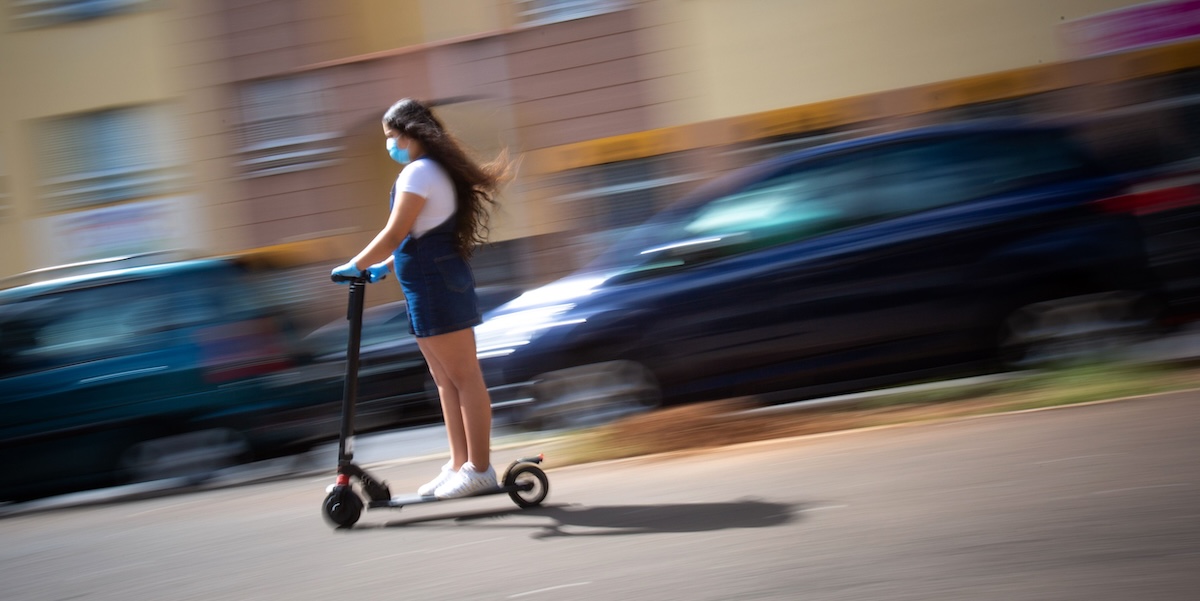


On a summer day in Delaware County last year, 12-year-old Abigail Gillon and her best friend were riding an electric scooter together when they fell into the road and were struck by a car. Abby tragically lost her life. Her friend survived with serious injuries.
Stories like Abby’s are becoming more common.
At pediatric trauma centers like Children’s Hospital of Philadelphia and St. Christopher’s Hospital for Children, clinicians are seeing the consequences of rising e-bike and e-scooter use among children and teens in real time. Research led by CHOP analyzing national injury data has documented a sharp rise in injuries linked to e-scooters and e-bikes among children, including a more than 70 percent increase in recent years.
E-bikes are heavier than traditional bicycles and can reach speeds of up to 28 miles per hour. They accelerate quickly and are often used in traffic. For younger riders without experience navigating city streets, the margin for error is small.
The scale of this problem is growing quickly. National data shows that children ages 14 and younger accounted for about 36 percent of micromobility-related injuries between 2017 and 2022, despite making up only about 18 percent of the U.S. population. These are not minor injuries either. Compared with traditional bicycles, e-bike crashes are more likely to involve motor vehicles and result in more severe outcomes, including traumatic brain injuries, intensive care admissions, and long-term disability.
One of the most concerning patterns is how rarely children wear helmets. In Philadelphia, helmet use is required for children under 12, but not for older adolescents, even as they ride faster and more powerful micromobility devices. National data show that fewer than half of children consistently wear helmets, and use declines sharply during the teenage years. This leaves many of the highest-risk riders with the least protection.
There are also important equity considerations in a city like Philadelphia. Not all children use e-bikes in the same way. For some families, they are recreational. For others, they are a practical way to travel short distances across neighborhoods not easily served by direct public transit routes.
E-bikes and e-scooters are here to stay. The question is whether we will act quickly enough to keep children safe.
At the same time, safety resources are not always equally accessible. While basic bicycle helmets can be relatively inexpensive, higher-quality or full-face helmets that offer more protection at higher speeds can cost significantly more, creating a real barrier for many families. Helmet design matters too: Most options don’t easily accommodate certain hair types, styles, or religious head coverings, which can make consistent use more difficult. When safety is harder to access, risk increases. Safety efforts will only work if they are practical and accessible for the families expected to use them.
As a medical student training to care for children, I see this as a preventable public health issue.
Abby’s death prompted the introduction of Abby’s Law (SB1008) in Pennsylvania, an effort aimed at strengthening safety protections for young e-bike and e-scooter riders. The legislation proposes the following:
-
- A minimum age for riders — age 16.
- Requirement for helms for 16- and 17-year-old riders
- Statewide speed limit of 20mph for e-scooters
- Prohibition of multiple riders on e-scooters not designed for more than one person
- Requirement that e-scooters follow bicycle traffic rules
- Requirement that PennDOT develop and distribute public education materials focused on e-scooter, pedestrian, and bicycle safety for both riders and drivers
- Requirement that e-scooter sellers give buyers written safety notices
While no single law can prevent every tragedy, the growing attention to this issue reflects an important reality: These devices require clearer safety expectations, better education, and stronger community awareness.
Parents and caregivers can start with simple but important conversations at home. Understand the type of e-bike or e-scooter a child is using and how fast it can go. Set clear rules about where and how it can be ridden. Sit down with your child and reinforce basic traffic safety, including stopping at intersections, watching carefully for cars and pedestrians, and riding with the flow of traffic. Children and teens should avoid carrying passengers and practice skills like braking, turning, and navigating traffic in a controlled environment before riding independently.
But families should not carry this burden alone.
Pediatricians and healthcare providers should make e-bike safety counseling as routine as discussions about car seats or seat belts. Schools, youth organizations, and community groups can help educate families and normalize helmet use. Local leaders and public health officials should expand access to affordable, inclusive helmets and invest in safety education that reflects the needs of Philadelphia’s diverse communities.
Abby Gillon’s death was a devastating loss. It should also be a turning point. E-bikes and e-scooters are here to stay. The question is whether we will act quickly enough to keep children safe.
The next tragedy is preventable. The time to act is now.
Tiffany Jackson is a medical student at the Philadelphia College of Osteopathic Medicine and a member of Trainees for Child Injury Prevention (T4CIP).
The Citizen welcomes guest commentary from community members who represent that it is their own work and their own opinion based on true facts that they know firsthand.
 MORE ON PROTECTING OUR KIDS