



Lesson #1: Experiential learning: organize, lead, follow.
300 high school students, teachers, and chaperones from nine schools mill and talk and laugh under a dark sky-blue sky with clouds and bright yellow tulip poplars in LOVE Park. Other than the signs — ”VoteVoteVoteVote,” “Youth Voices Matter,” “Your Vote Matters” — this could be any field trip. Then a drumline strikes a beat. Positive Movement Entertainment, aka the Elmo drumline, with sure enough, a very tall man in a big red Elmo suit, turns toward 15th Street for their iconic march around City Hall.
Lesson #2: To see themselves as a political cohort — young Philadelphians whose votes are not wasted effort, but vital.
Thomas Quinn began Philly Youth Vote when this lesson outgrew his civics class at Central High. Then it outgrew the city. Now the statewide PA Youth Vote has a regional director in Pittsburgh and new staff, including Program Officer Liza Meiris.
Meiris offers what might be an overarching goal for the day: “Learning to be loud!” Schools typically want their students quiet, she says. As the loud girl in school, she says, eyes sparkling, she remembers feeling shut down. “But when people need someone to make things happen … ” she says, “They need people who can speak up.”
Lesson #3: Speaking up, together.
The student to whom Meiris gave a megaphone has found his rhythm. “Youth Vote Matters!” Students chant with him as they walk. Pigeons, disturbed from their roosts, flap and in the wind. Tourists, smokers, bystanders stop to watch. A few show annoyance. Others nod and smile. Police cars follow behind, slowly, lights blinking as the group snakes past the Octavius Catto statue, turns briefly past North Broad, then onto JFK again.
There, on the North Apron of City Hall, a stage for speakers and a tented table for bright yellow and blue PA Youth Vote merch have been set. Flags flap in the 15 mph gusts, and volunteers run for fliers. Students crowd around the drumline almost as if to start an old-school cypher.
Lesson #4: Use artistic and cultural forms to convey content — and as content.
Drumming regulates and aligns heartbeats in a group; the circle confers a sense of safety. Liza Meiris, a musician herself, understands this. Once the Elmo drummers break off, Bona Fide Entertainment, a combo band at the foot of the stage, takes up the beat, simplifies it, and makes the transition to:
Lesson #5: Individual voices can be loud, yes, but have to be more: well prepared, factual, passionate, honest.
The diminutive Meiris bounds up onto the stage to welcome students. She invites them to take advantage of paid internships, and to use their voices and arts for activism. A 20-year educator, certified to teach history, English, and math, Meiris never makes the mistake of talking too long. Individual students follow suit. Also loud, but without shrieking.
Leila Salama from the Academy at Palumbo High School gives the Land Acknowledgement. OK, so she yells a little. Especially her closing statement. “This land we are standing on was Lenape land … No one is illegal on stolen land.”
Lesson #6. Respect the grown-ups who work hard for you.
A few adults besides Meiris speak. They include Shania Bennett, the 24-year-old Director of the Mayor’s Office of Youth Engagement. She tells students that even if they’re too young to vote they are not too young to lead. City Commissioner Lisa Deeley emphasizes that judges they’re voting for now will be on the bench for 10 years, longer than half their lives. A few students reel.
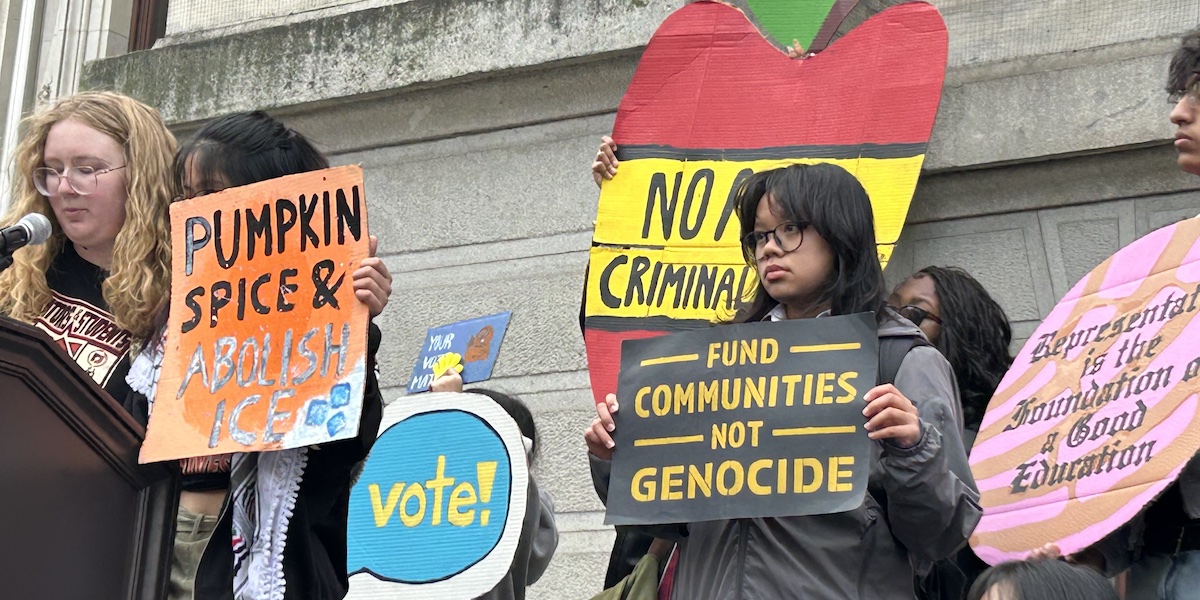
Then, seniors Aster Chau from Palumbo and Hazel Heiko from Northeast High give a cross-school speech about youth potential to affect government policy. One speaks, then the other, then the first. It’s a back-and-forth that models cooperation. Behind the two, students hold signs. At Northeast High more than 50 languages are spoken. Not surprisingly, along with the simple VOTE messages, are signs that protest ICE raids.
Lesson #7. Discussion opportunities.
Even before the go-ahead is announced, students have found the table with grab-and-go lunches from the 721 by DSC caterer and the merch table, with pins, stress balls, and T-shirts. Vote Vote Vote.
While eating lunch, a student from Palumbo says that she’s researched the many judges — and has translated information into Bengali for her mother who speaks English fine for everyday use, but is glad of help with details.
Nasir McCafferty from Lankenau Environmental Science insists that, “Oh, yeah,” he will go to the poll next week. “My grandmother sat me down …”
“When people need someone to make things happen, they need people who can speak up.” — Liza Meiris, PA Youth Vote
His schoolmate Naja Wilson allowed as how, for someone voting for the first time, there was “a lot of information.” So many candidates! Most judges recommended by the PA Bar Association; but not all; and some running despite scandal. Classmates sitting and eating helped name the races: for District Attorney, City Controller, PA Superior Court, Commonwealth Court, Court of Common Pleas, and the retention votes, for Philadelphia Municipal Court and, as the statewide advertising tells us, for PA Supreme Court. “It’s a lot. A lot.”
Michael Gallagher, a teacher at Ben Franklin High, has walked seven students down Broad Street to attend. His eyes never stop tracking his students as they bop through the crowd. One student with autism sits close to him on the apron’s curb, and works away on his phone. When I ask whether there’s too much stimulation here, Gallagher shakes his head no. Being around the other kids, here, outside, the noise — ”He likes it.”
Loud has been good for this student, too. Loudness not to hurt or punish or intimidate, like so much human noise we — and they — encounter. This has been like the loudness at a sports event, except for much bigger stakes.
While we talk, The New York Times headline scrolls across my watch to tell me that 42 million Americans in 20 million households are due to lose Supplemental Nutrition Assistance Program (SNAP) benefits if the federal government shutdown continues past November 1.
“My generation was progressive,” he says, wondering at the numbers of American youth who voted conservative in the last election — and the thousands here in our own city who do not vote at all. “We voted!”
Lesson summary: “I just want them to vote!”
Lorene Cary is a lecturer at Penn and author, most recently of Ladysitting: My Year with Nana at the End of Her Century, a care-taking memoir, and My General Tubman, a play about the complex journey of the abolitionist/activist that ran this year at Arden Theatre. She is the founder of #VoteThatJawn, the initiative to register and engage young voters.

MORE ON YOUTH + VOTING IN PHILADELPHIA