


It sounds ridiculous to say it: But, walking is being reinvented as an appointment activity. Forget about those walking tours where you follow a person hoisting a flag telling you about the city’s history while people with cameras slung over their chests gape. Forget being a flâneur, aimlessly wandering the city.
Instead, now thousands of people are circumnavigating Manhattan on foot, not for charity, just to have done it. Walking tours — not for tourists, but for locals — are garnering waitlists. People are making a living writing about their walks. What was once just a form of transportation, exercise, a way to kill time or chat with a friend, walking in cities is now becoming a way to reconnect with place and discover the unsanctioned parts of cities.
Why is walking trending right now? My instinctual response to that question was the pace of the world. With all those 15-second videos and AI agents speeding up work, people want something slow and off screen. But if that were the case, I think we’d see mostly a trend toward solo walks in nature. Instead, what we’re seeing is a series of new kinds of urban walks, and a growing culture around them.
The unvarnished walk
Cities put great effort into making certain paths legible and enjoyable. The best examples of this type of wayfinding support would be waterfront trails, mural tours, historic districts with interpretive plaques and a recommended self-guided tour.
But perhaps for many urbanites, who have seen that pretty side of the city, the under-narrated venues, the detritus of urban planning, the ruins of our industrial past, are more appealing. People are lining up for authenticity because it’s a way to be a tourist in your own town — without the $200 theater tickets or James Beard-nominated meal (see above note on fun shortage).
When I started writing about cities in the early 2000s, psychogeography was having a moment. Guy Debord had defined it in 1955, in Introduction to a Critique of Urban Geography, as the study of how the geographic environment — designed or accidental — acts on people’s emotions and behavior. The method was the dérive: a walk following the pull of the terrain rather than a destination, not motivated by the usual concerns of going to work or running an errand.
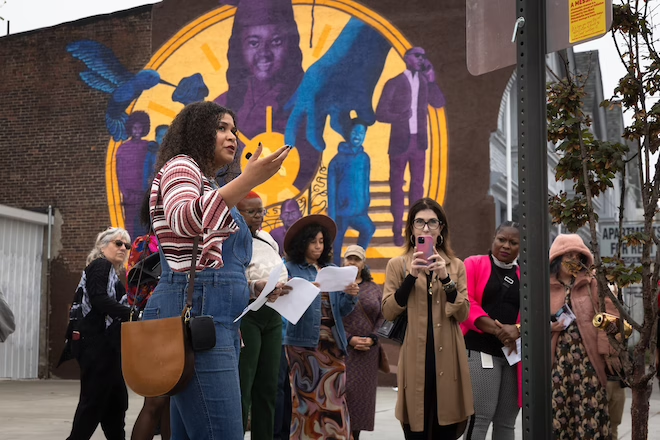
But while it is tempting to associate the dérive with some kind of aimless, relaxed experience, the dérive was not always about slowing down. Henri Lefebvre later described early dérives that used walkie-talkies, with one group walking a neighborhood while staying in radio contact with a group somewhere else entirely. The goal was to hold two separated parts of the city in mind at once — to experience a fragmented place simultaneously instead of sequentially. Low-tech virtual reality, perhaps, in pursuit of an intense exploration of the true experience of the city.
I see many of today’s walkers reinventing that kind of intense dérive.
I remember reading about Will Self, who wrote a book on psychogeography, walking from JFK into Manhattan. The cab ride or subway from the airport has traditionally been a kind of non-place — a gap in time before arriving in the “actual” city. Self showed that the experience of actually walking out of the arrivals terminal, into the neighborhoods butting up against the runways, could compete with the excitements in the city itself — and definitely would be a more authentic way to show up there.
Nowadays, we’re seeing mass walks like The Great Saunter, a 32-mile circumambulation of Manhattan that’s been held annually for 40 years, blowing up and reaching a mass capacity of 3,500 attendees — and a waitlist of 3,000 more people. It’s got Dîner en Blanc energy, the pleasure of doing the cool thing in the company of others who also knew about it. While it’s undoubtedly connecting people to the city in a new way, it also feels more like it’s about collecting an experience than truly knowing Manhattan.
Then we’re seeing a new kind of program like Walk Around Philadelphia, which has just opened registration for 22 walks this fall. Founded a decade ago when four artists walked 100 miles around the city, the organization has evolved into a nonprofit with a 30-year roadmap toward becoming a global model of civic belonging.
As the website explains:
Walking the perimeter invites us to see Philadelphia from its margins rather than its center — noticing waterways, industry, neighborhoods, ecosystems, and the boundaries that shape everyday life. There’s something powerful about circumnavigating a place — tracing the whole outline, step by step — that deepens our relationship to it and to one another.
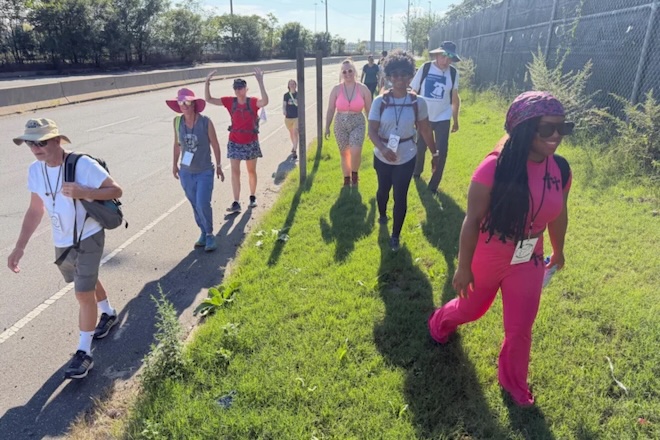
Finally, there is walking as a content vertical. Chris Arnade is perhaps the most famous of Substack writers who walks and writes about it for a living. He covers absurd mileage and reflects back the culture, the economy, the state of the infrastructure of the places he’s visiting. At a time when everyone is meeting virtually and working remotely, it’s a newsletter that reinforces the importance of actually putting your feet down in a place and being transformed by experiencing the world IRL. People read Arnade not only for his musings on contemporary life, but for the fact that he goes on walks that no other travel writer would, like through the industrial belt of New Jersey.
What these different practices all have in common is a sense that their appeal is permission to go places that we’ve all wondered about but rarely if ever dared to go on our own. Group walks give us a sense that this is a legitimate way to spend a Saturday — it feels a bit like a run club with more of an intellectual bent. There’s also a kind of permission to walk through neighborhoods where we might not feel like we belong, but which might offer a more authentic or novel look at the city than the neighborhoods we routinely travel through.
All of which points to something cities could do on purpose. We’re good at building the sanctioned route: the trail, the loop, the plaques. We’re much less practiced at building for the walk nobody planned, and in fact, we often discourage people from going to certain parts of town by discontinuing sidewalks, or failing to provide legal passage along the industrial waterfront and under the interstate.
Providing that infrastructure would give more people the opportunity to get closer to our cities and have a deeper understanding of our communities. It’s impressive how some of these programs, like The Great Saunter, have massively scaled. But what might happen if we scaled a deeper attention to place? We might just build a stronger case for better funding and managing our cities.
Diana Lind is a writer and urban policy specialist. This article was also published as part of her Substack newsletter, The New Urban Order. Sign up for the newsletter here.
 MORE FROM DIANA LIND
