


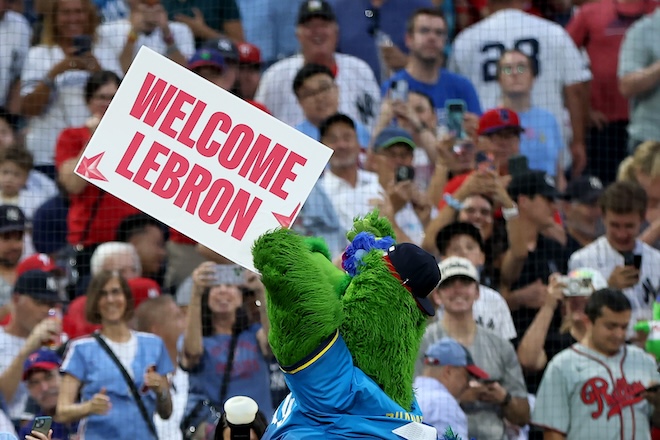
And so it was that, upon the 250th anniversary of the world’s greatest civic experiment, LeBronism came to this most historic of birthplaces, and the people rejoiced.
Listen to the audio edition here:
The celebration was not for a mere basketball player, for LeBron James long ago transcended the sport that catapulted him to iconic cultural status. He’d gone from the child prodigy I’d shadowed for GQ magazine 20 years ago as he competed in a Bubblicious bubble-blowing contest against a team of 9-year-olds, to the Obama of basketball — a great player turned civic superhero who has used his power to essentially fire a racist team owner; reinvent the business model of his league; become an entertainment industry goliath; educate his hometown’s at-risk kids; and, most critically, transform himself into the defining athlete-activist of his generation. In doing so, he helped free an era of mostly Black athletes from the suffocating expectation that they should simply “shut up and dribble,” and he did so without being pedantic or ideological.
“He chose us,” one accomplished civic leader said to me last Friday, his voice laced with wonder. Funny, because while LeBron remains a great player, the Sixers had just acquired a younger, better one just weeks before — superstar Jaylen Brown. Yet outside of us hoop heads, there was no comparable citywide jubilation. That’s because the celebration wasn’t really about basketball. All the memes and the high fives — grown men called me, their voices quavering, muttering “I can’t believe it” — were really about something much deeper, something woven into Philadelphia’s DNA.
LeBron’s decision felt like validation. Here was living proof that our city had become a destination rather than a consolation prize, a tangible rebuttal to the long-suffering civic inferiority complex we’ve carried for generations.
It was no coincidence that James’ decision to take his talents to Broad Street, at age 41, came on the heels of our World Cup triumph. Soccer, let the record show, is a stupid sport; there’s hardly any scoring and it’s riven with athletes who spend inordinate amounts of time rolling around on the pitch pretending to be hurt. Hosting the World Cup, however? That was a civic masterpiece. Our streets were miraculously pristine. Wide-eyed visitors marveled at what Philadelphians too often overlook. For a few glorious weeks we saw ourselves through someone else’s eyes and liked what we saw. Moreover, the tournament gave us a common experience in divided times; in this town, sports punches well above its weight, and ever since “No one likes us and we don’t care” we’ve slowly begun shedding the defensive crouch from which we’ve so often introduced ourselves to the nation.
Just when the city seems to be whispering to itself, “Maybe we really are worthy,” here comes James’ signing. Could this finally be the beginning of the end of the Philly Shrug?
“Philly — the city that starts at ‘No,’” former Mayor Michael Nutter likes to say, shaking his head at our sclerotic impediments to progress. It’s become ingrained, and you know the background by now: We lost our status as the nation’s political and financial capitals, to Washington, D.C. and New York, respectively. We became the city Lincoln Steffens famously described as “corrupt and contented,” defined by industrial decline, urban decay, and absentee leadership.
Many of us inherited the trauma of 1964, when the Phillies authored the worst collapse in sports’ history; up 6 ½ games with 12 to go, a choke to end all chokes. My father used to say that during those awful weeks, the only other time he’d felt such despair hanging over Philadelphia was in the days after John F. Kennedy’s assassination.
Our civic neuroses became so ingrained we even booed Santa (though not reported was that it was a 20-year-old drunken last-minute Santa substitute, who later admitted he deserved all those snowballs fans threw at him). No wonder, then, that when the Eagles got inside the opponents’ 20-yard line, Dad would shout at the TV: “Kick a field goal now! Before something terrible happens!”
Then came MOVE — our city’s bombing of itself — on the very day ground was broken for the first building ever to rise above William Penn’s hat atop City Hall, a skyline finally daring to imagine Philadelphia as a city that could once again think big. With few exceptions — the Rendell reforms come to mind — every step forward seemed tentative and, worse, incremental.
But now comes a new generation, untethered from many of those inherited traumas, less interested in managing decline than in testing possibility. Dare I say momentum is in the air? Can it be related that we’re among the nation’s leaders in public safety gains or that, just days before James’ announcement swept social media, CNBC reported that Pennsylvania is among the nation’s leaders in cutting red tape and has the highest GDP growth of east coast states?
It’s a little harder to shrug these days — no matter the next shenanigan pulled by, say, our sheriff, whose timeline of misdeeds seem to belong to an increasingly bygone era. Because LeBron’s imprimatur has the air of ratification: We are a city with problems, yes, but one that won’t shrink from them. So says the greatest competitor, sportsman and civic light of our era.
Obama once said. “LeBron is an example of a young man who has, in his own way and in a respectful way, tried to say, ‘I’m part of this society, too,’ and focus attention.”
An athlete — and city — always in the act of becoming
In that sense, the LeBron story is a metaphor for the possibility of Philadelphia’s next rise. Because no one has reinvented himself more completely than King James. He is always in the act of becoming. Fatherless and impoverished in his Akron, Ohio youth, James dreamed big and, long before the term became fashionable, practiced the art of manifestation. Those days I spent with him when he was 20? He was a wise-cracking, fart-joking kid, high school buddies in tow. For the photo shoot, he requested just … Fruity Pebbles cereal. Allen Iverson, about whom I’d just written a book, would have demanded a fountain of Cristal.
That day, he wrestled with his friends, Rich Paul and Maverick Carter, on the floor, all of them giggling like teenagers intent on postponing adulthood for another day. Yet, when I finally broke through the juvenilia, kid morphed into man. We were seated in Blue Fin restaurant, and he was scarfing down a stack of pancakes, a side of sausage, and a mound of sliced bananas. His eyes locked on mine and his voice took a deep, serious tone once I asked about his game, which he referred to as, “the special powers that I have been given.”
“Once I get comfortable with my surroundings out there, it seems like everything just slows down,” he told me. “I don’t want to sound cocky when I say this, but it’s like I see things before they happen. I kind of know where the defenders are gonna be. I kind of know where my teammates are gonna be, sometimes even before they know. My game is really played above time. I don’t say that like I’m saying I’m ahead of my time. I’m saying, like, if I’m on the court and I throw a pass, the ball that I’ve thrown will lead my teammate right where he needs to go, before he even knows that that’s the right place to go to. I just slow things down to a point where I can control what happens.”
He paused, shrugged. I was wondering if, some 260 years ago in Salzburg, Austria, an interlocutor like me was hearing similar sentiments sitting across from Amadeus Mozart, sans the tattoos.
“It’s a God-given talent,” James said.
Prodigies rarely age well. From William James Sidis, who entered Harvard in 1909 with a 300 IQ at 11 years old, to 14-year-old Freddy Adu, who was to save American soccer in the early aughts, they tend to fade away — falling prey to pressure from within and without.
LeBron was supposed to be another cautionary tale. Instead, he became something far rarer: a prodigy who kept growing. That James has navigated such perilous terrain and has emerged as a mentor to a whole generation of not only basketball stars, but entrepreneurs and entertainers, is a singular achievement. Iverson had a Hall of Fame career, but he didn’t exhibit the same propensity for growth. In her poem “Iverson’s Posse,” Nikki Giovanni repeats the refrain “Send your posse to school, Iverson.” He didn’t, but LeBron essentially did. Paul has gone on to be sportsworld’s most powerful agent (engaged to Adele!), and Carter a Hollywood mogul.
Today it’s easy to forget just how reviled James once was. In 2010 he was sports’ public enemy number one, the embodiment of athlete narcissism and entitlement when he bolted his hometown Cavaliers for Miami, as Jeff Benedict so meticulously chronicles in his 2023 book LeBron. Scott Rabb captured that version of LeBron brilliantly in The Whore of Akron, a book fueled by heartbreak and betrayal.
But rather than remain comfortably ensconced atop the dynasty he built in Miami, James chose the far riskier path of returning home to redeem both himself and the city that had once burned his jersey in effigy. He later likened his four years in Miami to college — a necessary place to grow before coming home and leading the Cavs to the 2016 title.
By then, all was forgiven. At the championship parade, James gave a 15-minute speech in which he talked in great, earnest detail not about himself, but each of his teammates instead.
Here was living proof that our city had become a destination rather than a consolation prize, a tangible rebuttal to the long-suffering civic inferiority complex we’ve carried for generations.
James has since become something no athlete before him ever truly was: a power broker whose influence extends well beyond the boundaries of his sport. Engage if you will the on-court GOAT debate (for me, it’s Michael Jordan); off-court, James has seen to the end of Jordan’s calculated “Republicans buy sneakers, too” careful neutrality. James has become, if not political, a public moralist, and has given permission to a generation of athletes to freely speak their mind.
When then-Clippers owner Donald Sterling was caught making vile racist remarks on audio, it was James who didn’t waste time by first calling league honchos. He simply marched before the cameras and essentially fired an owner of the league that employed him. “There are only 30 owners and 400-plus of us,” he told a media throng. “I can only imagine if a player came out and said something of that stature what would happen to us as players. So I believe in [Commissioner] Adam [Silver]. I believe in the NBA and they have to do something very fast and quickly … There is no room for Donald Sterling in our league. There it is.”
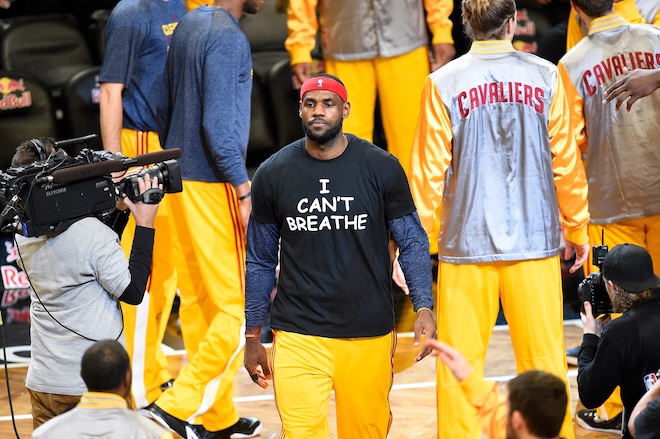
When Obama needed help getting folks to sign up for Obamacare, who did he turn to? James, who took on the task even as Senator Mitch McConnell complained to NBA executives. When Eric Garner was choked to death by police, it was James who, in violation of league policy, wore a T-shirt bearing Garner’s last words — “I Can’t Breathe” — on court. When Trayvon Martin was killed, James and his teammates donned hoodies. How savvy is he? When Fox News’ Laura Ingraham had had enough of his social commentary and went on her now infamous “shut up and dribble” rant about James’ outspokenness, you could tell from his response how much he’d learned from the examples of shapers of public opinion ranging from Obama to Muhammad Ali to Jackie Robinson.
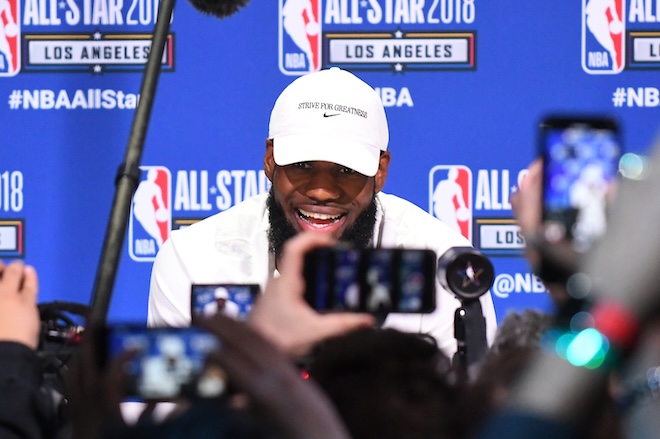
“The best thing she did is help me create more awareness,” he said of Ingraham. “So I get to sit up here and talk about social injustice and equality. So thank you whatever her name is. I don’t even know her name.”
Booyah. “We went through a long stretch there where [with] well-paid athletes the notion was, Just be quiet and get your endorsements and don’t make waves,” Obama once said. “LeBron is an example of a young man who has, in his own way and in a respectful way, tried to say, ‘I’m part of this society, too,’ and focus attention.”
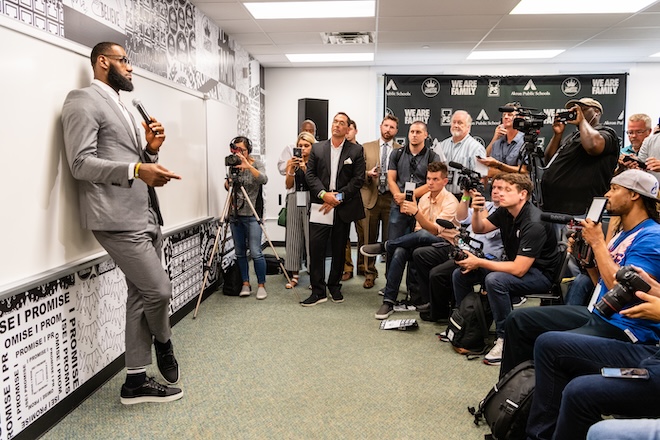
Thing is, he has done more than just talk. He started More Than A Vote, a minority voter registration and get-out-the-vote organization. In Akron, he opened House Three Thirty, a state-of-the-art reimagining of the old school community center, complete with a consortium of financial advisors providing financial planning to low-income families, funded by the LeBron James Family Foundation and JPMorgan Chase. Also in Akron, his I Promise School gives underprivileged students free tuition, uniforms, transportation within a two-mile radius, breakfast, lunch and snacks, bikes and bike helmets, a GED program for parents, and free tuition to the University of Akron for all students.
After the murder of George Floyd and the shooting of Jacob Black in Milwaukee in 2020, I remember feeling — wrongly, it turns out — that James wasn’t pushing hard enough. He’d helped organize an NBA player wildcat strike and the NBA agreed to use team arenas for mass voting and to establish a $300 million social justice fund. But, I argued, James could have pressed further. Imagine if he and his fellow players had demanded that the league take its billions out of BBVA — the Spanish conglomerate that was at the time the league’s “official bank” — and instead deposit its considerable nest egg in Black-owned banks or a B Corp like Amalgamated Bank, the nation’s largest union-owned bank, for the express purpose of targeted investment in distressed Black and Brown neighborhoods. Keep in mind this stunning fact: Of the nearly 5,000 banks in America, only 21 are Black-owned.
But since then, James and other players have quietly influenced their league. In ’24, the NBA announced its new banking partner — SoFi — which is partnering with Celtic Jayson Tatum to establish the SoFi Generational Wealth Fund, a financial literacy and family-sustaining wealth vehicle. So: progress.
It’s so easy for fame to trap celebrities inside the gravitational pull of their own egos. That James has avoided the trap just may be his most lasting legacy. He idolizes Ali, who wanted to be remembered for his compassion and human rights work more than the beauty of his pugilism. Other than chess master Garry Kasparov, it’s hard to think of a public figure since The Greatest who has grown so fully and so consciously as James. Yes, Kasparov fits on several levels.
Kasparov arrived on the world stage as a force of nature, overwhelming opponents with sheer brilliance and aggression. As he matured, he became a different kind of champion — less dependent on instinct than on wisdom, pattern recognition and restraint.
Watch LeBron today and you see a similar transformation. The breathtaking athleticism remains. But the game is now played more with head than muscle. He has become basketball’s great orchestrator, manipulating time and space the way Kasparov manipulated the chessboard.
Yet it’s Kasparov’s second act that truly intrigues. After retiring from chess, Kasparov devoted himself to defending democracy and human rights, becoming chair of the Human Rights Foundation. He just might be the world’s loudest Putin critic not yet poisoned or tossed out an open window.
Kasparov found a larger purpose after mastering his profession, and you get the sense that LeBron may be on that trajectory. Because what has always distinguished James isn’t simply excellence, so much as dissatisfaction with excellence alone. Every few years he seems to ask himself a new question.
What does greatness require now? At 18, the answer was becoming basketball’s next prodigy. At 28, it meant returning home to Cleveland. In his 30s, it meant giving athletes permission to become citizens again.
Bring some of that to Philly?
What will be James’ last, boldest act, and might we play a part in it? After all, here he comes, this 6’8” avatar of the American Dream, to the city of our founding, where, for all our steps forward, said dream is still in jeopardy. You know the facts: the worst economic mobility in the nation, one of the poorest big cities in the country. LeBron James, at 41, is one of his nation’s most creative, powerful innovators. Might we invite him to our civic problem-solving table?
It’s a lot to ask. But if James were just about collecting rings, he would have never left Miami. He’s a romantic at heart — it’s one of the traits that separates him from the coldness of Jordan — and Philly, for all its tough guy posturing, falls hardest for those who choose us.
Word is that James will chopper in from New York and hunker down when in Philly in Michael Rubin’s often vacant, but no less breathtaking, Main Line digs. But here’s a modest proposal, LeBron. You buy 1121 Winding Drive in Cherry Hill, for $1.5 million. It’s a steal at that price, with its pool, tennis court, basketball court, shuffleboard court, gazebo, two kitchens, five garages, and six bedrooms.
But don’t buy it for any of those amenities. Buy it because it was once owned by Ali, from 1970 to 1973, when the Champ moved here just to burrow himself further into Joe Frazier’s head.
Ali fell in love with all things Philly and couldn’t be disengaged. He calmed racial strife at South Philly’s Tasker Homes, he hired down-on-their-luck area fighters, and he spent his days visiting hospitals. “One day he got into training camp late because he heard a thing on the news about this little kid who had gotten his legs cut off by a train,” Maury Levy wrote in Philly mag. “He went to the hospital, unannounced, and held the kid in his arms and started dancing around. ‘This,’ he said, ‘is the Ali shuffle. And one day you’re gonna be doing it yourself.’”
After boxing, stricken with Parkinson’s, Ali embarked upon his final and most lasting permutation. Boxing bored him now, he told his authorized biographer, Thomas Hauser. As Kasparov would, he found his life’s purpose in a new kind of fight. “Now my life is really starting,” he said. “Fighting injustice, fighting racism, fighting crime, fighting illiteracy, fighting poverty, using this face the world knows so well and going out and fighting for truth and different causes.”
Buy the Ali house, LeBron, and begin the transition to your greatest act yet. Coach your young teammates to a ring while you help us restore the American Dream right here, where it was first conjured. It’s a lot to ask, yes. But our city turns its lonely eyes to you.
 RELATED STORIES ON PHILLY BASKETBALL
