

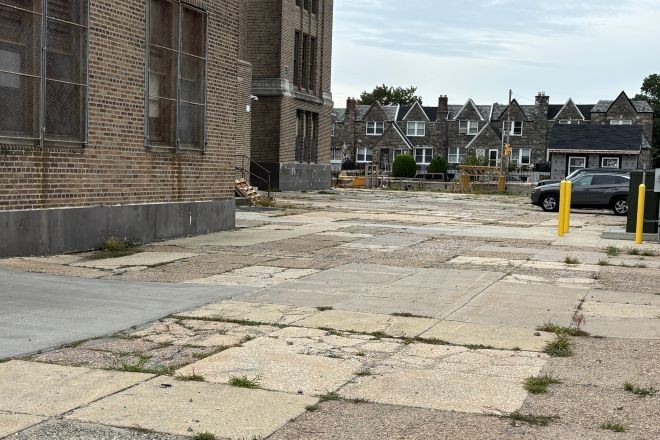
Like most public schools in Philadelphia, Science Leadership Academy at Beeber in Wynnefield, an 11-year-old, 500-student (grades 5 through 12) extension campus of Science Leadership Academy, is surrounded by asphalt and concrete. And even that’s not in great shape. Over the years, trucks and heavy equipment used to renovate the nearly 100-year-old school building have cracked and degraded sections of the surface, rendering them unsafe for both play and pedestrians. When younger SLA Beeber students go outside during lunch or recess, they typically toss a ball around or sit at a picnic table; older students rarely go outside.
Listen to the audio edition here:
Several years ago the Home and School Association took note of the condition of the schoolyard and began advocating for something better. After some research and a two-year design process, they — and I, a member of the HSA, school volunteer and grandparent of an SLA Beeber student — joined the movement for green schoolyards. But joining a movement does not guarantee results, and the School District of Philadelphia doesn’t seem to be in a rush to help us out. In this, SLA Beeber is not alone.
According to The Philadelphia Inquirer, as of the end of 2023, roughly a third of Philadelphia’s 149 elementary schools had no play area in place or under construction. (Not surprisingly, elementary schools in wealthier catchments tend to have better maintained outdoor spaces because parents can afford to donate and fundraise for them.)
Figures about the City’s 90 or so public and charter high school schoolyards seem to be unavailable. High schools tend to focus on sports facilities, and outdoor high school fields are often in poor condition — not surprising since Philadelphia requires a single physical education credit in order to graduate. Few, if any, high schools offer onsite outdoor learning spaces where students can connect their academic studies directly with the natural and built environment around them.
As a grandparent of a Beeber 12th grader and a former educator, I see the absence of outdoor green space as a loss to both schools and their communities. What message are we giving our school communities if we fail to create and maintain attractive, welcoming and well-maintained physical facilities and outdoor spaces for our children and those responsible for their growth and development?
Better than blacktop
Most of us probably recall schoolyards covered in asphalt, a common practice even today. According to the Trust for Public Land, in 2021, “of the 90,000 public schools in the country, only a tiny fraction have schoolyards that are green and inviting.” Scientists have long raised concerns about the surface’s heat retention, especially in cities, which tend to have a preponderance of treeless heat islands.
But outdoor spaces are also critical for learning and development. Since the 1930s, researchers and practitioners have been emphasizing the value of outdoor activities for children of all ages. Although originally focused on playgrounds and playground equipment and spaces, the notion of outdoor “play” has expanded in outdoor settings to include exercise, social interaction and alternative learning opportunities not available in a confined classroom setting.
Also, as organizations like the Trust for Public Land point out, outdoor school space can play a much greater role in education and civic and community life in general. Not only could such spaces model environmental safety and awareness, but they could also be an antidote to how students understand and respect their neighborhoods. But they could also teach students to understand and respect their neighborhoods?
But, just as with so many worthy initiatives, the District has never found the funds to take up the mantle of greening schoolyards on its own and instead has largely relied on external funding to create and maintain such spaces.
In 2011, the District partnered with the Philadelphia Water Department for the Green Schools program, which sought to promote green infrastructure, place-based education, and community on school grounds. This initiative initially consisted of eight pilot schools and went on to impact up to 38 (out of 331 District and charter) schools.
Alain Locke School in West Philadelphia, Overbrook Elementary and Tanner Duckrey in North Philadelphia have all enjoyed partnerships with the Trust for Public Land. The renovation of the Add B. Anderson School in Cobbs Creek in 2022 was financed in partnership with L.L. Bean, Children’s Hospital of Philadelphia, the Philadelphia Water Department and the Trust for Public Land. The Eagles pitched in to renovate Stephen Girard Elementary’s schoolyard last year.
Green Futures, a project of the School District, invites schools to take advantage of sustainability curriculum and other resources and offers suggestions for fundraising for schoolyards — but provides no actual funds for that purpose. Rebuild Philadelphia, with funds from the Beverage Tax, has spent hundreds of millions of dollars, but mostly on parks, recreation centers and libraries, not schoolyards.
Elected officials also play a crucial role in channeling government resources to such projects, but there is limited money available; most comes through state grants. The need to create those relationships with funding sources, community organizations and government officials makes it a daunting enterprise for local home and school associations or “friends of” school groups, which often initiate and take the lead in such efforts.
What message are we giving our school communities if we fail to create and maintain attractive, welcoming and well-maintained physical facilities and outdoor spaces for our children and those responsible for their growth and development?
It’s worth pointing out that this is far from a new problem: Recent reporting on new playgrounds in Philadelphia schools reveals that like our city’s school buildings themselves, Philadelphia schoolyards have suffered neglect for generations. The reporting also validates what we all know to be true: When a schoolyard receives renovations, school communities celebrate.
From year to year various outside organizations have formed relationships with the District and tried to help. Most recently, after a lengthy lobbying process at SLA Beeber, the District connected the school with love.futbol and Fiesta Playgrounds, who’ve promised a soccer pitch and outdoor enhancements such as equipment and painting. The school community is grateful for their support, but implementation will take years to complete. Significant fundraising and more design work ahead must happen before the project gets underway.
And meanwhile, too many generations of schoolchildren simply miss out on the benefits such enhancements offer.
As with so many other identified needs in our communities, funding for green schoolyards will need to be subsidized by the government in order to pick up the pace of schoolyard transformation. We need our elected officials to prioritize this work. Combining forces with environmental activists and focusing on the state level offer more avenues for funding than struggling alone for local or federal grants.
Could Philadelphia and PA follow the example of California, where Governor Gavin Newsom and state legislators, concerned about the effects of the heat produced by asphalt, have submitted a $10 billion school bond to the voters which, if approved, would include funds for planting trees and removing pavement around public schools? The Los Angeles school district has promised $500 million for school greening projects; their school board has approved a $9 billion facilities bond issue, including $1.25 billion for planting trees, creating shade and removing blacktop. Green Schoolyards America reports that similar efforts are underway in other states.
In the meantime, a better understanding of how policies interact can help us all make more responsible decisions, seek out partnerships and organize our priorities, enabling us to pressure decision-makers to look for solutions and allot resources in a way that addresses multiple problems at the same time and rewards not just special interests but all citizens. In support for green schoolyards, education, climate, community and equity come together. Surely, we can see the benefits such thinking and collaboration offers all of us.
Peshe C Kuriloff, Ph.D. was a professor of practice at Temple University, and is now retired. She has five grandchildren currently attending Philadelphia public schools; her son is the assistant principal at SLA Beeber.
The Citizen welcomes guest commentary from community members who represent that it is their own work and their own opinion based on true facts that they know firsthand.
 MORE ON IMPROVING OUR SCHOOLS