

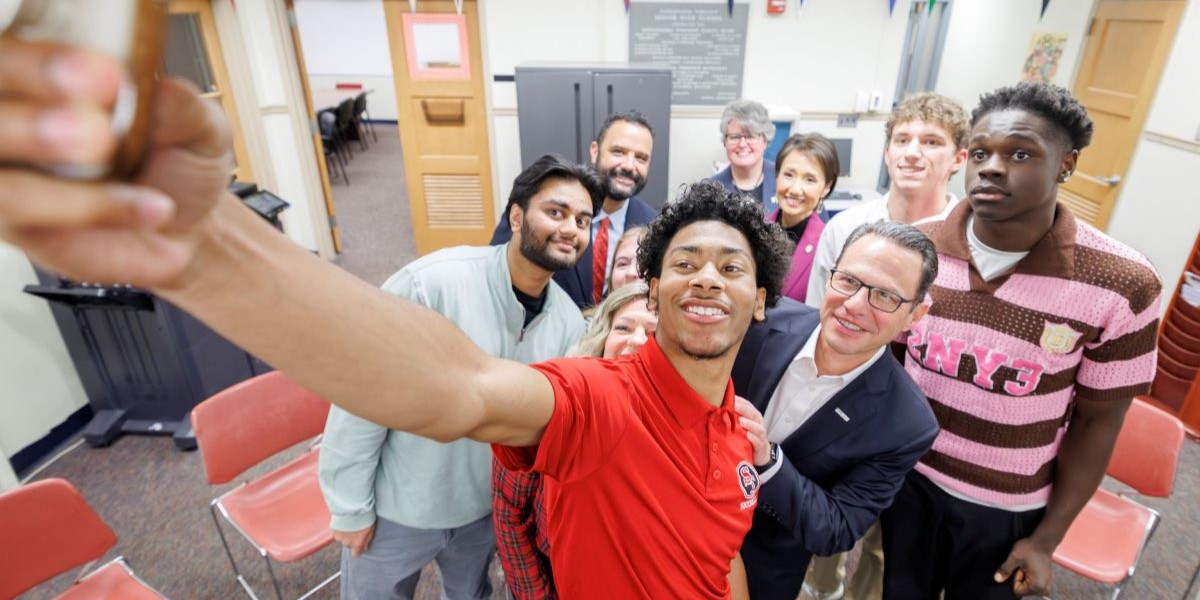


Last Thursday, educators, advocates, lawmakers, and students gathered to deliver a simple yet profound message: Gov. Josh Shapiro must opt in to a new, first-of-its-kind federal scholarship program.
The Empowering Parents press event, hosted by Invest in Education, featured several speakers who discussed and promoted the Federal Scholarship Tax Credit (FSTC). A byproduct of the “One Big, Beautiful Bill” Act, the FSTC allows individuals to make dollar-for-dollar tax-deductible donations (up to $1,700) to scholarship-granting organizations nationwide. Students receiving these scholarships can use them to cover a wide array of education-related expenses — everything from private school tuition to after-school tutoring.
And the anti-voucher crowd can rest easily. These scholarships rely entirely on private money and do not take a single cent away from public schools or the state. Rather, this program adds more to existing K–12 funding. In fact, public school students also qualify for FSTC scholarships to cover their own school expenses.
The timing of this opportunity is fortuitous. Anger and discontent with Philly schools have reached an all-time high. During the most recent school board meeting, students and parents voiced their frustrations over the district’s plan to close 18 schools, questioning and berating district officials for more than eight hours.
But these closures are the least of their worries.
Academic achievement at Philly schools has plateaued. More Philadelphia kids are graduating without meeting statewide standards. Only one-third of Philly students are proficient in English Language Arts, according to statewide testing. And despite claims of improvement, only a quarter of Philly students are proficient in math.
Abysmal academics aside, violence still plagues Philly schools. A 24-year longitudinal study by Carnegie Mellon identified seven out of 10 Philadelphia schools as “persistently dangerous.”
Governor Shapiro, don’t wait — do the right thing by signing on to the FSTC and giving Philly kids and families the opportunity and resources to chart their own educational course.
Philly families need better educational options — and they need them now.
Indeed, Pennsylvania already offers some programs for families seeking alternatives. Last year, the Commonwealth’s two premier tax-credit scholarship programs — the Educational Improvement Tax Credit (EITC) and the Opportunity Scholarship Tax Credit (OSTC) — awarded more than 101,000 scholarships statewide, with nearly 37,000 going to Philadelphia students alone.
However, almost just as many Philadelphia students — about 25,000 — received a denial letter for their scholarship application.
Clearly, demand has outpaced supply — and the FSTC can fill that gap.
In fact, these programs have developed a symbiotic relationship. Thanks to EITC and OSTC, Pennsylvania already has a robust network of more than 250 scholarship organizations to provide the new federal scholarships to kids across the commonwealth.
Despite all the valid reasons to opt in, Governor Shapiro is stalling. In an email, the governor conveyed his “plan” to await “federal guidance to address key questions about how this program would work.”
But Shapiro shouldn’t wait too long. Even as federal regulators finalize the FSTC, he should, at a minimum, submit his intent to opt in to the federal government, removing uncertainty and allowing schools, scholarship organizations, and parents to prepare for the new program.
Also, this program transcends the traditional partisan divide.
The Invest in Education event attracted lawmakers and advocates from both sides of the aisle. Jorge Elorza, CEO of Democrats for Education Reform, and state Rep. Martina White, a Philadelphia Republican, both called upon Shapiro to opt in. State Sen. Anthony Williams, a Philadelphia Democrat, originally planned to attend but instead submitted a statement, which Elorza read.
“I’m supporting this effort because the relationships between parents, students, and teachers should be the priority in educating a child and, foremost, where and when a child is sent to a particular school,” Williams writes.
Governors from both parties are also signing on. So far, 27 states have indicated intent to participate in the program, and three have pending legislation.
Philly families need better educational options — and they need them now.
Although most states lean Republican, Democratic-led states have also joined the cause. Colorado Gov. Jared Polis, a Democrat, called his decision to opt in a “no-brainer.”
Even governors who first refused to join now seem to have changed their minds. Despite initially stating their intentions not to opt in, three Democratic governors — Govs. Michelle Lukan Grisham (New Mexico), Josh Green (Hawaii), and Tina Kotek (Oregon) — appear to be reconsidering their original intransigence. Green admitted to taking the proposition “very seriously.”
And they would be wise to rethink their prior stances: Polling shows that these polls are wildly popular. Nationwide, nearly two-thirds of Americans support their respective governors’ opting into the FSTC, according to a poll conducted by Emerson College and Democrats for Education Reform. The same pattern holds true in the commonwealth, with 72 percent of Pennsylvanians encouraging Shapiro to do the same.
Not only would refusing to opt in be a huge unforced political error, but it would also leave a lot of money on the table. If only 15 percent of Pennsylvania tax filers donated, Pennsylvania would receive nearly $500 million in scholarships, according to an analysis by Education Reform Now. That’s close to half a billion dollars lost.
Again, this is a no-brainer. The demand is here. The infrastructure is here. The public support is here. The cost is nonexistent.
All that’s missing is the governor’s signature. Governor Shapiro, don’t wait — do the right thing by signing on to the FSTC and giving Philly kids and families the opportunity and resources to chart their own educational course.
Andrew Lewis is President and CEO of the Commonwealth Foundation, Pennsylvania’s free-market think tank.
The Citizen welcomes guest commentary from community members who represent that it is their own work and their own opinion based on true facts that they know firsthand.
 MORE ON EDUCATION IN PHILLY