


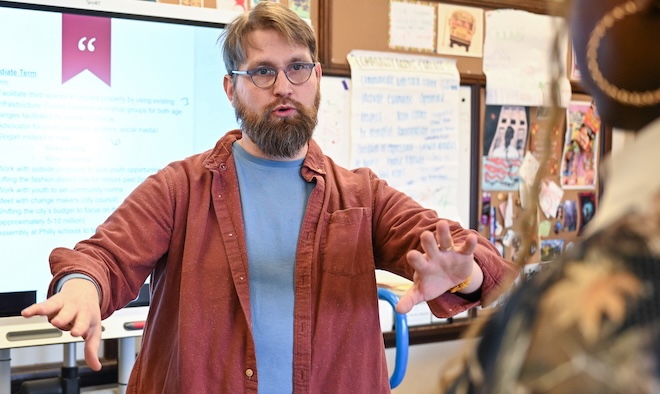
The energy in Charlie McGeehan’s high school classroom at the Academy at Palumbo on a grey, February day is anything but dreary.
The class is engaged in a kind of curious, creative chaos that McGeehan calls “fun and focused.” Students push desks aside to better work with one another. They talk animatedly and type furiously as they get ready to present their ideas to a panel of student “judges,” gavels and robes included, who will assess the presentations. Today’s topic: third spaces for teens, somewhere outside of school, work and home that they can go to hang out and just be kids.
McGeehan drifts between the groups, thoughtfully stroking his beard, asking questions that push students to think critically. He teaches civics to 11th and 12th graders, but rather than focusing on federal politics — though he’ll touch on those too — he works with them to understand state and city government.
And he does that by teaching them to be good citizens, the kind who call their elected officials, advocate for the issues they care about, and who know that citizenship goes beyond casting their votes in the ballot box twice a year.
“The bottom line right now is that a lot of young people come into this class with a pretty negative view of our politics and our political system and of politicians,” McGeehan says. “We could spend every day talking about what’s happening in the federal government right now, and it’s just not going to make anyone in here empowered to do anything. I’ve developed a passion for teaching local politics because people will actually respond, people will actually come in, you can actually speak to those council members.”
For his work shepherding our next generation of citizens, McGeehan is being recognized as our 2026 Educator of the Year. He will be honored alongside his fellow Citizens of the Year at a dinner celebration on April 22, at Fitler Club Ballroom. (You can read about all of this year’s winners here, and find out about tickets and sponsorships for the star-studded event here.)
“I wouldn’t want to teach anything else”
Though he grew up in Media in a family of educators — his mom taught fifth grade and his dad taught middle school math — McGeehan didn’t always know he wanted to be a teacher. He was passionate about history, activism and politics, studying political science and African American Studies at the University of North Carolina Chapel Hill.
He wanted to go into social change work, but thought he would give teaching a try. He’d heard about a summer program through Breakthrough Atlanta, teaching middle schoolers. The program was “the hardest thing I’ve ever done,” McGeehan says, “but it also felt meaningful.”
“We could spend every day talking about what’s happening in the federal government right now, and it’s just not going to make anyone in here empowered to do anything. I’ve developed a passion for teaching local politics because people will actually respond.” — Charlie McGeehan
He was teaching students the history of Georgia — something he’d never studied — and he felt like he was learning and connecting with students. He could see the “aha” moments when they connected with the curriculum and saw how it related to their lives. “I was learning and teaching — which was also the challenge — but it’s exciting when you find those moments where you’re like, wow, I presented that material in a way that really connected to students,” McGeehan says.
His career has taken a few twists since then — moving back to Philly in 2010, teaching everything from English and theater to math — before he ended up in his current role, teaching civics to 11th and 12th graders at Bella Vista’s Academy at Palumbo.
“Increasingly over my time here, I’ve found teaching civics to be the most meaningful and impactful part of my work,” he says. “I wouldn’t want to teach anything else.”
Effecting local change
In the classroom, the students present their ideas for how they could advocate for more “third places” for teens. One group mentions lobbying City government to turn abandoned, City-owned buildings into rec centers and other places for teens to hang out. Another raises the idea of contacting the Fashion District and asking them to lift the curfew for unaccompanied teenagers. They came up with a slogan: “third spaces for safe faces.”
The exercise isn’t merely speculative. As part of his classes, McGeehan’s students undertake a civic action project: choosing an issue they care about, researching the work governments and local organizations have done related to the problem, and then contacting elected officials to advocate for solutions. The project has brought officials ranging from City Council members Anthony Phillips and Cindy Bass to State Senator Nikil Saval into his classroom.
“He made the research really exciting,” says Gianna Tran, a 2025 Palumbo grad. “He always ties the curriculum back to current events, and this is why students are so intrigued.”
This year, his classes chose projects focused on how schools support marginalized students, the connection between gun violence and domestic violence, and advocating for more third spaces for teens.
McGeehan’s action projects aren’t just assignments. Several of his student’s projects have led to change on the local level. Last year, one class advocated for City Council to better engage youth in its Parks and Rec planning. Councilmember Phillips introduced a resolution asking the Office of Youth Engagement to increase its collaboration with Parks and Rec, which passed this spring. Several of his students went to City Council to speak in support of the bill.
“That was one of the most impactful invitations we’ve had,” McGeehan says.
Aster Chau, a senior at Palumbo who took McGeehan’s class last year and testified before Council in support of the Parks and Rec resolution, says that the project empowered them to speak up. “Prior to junior year, I would’ve never imagined myself actually having a conversation with these people,” they say. “They just felt so far away, despite being a few blocks away from Palumbo.”
Now, they’ll stride up to Senator Nikil Saval and Councilmember Nicolas O’Rourke at a Lunar New Year event just to say “hi.” “I would not have had that confidence before,” they say.
Making civics real
Beyond the larger-scale civic action projects, McGeehan works with local organizations to get (and keep) students engaged.
“He doesn’t limit it to just the classroom setting,” says Jude Husein, deputy executive director of Philly BOLT, the nonprofit that works to recruit and train grassroots leaders. “He really encourages young people to go out there and speak to people and get to know people.”
Sometimes that means calling and emailing elected officials (during my visit, one student cheered when she got an email response from her state representative). Other times it means working with Committee of 70 and the City Commissioners Office to recruit students to be poll workers. Each year, nearly 100 Palumbo students sign up and about 50 to 60 end up working the polls.
“It’s a good way to understand how elections work, and to make voting feel less intimidating,” McGeehan says. “It’s really cool for students to have the opportunity to be poll workers and not only see how things work, but to take charge and run them themselves.”
One of the partnerships he’s formed over the years is with Philly BOLT. Fifteen of his students participate in its fellowship program and they teach what they learn in the fellowship to their peers as part of class every Wednesday. Two of his former students, Tran and Faustine Gultom, are acting as mentors as part of the program. They’re interns at Philly BOLT while studying at Temple and Thomas Jefferson University respectively.
“I got to grow as a leader in his classroom,” Gultom, a 2025 Palumbo grad, says. “He told us that we could always reach out to City Council members, we could write letters, we could protest, we could make signs. He always made it feel like we could do something, and it’s possible even if we’re young.”
This year, he’s also working with Philadelphia Young Playwright’s Civic Theater program, encouraging students to explore contemporary civic problems through an artistic lens.
“When I conceived of this program, I knew that I wanted to bring in a civics teacher to work with me and he was the very first person I thought of,” says Madeline Charne, director of education and programs at Philadelphia Young Playwrights. They first met when McGeehan was teaching at The U School a few years ago.
“He’s been helping students do power breakdowns and learn about kinds of people who make change in the city,” she says. “He helped connect them to three different kinds of change makers — politicians, journalists and activists — the three types of change makers that our students identified as wanting to help them.”
Beyond the classroom
In these times — when parents are protesting curricula and teachers are getting in trouble for expressing their views outside of the classroom — it is radical to take a concrete, action-oriented approach to teaching civics. McGeehan doesn’t want to shy away from current events in the classroom. For instance, he’s talked with his classes about the removal of President’s House exhibit on slavery at Independence Mall.
He wants to teach students to think critically about what they’re seeing on the news, but also to keep them engaged in the classroom. Students are passionate. They see what’s going on around them and they want to discuss it with their peers. He regularly surveys students and takes note of the topics they want to cover.
“I really want everything that I do in my classroom to be connected to what students care about and are passionate about and are interested in,” McGeehan says.
“Increasingly over my time here, I’ve found teaching civics to be the most meaningful and impactful part of my work. I wouldn’t want to teach anything else.” — Charlie McGeehan
“We need to be willing to engage in our classroom in topics that are controversial, because that’s what students want to talk about, and we have to be able to talk to them about it. If we feel like we’re going to be punished or censored for teaching about those types of topics, it makes the work a lot harder, and it makes people a lot less willing to do the type of work that students are going to respond to.”
McGeehan has a humble, aw-shucks attitude to the work he does. But absolutely everyone I spoke with mentioned a new thing he does to help his students — “Did you know he coaches mock trial?” “Did you know he created a food bank at Palumbo after federal SNAP cuts?” He’s taking real action every day to advocate for his students and make them better citizens, something we will all benefit from one day.
“He has a lot of hope, which is why he’s able to inspire so many young people and support them,” says Do, at Philly BOLT.
That hope, McGeehan says, fuels what he does. It keeps him coming into the classroom even when it’s difficult, even when our schools badly need more resources, and inspiring students to make change.
“It’s a symbiotic relationship between me and students in this type of work. I get a lot of energy out of the energy that they give back to me and out of the energy that they’re willing to expend. It makes me more motivated to do better and take more risks” McGeehan says.
“My hope is that by teaching them how the system works, by having them understand the people who are out there trying to make changes and pass legislation, they’ll leave here paying a little bit more attention, getting a bit more involved, and understanding that there are ways to make the changes that they want to see.”
Corrections: Charlie McGeehan majored in African American studies at the University of North Carolina. Aster Chau uses they/them pronouns.
 MORE ON TEACHERS FROM THE CITIZEN
