



Two women. Two global cities. Two firsts.
Mayor Cherelle Parker of Philadelphia and former Mayor Anne Hidalgo of Paris are the first women to lead their cities. Their personal stories share striking parallels: Hidalgo grew up in public housing; Parker was raised by a single mother who worked multiple jobs, with strong support from her grandparents. Both know firsthand what it means to fight for opportunity — and both are now shaping the futures of major global cities. Their visions are bold and in many ways aligned.
Hidalgo set out to make Paris a Green Metropolis.
Parker wants Philadelphia to become the safest, cleanest and greenest big city in America — with economic opportunity for all.
Philadelphia and Paris have a lot in common on an aesthetic level — both are high density, walkable and transit-oriented, with strong architectural character and historic fabric. Both cities have vibrant public spaces — parks, plazas and waterfronts. Even the Benjamin Franklin Parkway, planned in the early 20th century, was inspired by and modeled after Paris’s grand boulevards, especially the Champs-Élysées.
Despite what they have in common, on a fiscal level, Paris has an advantage over Philadelphia. Paris operates with an annual budget of roughly $11 billion. With a population of 2 million, this translates to $5,000 to $6,000 per resident. Philadelphia, on the other hand, recently proposed an annual budget of $7 billion, amounting to roughly $4,400 per resident, representing a more constrained fiscal environment.
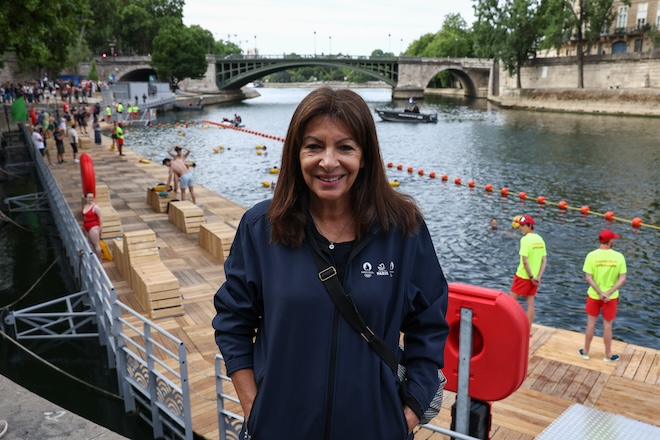
For all they share, and all that separates them, it is exhilarating to imagine what these two mayors might learn from each other if they were to meet up and compare notes.
Hidalgo, whose second, and final, six-year term has just come to an end, has a decade more than Parker under her belt serving as mayor. Parker, meanwhile, has spent the entirety of her first term navigating a uniquely complex moment — leading a city that has not elected a Republican mayor since 1947 — during President Trump’s second term, a period that has reverberated across cities and reshaped the landscape for local leaders.
From “new equilibrium” to transformation
On a recent flight to Paris, I dove into a framework developed by Metro Future and the United Nations Development Programme that categorizes cities into four futures: Baseline, New Equilibrium, Transformation, and Decline. This reading made me think about both Philadelphia and Paris.
Philadelphia has made real progress over the past decade — job growth, population gains, neighborhood reinvestment. But if we’re honest, we may still be in what the framework calls New Equilibrium: stable, improved — but not fundamentally reimagined.
Transformation is something else entirely.
And that is precisely what Mayor Parker is positioning Philadelphia to achieve.
How does Philadelphia move from successful pilots to citywide transformation?
After twelve years under Hidalgo’s leadership, Paris offers a model of what transformation can look like in practice.
During her time as Mayor, Hidalgo pursued a sweeping reinvention of Paris — reducing car traffic, expanding cycling infrastructure, planting tens of thousands of trees, investing in social housing, and reclaiming public space for people. Her policies were controversial at times — but that may be the point. Does transformation ever happen without friction?
While many Parisians balked at reducing parking for bike lanes and pedestrians when first proposed, in 2025, 66 percent of Paris voters supported converting 500 additional streets into pedestrian green streets and removing 10,000 parking spaces.
Could Philadelphia take these types of major steps, even if it means losing a few supporters in the short run? After all, Hidalgo has shown that you can win a lot of constituents back once they see the transformation materialize.
What does a “clean” city really mean?
In Philadelphia, “clean” typically refers to addressing litter — a long-standing and very visible challenge that our city has been tackling for far too long.
In Paris, the definition goes deeper.
Paris’s streets are far from sparkling (any visitor will quickly notice how many dogs leave their mark on the sidewalks). But the city has made extraordinary progress on two fronts that fundamentally shape public health: water and air.
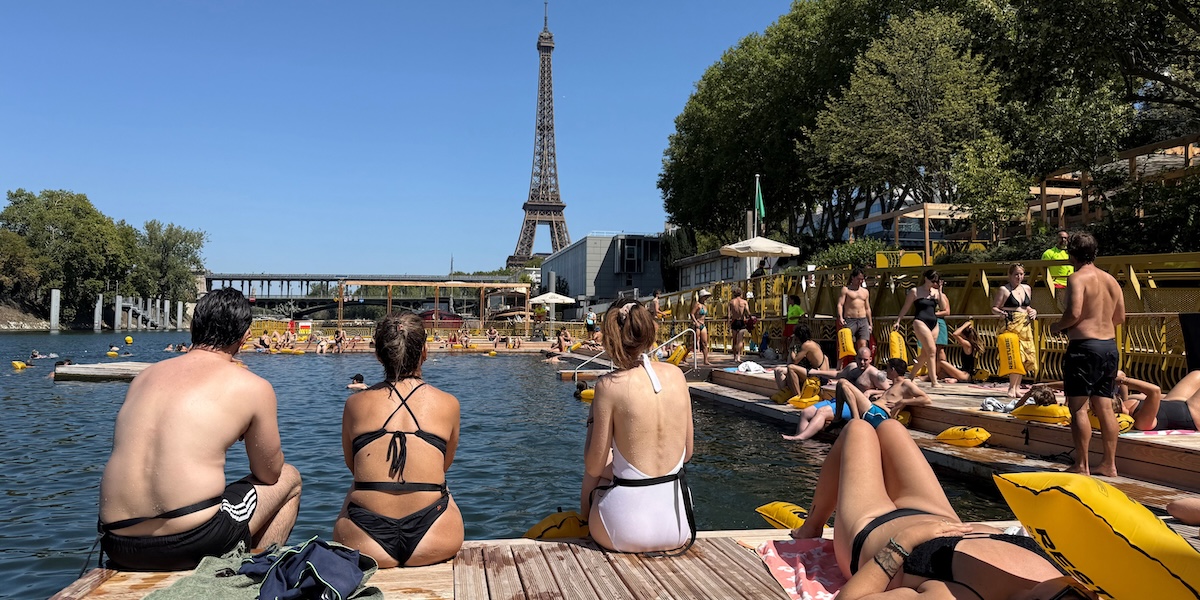
The Seine River is now swimmable again — a feat made possible by major infrastructure investments tied to the 2024 Olympics. What was once unthinkable is now reality. While Philadelphians may not be contemplating a river swim just yet, the city has made sustained investments in water quality through its nationally recognized Green City, Clean Waters program, which uses green stormwater infrastructure to reduce pollution flowing into the Schuylkill and Delaware rivers.
Both cities are attempting to improve air quality. Paris has managed to cut air pollution roughly in half over the past decade through its reduction in vehicle emissions, while Philadelphia is beginning to build the foundation for similar progress. The installation of 76 air quality monitors across neighborhoods gives the City real-time data to act on.
But Paris raises a bigger question: What is Philadelphia’s “Seine moment”? What bold, seemingly out-of-reach goal could redefine how we think about environmental health here?
The green city is a designed city
When it comes to climate resilience and urban design, Paris offers a masterclass in scale. Mayor Hidalgo committed to the following in her second 6-year term, which is came to a close in March 2026:
-
- 170,000 trees planted or planned
- 225 “school streets” already closed to cars (with a goal of 300)
- 1,000+ kilometers of bike lanes
- 500 additional streets slated for pedestrianization
None of this happened without resistance. But over time, the changes reshaped how residents experience their city. They changed how Parisians move, gather, and live.
Philadelphia is not starting from scratch, but our city needs to get serious about turning up the dial when it comes to implementation. The Philly Tree Plan aims for 30 percent tree canopy in every neighborhood (up from roughly 20 percent today). Urban forestry modeling suggests that the additional 10 percent needed for Philly Tree Philly represents approximately 1 million trees.
When it comes to pedestrian-friendly streets, the city has piloted closing streets to cars with measurable success — Center City District’s Open Streets program increased foot traffic by 27 percent and boosted sales by 38 percent.
But Paris didn’t just pilot — it committed.
There are also small, practical lessons we can learn from. European cities routinely use retractable bollards — often automated and even illuminated — to manage street access without having to pay for Police overtime to man street closures. It’s a simple design solution with big implications for scalability.
The question becomes: How does Philadelphia move from successful pilots to citywide transformation?
Transformation begins with the willingness to push beyond what feels realistic — and to stay the course long enough to make it real.
Economic opportunity Is spatial
Beyond climate and cleanliness, both mayors share a deeper understanding: cities must work for people who did not grow up with privilege. That perspective shapes their policies.
Paris has embraced the “15-minute city,” ensuring residents can access work, healthcare, education, and culture within a short walk or bike ride. It has also aggressively expanded social housing, aiming for 30 percent of all housing to be subsidized — and is intentionally placing it in wealthier neighborhoods.
Philadelphia’s recently announced H.O.M.E. Initiative — committing to 30,000 homes — is a major step forward. But lessons from Paris and other cities tell us that where these homes are built is a key factor; mixed income communities are essential for economic mobility. Intentional strategies will be needed in the City of Brotherly Love and Sisterly Affection to avoid furthering income segregation. Philadelphia’s inclusionary zoning policy allows developers to opt out by contributing to a fund. That supports affordability broadly — but does not contribute to reshaping neighborhood-level opportunity.
Paris forces the issue. Can Philadelphia do the same?
Transformation starts with a wild imagination
Cities don’t transform because of a single policy or program. They transform because leaders — and residents — are willing to imagine something bigger.
Paris shows what sustained, decade-long commitment to a bold vision can achieve. Philadelphia’s mayor has a similarly expansive vision and a moment of opportunity, with global events like 2026 on the horizon.
If Mayor Parker and Mayor Hidalgo ever did sit down together, they might exchange technical strategies, policy ideas, and political lessons. But they would certainly agree on something more fundamental: Transformation begins with the willingness to push beyond what feels realistic — and to stay the course long enough to make it real.
Sylvie Gallier Howard is the CEO of Equitable Cities Collaborative, a firm that provides strategic advisory services to governments, nonprofits, philanthropy and the private sector. She is the former Commerce Director for the City of Philadelphia.
The Citizen welcomes guest commentary from community members who represent that it is their own work and their own opinion based on true facts that they know firsthand.
 MORE ON MAYOR CHERELLE PARKER