


What do the protests this year in Minneapolis against ICE, the efforts to stop the ICE detention centers, and successful opposition to those AI data centers have in common?
Answer: Two things.
First, each represents an arena in which ordinary citizens, coming together across party lines, are succeeding in putting a stop to things that morally outrage them. In my mind, these efforts are giving the lie to the idea that Americans all hate one another and are ready for civil war. (Even two ideologically opposed governors — Greg Abbot of Texas, and Cathy Hochul of NY, have come out in opposition to data centers. So has Governor Josh Shapiro after initially supporting them.)
But these examples share another trait: They are all reactive. They show citizens successfully opposing something harmful and morally offensive. Fair enough. But what are examples of cross-party citizen action where people are not just resisting, but building, i.e., advocating for and achieving something constructive?
In a testimony to what is still good about the United States, there are a great many to choose from.
A dramatic example is the remarkable effort of the citizens of Riverton, Wyoming, population 11,000. When the town’s hospital shut down key services, including the emergency department, in 2021 and effectively ceased functioning as a full hospital a year later, residents — ranchers, tribal members, conservatives, liberals — voted overwhelmingly to create a community-owned hospital district. Working together across party lines, citizens secured local and county funding, negotiated with the state, and built a new medical system from the ground up. The new hospital will open its doors this year.
Similar if less dramatic citizen efforts are also occurring in Burlington, Vermont, where the town built a community-owned broadband network when private providers failed to deliver affordable service. Detroit neighborhoods created land trusts and urban farms to reclaim abandoned property and stabilize housing. Citizens of Greensboro, NC train trusted neighborhood figures to mediate conflicts and support high-risk individuals before violence occurs.
Go Philly!
The Philadelphia region offers many vivid examples of what democratic engagement looks like when citizens move into the high-concern, high-efficacy quadrant.
I am referring to the matrix, below:
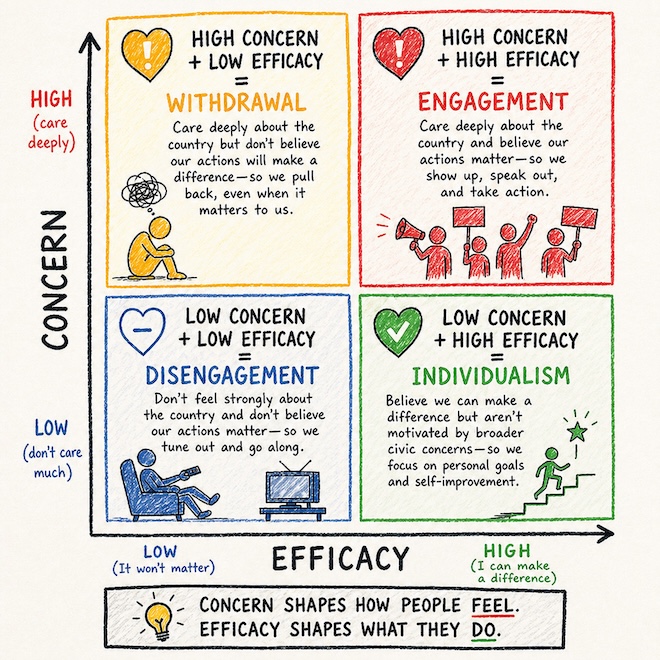
In Philly’s Kensington area, residents created the Kensington Corridor Trust to take commercial land out of speculation and place it under community stewardship, proving that neighbors can reclaim a future everyone else had written off.
In West Philadelphia, the Skills Initiative emerged from local organizing long before it became a national model, showing how communities can build economic mobility from the ground up.
East Falls residents formed their own development corporation and are shaping the neighborhood’s residential and commercial growth.
And in neighboring Media, PA, citizens created the FreeStore and Time Bank, building a civic economy based on shared skills rather than market transactions.
None of these efforts were driven by sweeping national movements but by ordinary people who care deeply about their communities and believe their actions can matter. They demonstrate that when concern is paired with efficacy, citizens do more than participate in democracy — they build it. Those people live in the upper right quadrant.
Action: the antidote to despair
Initiatives like these don’t just solve practical problems — they directly counter two forces driving so much of the widespread despair many Americans feel at the state of our country: the belief that nothing will ever change and the belief that only national politics matters.
People act when they both care about a problem and believe they can shape the outcome — the core insight of the concern-efficacy matrix. When communities have both, democratic energy becomes contagious. Riverton and the other examples show this clearly: Residents cared deeply about a community problem and believed they could build something new together.
Civics education should help students see this dynamic, because democratic life depends on cultivating not just concern but the lived experience of efficacy at a human scale. Effective civics teachers help people learn that democratic agency is not confined to voting or national debates; it is real and alive when people in communities take responsibility for solving their own problems.
Local problem-solving has another benefit: It builds trust. Robert Putnam called this social capital. He pointed out that the type of social capital that counts the most (he called it “bridging capital”) results when people form “cross-cutting relationships,” his term for ties that connect people who differ politically or socially.
When people come together from different circles or ideologies and work side-by-side on something they all care about, boundaries soften and community-driven projects become antidotes to polarization. As they do, they replace helplessness with agency and remind people that democracy isn’t something to be argued about on screens but built together, face to face.
When neighbors organize to build a hospital, reclaim a commercial corridor, or create a community-run skills initiative, they experience something that a focus on national politics rarely provides: proof that their actions matter. That lived experience of efficacy pulls people out of the “withdrawn” quadrant of the matrix.
My friend, Andy, who is fond of saying, “Things aren’t hopeless and you aren’t helpless,” is right. And when you act out of those truths, things get better.
Richard McKnight, PhD is the Project Director of Light Many Fires, a civic engagement project in the Philadelphia area. In this capacity, he speaks to groups and facilitates dialogues about the themes in his book, When We The People Lead, The Leaders Will Follow.
 CITIZENS TAKING ACTION
