




Fairmount resident Michele* was horrified as she watched video after video and news report after news report about Immigration and Customs Enforcement (ICE) snatching U.S. residents from their homes, cars, jobs, courthouses, grocery stores, even sidewalks in cities and towns for potential detainment and deportation. To her, what ICE was doing was incredibly inhumane and unAmerican.
Michele had protested and donated to mutual aids to support individuals taken by ICE. But, she wanted to do more.
When a friend told her about El Comite De Trabajadorxs de Restaurante, a South Philadelphia-based nonprofit that, among other things, canvasses local restaurants and other small businesses in the hopes of training workers to protect themselves from unlawful ICE searches and human seizures, Michele signed up to help.
“At first, I felt nervous … it’s such a nerve-wracking topic,” she recalls. But after talking to more established Comite canvassers, “I felt much more comfortable,” adding, “We have to accept [ICE raids] as a reality, and it’s better to talk about it.” Better still to talk to people who are frightened for themselves, their livelihoods, their families and their coworkers.
Since the winter of 2025, volunteers for El Comite De Trabajadorxs de Restaurante have visited more than 450 Philadelphia restaurants to help prepare both front- and back-of-the-house workers in the event of an ICE raid. These volunteers provide facts and training, set up response and preparation strategies, and designate responsibilities.
Their goal: Turn these businesses into “sanctuary workplaces” for as many as possible of the estimated 12,800 foreign-born workers in Philadelphia’s accommodation and food services sector. So far, they’ve accomplished making thousands of employees in Philadelphia are now prepared for ICE both in and beyond their workplaces, information they’ve shared with family and community members.
El Comite De Trabajadorxs de Restaurante
El Comite De Trabajadorxs de Restaurante came about during the height of the Covid pandemic, when revelations arose about adverse working conditions nationwide disproportionately affecting undocumented workers, especially frontline workers and members of the restaurant industry, — namely a lack of safety and health protections, wage theft, and sexual harassment.
El Comite co-founder Nati Nicastro had organized for the Coalition for Restaurant Safety and Health and Philadelphia Area Project on Occupational Safety and Health (PhilaPOSH), an organization that facilitates legal support to workers, advocates for legislation towards workers’ rights, and fights for safe workplaces. Co-founder Carly Pourzand had worked with the People’s Growing Project, an initiative dedicated to environmental justice and urban greening in Philadelphia, and the People’s Kitchen, a space that supports Philadelphia community members facing food insecurity and where allies advocate for food justice. Nicastro and Pourzand joined with four immigrant workers — Erendira, Veronica, Yuris and Yanet — to build solidarity among laborers and advocate for safer, fairer working conditions.
Although Philadelphia has received less media attention than, say, Minneapolis for ICE actions that have taken place here, many of the city’s approximately 246,600 foreign-born residents — who, as of 2024, comprise roughly 30 percent of Philadelphia’s small business owners, according to Pew — seemed afraid.
“We began just as a worker committee,” says Pourzand. They hosted meetings for local workers, and circulated a survey asking them about their concerns. She was impressed by the more than 100 responses. “It takes a lot [of bravery] for an immigrant worker to fill out a questionnaire regarding their concerns,” she says. Doing so, she adds, “really speaks to the level of deep trust they found within the community we were building.”
Soon, the group was lobbying City Hall. They worked with City Councilmember At-Large Kendra Brooks on 2021’s Paid Sick Leave Bill that reinstated two weeks’ worth of emergency sick leave for approximately 750,000 employees of restaurants, sports venues, retail, and other businesses in the city. They advocated for the 2025 City’s Protect Our Workers, Enforce Rights (POWER) Act, legislation that provides the Department of Labor with expanded legal mechanisms to enforce municipal labor protections, including wage theft and paid sick leave ordinances, and to hold employers accountable for retaliatory practices against workers who exercise their rights.
They created and held survivor-led sexual harassment training, teaching workers about how to navigate consent in the workplace, how to exercise their rights, and how to be good bystanders while generally providing a healing space for survivors.
In short, El Comite achieved what they set out to, giving a voice to immigrant laborers. They didn’t know it at the time, but they were also preparing themselves for an onslaught of changes to federal immigration policy that would soon send the 16 percent of Philadelphians who are foreign born — along with their families and communities, and, frankly, anyone who might resemble or sound like someone from another country — reeling.
ICE in Philadelphia and PA
Between January 2025 and March 2026, ICE arrested approximately 8,800 Pennsylvanians for alleged immigration-related violations, a fourfold increase in the same kinds of arrests over the most recent 14-month timespan under the Biden administration. (Arrest numbers are not available for Philadelphia County alone.)
Although Philadelphia has received less media attention than, say, Minneapolis for ICE actions that have taken place here, many of the city’s approximately 246,600 foreign-born residents — who, as of 2024, comprise roughly 30 percent of Philadelphia’s small business owners, according to Pew — seemed afraid.
So, in the fall of 2025, Lucia Navarro, a contractor with El Comite, alongside Yuris and Erenirda, began visiting restaurants to provide workers with “Know Your Rights” information in the event of ICE actions there.
But they soon realized the need was greater than their capacity. Not only were there more restaurants than two people could handle, but since they could only speak Spanish, they needed more help.
So, the advocates put the word out that they were seeking like-minded helpers. By January 2026, they’d recruited 20 volunteers to visit major dining-out corridors in South Philadelphia, University City, Old City, Girard Avenue and Chinatown. Today, their ranks have swollen to 100 who’ve made a total of 14 citywide sweeps.
Canvassing for safe workplaces
Each time El Comite gathers about 10 new interested community members — current volunteers include seasoned labor lawyers and retail employees; no formal experience required — they invite them to a 15-minute orientation at their office. The format is simple: An experienced volunteer goes over a script, displays posters and templates for safety plans (which apply to both restaurant workers and customers), and leads the group in a role-playing exercise where prospective volunteers practice entering a place of business and interacting with a supervisor.
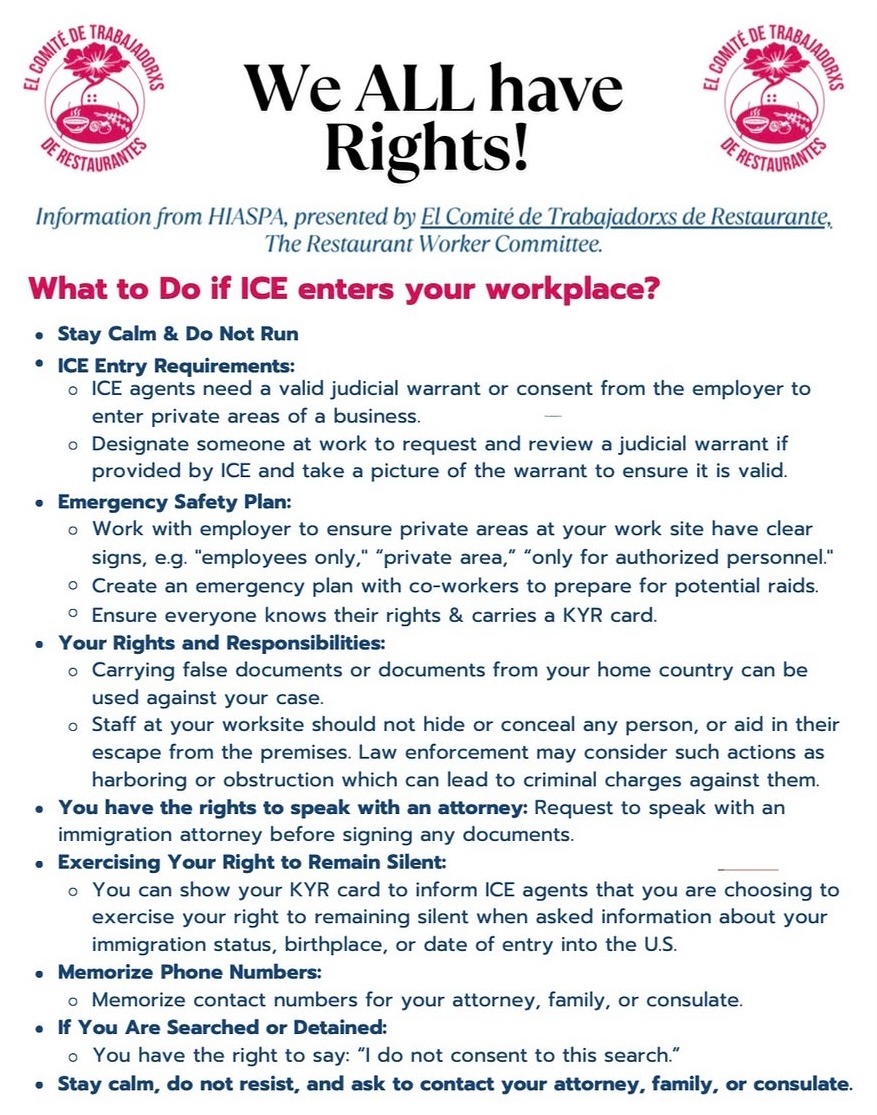
Once trained, volunteers go out in pairs to visit 10 to 15 pre-designated restaurants. They ask to meet with managers, and, if permitted, speak with employees about what to do if targeted or detained by ICE. They warn them about the common ICE tactic of showing unsigned search warrants (which do not legally require their compliance), and provide a valid / legal sample judicial search warrant — signed by a judge — for comparison’s sake.
Canvassers also inform businesses of their right to prevent federal agents from entering designated private areas and give out posters designating one or more areas as private.
“It takes a lot [of bravery] for an immigrant worker to fill out a questionnaire regarding their concerns,” she says. Doing so, Carly Pourzand adds, “really speaks to the level of deep trust they found within the community we were building.”
They also distribute a template of safety plans for managers and employees to build themselves. These plans designate employees with roles of “askers” who ask agents to see warrants, “blockers” who prevent access from private areas, “callers” to inform the Juntos ICE hotline, and “documenters” to record the operation and help build a legal case.
Nicastro considers the template to be “the most important material we provide … because it starts a conversation with the managers and workers amongst themselves. It prepares the staff and helps them visualize what they are going to do — and it helps all workers feel more united.”
Volunteers also give out posters summarizing immigrant workers’ rights in the event of an ICE raid and “red cards” for workers to show agents instead of speaking to them. These cards assert the holders’ 4th and 5th Amendment rights to refuse to answer questions and to deny searches, respectively.
The canvassers offer to set up a return visit for more in-depth staff training, which might include a review of Constitutional rights of citizens and non-citizens, and lessons in de-escalation and safety protocols in the case of encountering ICE in public or private settings. El Comite representatives always leave their information, in case of follow-up questions, requests for help, or even offers to volunteer alongside them.
Nicastro explains that the canvassing also helps her organization identify workplaces and neighborhoods that might be unsafe for immigrant workers. In this way, canvassing “is an entryway to show the employers that we are here to fight for their employees, and show their employees that we can help make things better for them,” says Nicastro. In other words, canvassing helps El Comite spread their original message of workplace safety and fairness. After all, says Pourzand, a sanctuary workplace shouldn’t just offer sanctuary from ICE. It should also provide safety when it comes to workers’ wellbeing and incomes. So far, Philly restaurants have done pretty well.
According to data canvassers have collected, 74 percent of businesses have been either very supportive or supportive of the mission; 8.3 percent were very unsupportive or non supportive; and 17 percent seemed neutral.
Among the very supportive: Fishtown’s Johnny Brenda’s, which was proud to attend a “Know Your Rights” training. The result hasn’t just impacted immigrant workers. Max, a Philadelphia resident and server at JB’s, says it feels good to work in a place that supports immigrant workers. “It is so important for everyone to feel as safe in their workplace as I do in mine,” she says.
*Editor’s note: Some last names have been omitted, at the request of interviewees, for fear of governmental retaliation and / or doxxing.
 MORE COVERAGE OF ICE IN PHILADELPHIA
