


Every other Wednesday morning around 8:30am, about 30 people, most in business casual dress, gather at Dilworth Park outside City Hall. Most of them have a cup of coffee in one hand and a set of handlebars in the other. This is the convergence — the end of the line — of the Philly Bike Train, a group who rides together once a week from different parts of Philadelphia to work in Center City.
Listen to the audio edition here:
They might represent the next generation of commuters.
Over the last five years, Philadelphia has added 40 miles of bike lanes. In 2025 the Bicycle Coalition and the Indego bike share system recorded ridership that increased by 15 percent. More than 17,300 city residents — 1.1 percent of the city’s population — reported using a bicycle to commute at least three days a week.
But this steady increase in two-wheeled commuting comes with a potentially deadly cost. As of March, one cyclist and two e-scooter riders were among the 35 victims of traffic-related accidents in Philadelphia, according to the Bicycle Coalition. These numbers put the city on track to exceed last year’s traffic deaths.
While bike lanes can go a long way to bring awareness to bike riders, they don’t always protect them. Things that do protect them include wearing a helmet and bright clothing, obeying the same rules as cars, including using lights after dusk, and … riding in numbers.
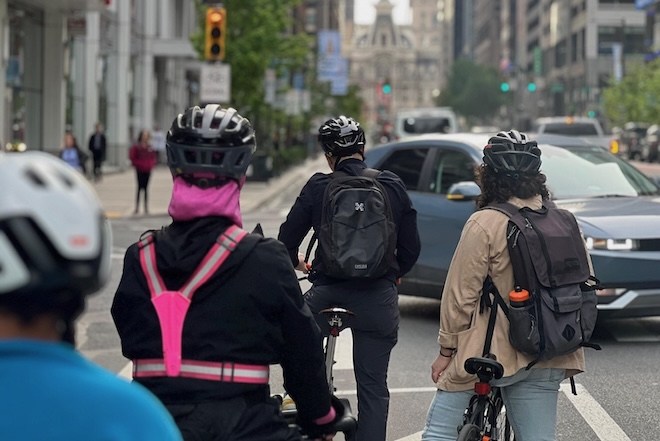
Safety in numbers
“My first ambulance ride was from getting doored riding north on 20th street, just south of Washington Avenue,” says Kelsey Hubbell, a Philly Bike Train ride organizer. “It was an early dismissal day for City workers, and I was grabbing hoagies to meet friends for a picnic on the Schuylkill. I pulled up to a red light as someone opened their passenger side car door. I rode right into it and spent five hours at the Jefferson ER for a few stitches.”
Hubbell feels much safer on Wednesday mornings.
Zac Benjamin previously lived in famously bike-friendly Portland, OR, where he “saw firsthand what happened when politicians considered people on bikes as a political force to court.” He founded the group in September 2024 with a single route from South Philly to City Hall. For the first few Wednesdays, no one came.
About a month later, riders began showing up, not just to join Benjamin in the 15- to 20-minute commute into the city, but to establish routes of their own. Alexa Ringer started up the Fishtown route. She says when she initially read about the idea, “My first thought was: How cool would it be to have a buddy on my commute? It’s way less stressful when you’re with friends.”
Today, the Bike Train runs from Clark Park, Wharton Square, Athletic Center in Brewerytown, Dickinson Square and Palmer Park to Center City, and has one route that runs in the opposite direction, from 15th and Mifflin to the Navy Yard. Each route has a dedicated ride leader.
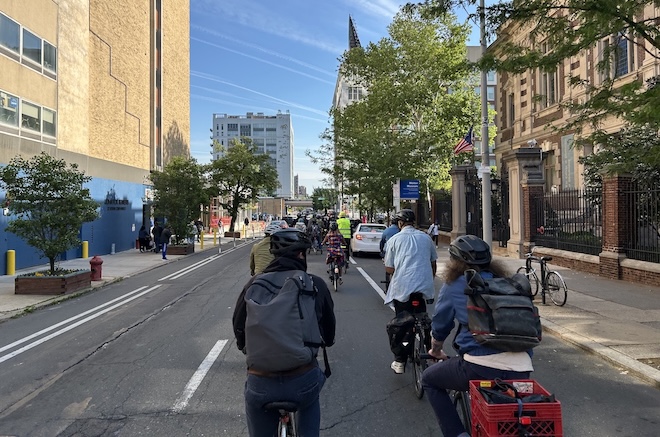
The group has grown their presence on social media. One rider hooked them up with free coffee upon arrival in Center City. Another illustrated a comic of the Bike Train for a Philly Bike Action zine.
“The open secret about the Bike Train is that it’s kind of a pre-work social club,” says Benjamin, who has also designed the group’s website. “We usually have coffee, and the hang out lasts for about 30 minutes as the rides each roll in. It’s been a great way to meet some very kind and passionate people.”
There’s no charge to participate, but many riders volunteer their time to make social media posts, develop partnerships, or talk up the group. At the end of last year, the group surveyed participants and found out 73 percent typically walk or ride to work — meaning more than a quarter of them would likely not bike to work, if it weren’t for the Bike Train.
The up (and down) sides of cycling
The benefits of cycling are well documented. Not only is it better for the environment than driving, but “a person on a bike saves themselves money, and data suggests it also benefits local businesses in a way that isn’t possible via car or by foot,” Benjamin says. “The health benefits compound similarly. Riding a bike improves one’s health: Both short term stress relief and long term heart health.”
Ringer says Center City’s layout is especially conducive to biking: “Philly’s grid and narrow streets mean there is often a low-stress way to get where you’re going, and the large number of narrow one-way streets means drivers tend to not go as fast.”
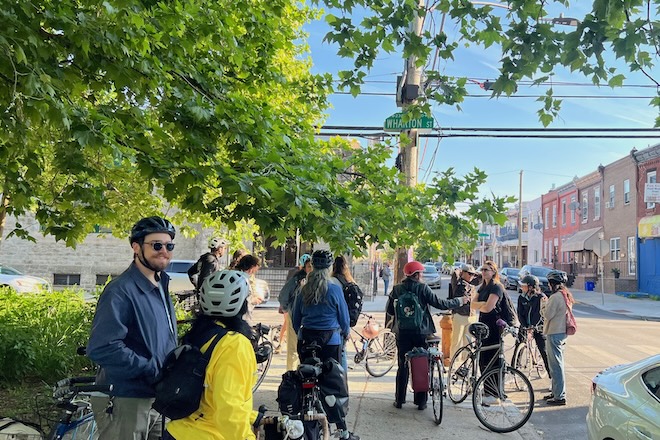
Nonetheless, “it can sometimes feel stressful when there’s no designated bike lane, shoulder, or space to ride if a driver impatiently wants to pass us.”
Speaking for the group, Benjamin says he’d like to see more and safer bike lanes. He calls bicycle infrastructure “a screaming bargain … Philly has plenty of low-hanging fruit. We could swap the bike lane on Spring Garden Street between the curb and the parking lane and it would make both safer.”
But adding bike lanes has not been without controversy. Critics accuse bike advocates of pushing an undemocratic “steamroller plan.” They also seem to invite cars and trucks to use them as temporary loading zones. So much so that in the fall of 2024, City Council President Kenyatta Johnson introduced and Mayor Cherelle Parker signed “Get Out The Bike Lane” legislation, prohibiting any stopping or standing in bike lanes, expanding on a 2013 law that prohibited parking in bike lanes.
The practice, however, continues, and Parker’s 2025 budget included $5 million for concrete protection for the bike lanes. City Hall also established new, more stringent policies around loading zones. It’s all part of Parker’s “clean and green” campaign, and the city’s long-established yet slow-moving “Vision Zero” campaign to improve traffic safety.
Other obstacles to safe cycling
Last May, following the tradition of the Bike Train, the City sponsored Bike to Work and Wherever Day. Coordinated groups of riders left from five different locations and gathered at City Hall to celebrate cycling as transport.
Promotions for the event boasted, We follow traffic laws and look out for each other. Join the fun! The post-ride rally emphasized the need for safer streets for bicyclists, pedestrians and drivers alike.
But even there, city leaders acknowledged the need for more. “Failure of infrastructure is a failure of government,” District 3 City Councilmember Jamie Gauthier told the crowd. That infrastructure can’t work for a city as a whole, so long as individual district representatives on Council can institute or block changes from happening.
The controversial practice of councilmanic prerogative — wherein district councilmembers have the final say over changes to their districts, for better or worse — has allowed, for example, District 1 Councilmember Squilla but not District 2 member and Council President Johnson to add additional protections for bike lanes along multi-lane Washington Avenue in their respective districts. So, the lanes in District 2 (West of Broad Street to the Schuylkill River) lack the traffic calming measures (fewer lanes, corner wedges, bus islands, bike lane protections) of the lanes in District 1 (East of Broad to the Delaware River).

Then, there are the challenges on a national level. In July, U.S. Secretary of Transportation Sean Duffy went on X and declared an end to federal support for “DEI bike lanes.” Duffy’s declaration was part of the Trump administration’s $1.73 billion shift away from Biden-era funding, which provided millions in bike-related infrastructure grants to places like Albuquerque, NM, and Fairfield, AL. Soon after the announcement, NPR reported that a “growing list” of “bike-related safety materials have disappeared from the Federal Highway Administration’s website.”
This could be bad news for Bike Train riders. According to that 2025 report from the Bicycle Coalition, unlike New York City, the City of Philadelphia relies substantially on state and federal funding for infrastructure, which includes bike lanes. Although it’s too early to predict how a change in Washington, D.C.-based policy will impact Philly, you can bet we won’t be receiving another $16.4 million in federal funds for bike and pedestrian safety as part of the Safe Streets and Road for All grant like we did in 2023.
That said, nationwide, support for biking persists. A March 2025 survey from YouGov found three-quarters of adults living in the U.S. supported bike lanes in their hometowns. As Philadelphia cyclists await more and safer bike lanes, “Philly Bike Train makes it easier to take up space on the roads,” Ringer says, “It’s our right too.”
Adds Benjamin, “We all see greatness in Philly and are working in our own ways to realize it.”
Corrections: As of March 2026, there have been 35 traffic-related deaths. Among them is one cyclist. One Bike Train runs south from 15th and Mifflin streets to the Navy Yard. A previous version of this post misidentified the Wharton Square route riders and Market Street.
 MORE ON RIDING YOUR BICYCLE IN PHILLY
