





On December 5, 2025, at the insistence of Secretary of Health and Human Services, Robert F. Kennedy Jr., President Donald Trump issued an executive order asking that the U.S. align its itself with peer countries that give fewer vaccines. Where the U.S. gives vaccines to prevent 18 different diseases, Trump noted that Denmark only recommends 10 vaccines, Japan 14, and Germany 15. Why can’t we be more like them?
First off, what problem are President Trump and RFK Jr. trying to solve by giving fewer vaccines? Since 2015, Donald Trump has argued that children get too many vaccines. Similarly, RFK Jr., believes that too many vaccines are overwhelming, weakening or perturbing our immune systems. Kennedy frequently points out that as a child he only got a couple of vaccines. And he’s fine. But a closer look tells a different story. It’s not the number of vaccines that’s important, it’s the number of immunological components in vaccines that counts.
RFK Jr. and I have one thing in common: We were both born in the early 1950s. At that time, we received the smallpox and diphtheria-tetanus-pertussis (DTP) vaccines. The smallpox vaccine contained about 200 viral proteins, each of which induced an immune response. The diphtheria and tetanus vaccines each contained one bacterial protein (inactivated toxins called toxoids). The pertussis vaccine was a different story. The pertussis vaccine, which was a whole, killed bacterial vaccine, contained about 3,000 different bacterial proteins, each of which induced an immune response.
Denmark is indeed healthier than the United States. But this has nothing to do with how many vaccines children receive and everything to do with a better healthcare system and a more homogenous, smaller population.
In other words, RFK Jr. and I each received about 3,200 separate challenges to our immune system in the form of viral and bacterial proteins. Due to advances in recombinant DNA technology, protein chemistry, and adjuvants, the 18 vaccines given to children today contain only about 180 separate immunologic challenges. In other words, RFK Jr. and I managed a greater challenge to our immune systems with the two vaccines that we received in the early 1950s than in the 18 vaccines that children receive today.
Some anti-vaccine activists have argued that Denmark has better longevity, lower infant mortality, and better health because they give fewer vaccines. Specifically, Denmark doesn’t give vaccines to prevent rotavirus, respiratory syncytial virus (RSV), influenza, varicella, hepatitis A, meningococcus, and Covid-19. Denmark is indeed healthier than the United States. But this has nothing to do with how many vaccines children receive and everything to do with a better healthcare system and a more homogenous, smaller population.
In other words, we aren’t Denmark:
-
- Denmark has a population of about 6 million people, roughly three-fourths the population of New York City.
- The U.S. healthcare system is largely private, market-driven, and expensive, leaving about 10 percent of the population uninsured, which has resulted in limited or delayed care. Denmark, on the other hand, has a universal, tax-funded system emphasizing free access.
- Denmark heavily subsidizes childcare while the U.S. has no federally subsidized childcare system.
- The U.S. childhood obesity rate is roughly 3 to 4 times higher than Denmark.
- The U.S. has roughly twice the incidence of diabetes compared with Denmark.
- The child poverty rate in Denmark is 4 percent; in the U.S., it’s 20 percent.
Although Denmark’s healthcare system far exceeds that in the United States, RFK Jr. and Donald Trump have ignored one important fact: Independent of the level of hygiene in the home, sanitation in the country, general health of the population, or access to healthcare, certain diseases, for instance rotavirus, RSV, influenza, and Covid-19, will infect virtually all children by 10 years of age. Every year, about 1,200 children in Denmark are hospitalized with severe dehydration caused by rotavirus infection. And every year, more than 2,800 children in Denmark, mostly less than 6 months of age, are hospitalized with pneumonia caused by RSV.

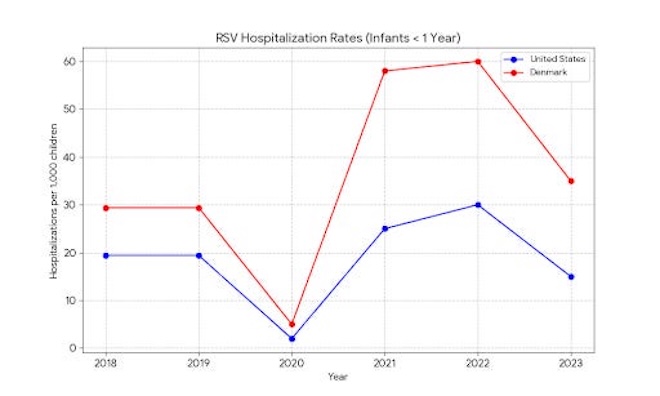
Accounting for differences in size of the countries, these figures are virtually identical to those found in the U.S. before vaccination. In the United States, a routine rotavirus vaccine recommendation in 2006 has virtually eliminated the 70,000 hospitalizations caused by rotavirus every year. During the past year, routine recommendations for a maternal RSV vaccine and an RSV-specific monoclonal antibody has reduced the 60,000 to 80,000 RSV-associated hospitalizations in infants less than 7 months of age by about 50 percent.
Given the impact of these vaccines, the better question is why doesn’t Denmark emulate our vaccine program, not the other way around?
Paul A. Offit, MD, is director of the Vaccine Education Center and professor of pediatrics in the Division of Infectious Diseases at Children’s Hospital of Philadelphia. This piece originally ran on his Substack, Beyond the Noise!
The Citizen welcomes guest commentary from community members who represent that it is their own work and their own opinion based on true facts that they know firsthand.
 MORE FROM PAUL OFFIT, M.D.