



What do you do with a black-and-white photograph from the 1890s depicting female physicians from around the world? Maybe you double take and ask yourself: Were women even allowed to become doctors nearly 150 years ago?
The strikingly diverse Victorian era group might also give you pause. Would that even be possible way back then?
Upon stumbling upon such a photo in 2016, Suli Holum asked herself those same questions — then took it several levels beyond. After spending the greater part of a decade researching the women in that photograph, this month, Holum debuted a play she researched and wrote about the Woman’s Medical College of Pennsylvania, once located at 6th and Arch streets, at People’s Light Theatre in Malvern.
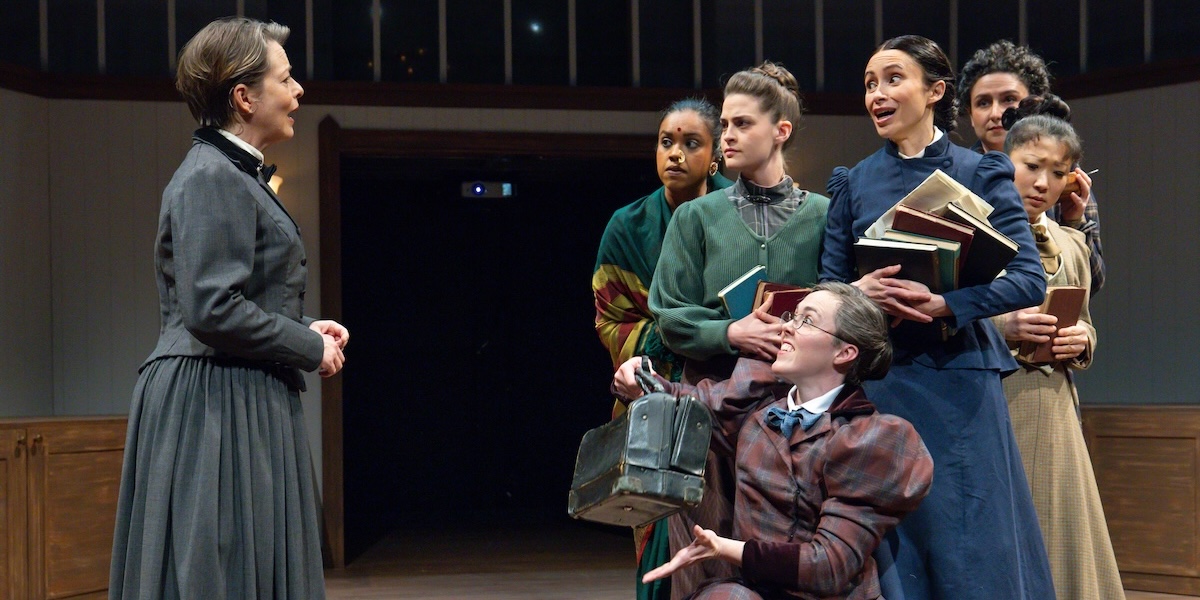
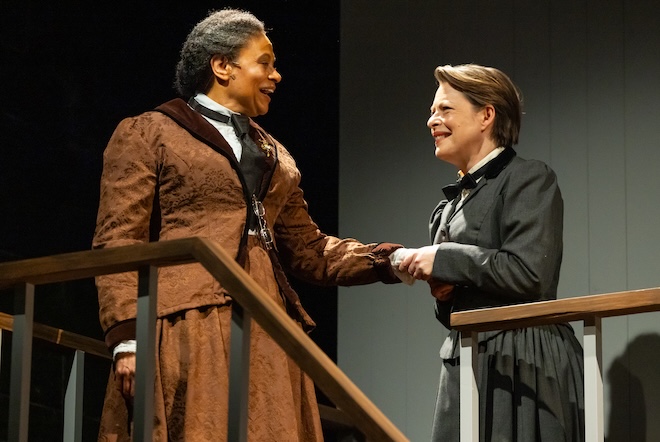
The Woman Question, directed by Melissa Crespo, has a nine-person ensemble cast. Holum plays Dr. Anna Broomall, a Delco native, obstetrician, teacher at the college and the founder of the nation’s very first maternal health and prenatal care clinic. Other cast members portray the nation’s first female Native American physician, along with students (all women) from Japan, Syria and India and the American South, where she had been enslaved — “all,” she says, “interacting with each other and becoming doctors together.”
The work does more than take its audience on a two-and-a-half-hour journey through history, weaving elements of documentary and fantasy, touching on matters of reproductive rights and women’s health. The Woman Question indeed begs the question: Is one of the reasons we’re so surprised to see a diverse group of women becoming doctors 150 years ago because women today, especially women of color, are still underrepresented in medicine, experiencing dramatic rollbacks of reproductive rights, and still struggling to be heard by their healthcare providers?
Work-in-process theater
Growing up in West Philadelphia, Holum had no short supply of theatrics in her household. Her mother, a professional modern dancer, and her father, a Lutheran minister, each had a unique sense of performance they carried with them, something Holum described as “a huge influence” on her own love of theater.
Couple that with a deep sense of social justice that stemmed from her father’s teachings, and Holum always felt connected to performance as a means of understanding.
“I’m really drawn to highly physical visual work and ensemble work,” she says. So much so, Holum co-founded the groundbreaking experimental Pig Iron Theatre Company during her undergrad years at Swarthmore College. That’s where she started playwriting.
Holum is a self-proclaimed maker; she has always looked at her theater experience as a place to shape a story with the help of other performers “writing on their feet.” In that sense, playwriting is fluid, shifting with each iteration of the show, forever undergoing the process of molding together like clay.
Zak Berkman, People’s Light’s Producing Artistic Director, who is also working on The Woman Question describes Holum as “a full-body force of nature: passionate, insightful, rigorous …muscular in the way she creates a work of theater … joyful and exhilarating as well.”
“I love responding to what is most exciting in a room, what lands in a room and gets people going. And then, figuring out how to craft [an idea] so that it can be successful over and over and over again,” she adds.
When Little Women meets The Pitt
Around two decades into her acting-playwriting career, Holum was writing a play as part of an independent project in an artistic residency at North Dakota State University. While researching and interviewing ND Native Americans, she came across the story of Dr. Susan La Flesche Picotte — the first female Native American physician and a graduate of the Woman’s Medical College of Pennsylvania.
“I stumbled on her biography,” Holum remembers. Then, she saw the black-and-white class photo. Wheels started turning immediately — and delivered straight to the school’s archive, “15 minutes from my house in East Falls.” (East Falls was the third and final location of the college, which became the co-ed Medical College of Pennsylvania in 1970.)
There, she found letters, diaries, and scrapbooks filled with photographs of these students — and something that resonated deep in her performative bones: “The lives of these students were so full of theater.” She means this literally. “They put on plays all the time. They did costume balls … I found a transcript of a mock trial class and script that one of the professors had written,” says Holum.
The whole thing felt like kismet — and solidified Holum’s own desire to share the remarkable stories of the trailblazing women from far and wide who came to Philadelphia to become healthcare providers throughout the country.
“From the very, very beginning, I started formulating this project that was going to be like Little Women meets The Pitt,” she says. [Editor’s note: Although The Pitt debuted in 2025, Holum is referring to the idea for the realistic HBO hospital drama.]
There were also external forces at play urging Holum to write: As she continued to research and create the story, Roe v. Wade was overturned in 2022.
“The time period that I was choosing, 1894, was done purposely, because I was really interested in offering a narrative about folks who were gathered and dedicated to moving forward [in women’s health] when progress was being pulled back [in the modern day],” she says. The juxtaposition — today, nearly 63 million women live in states that ban abortion care; just this week, the U.S. Supreme Court will decide whether to restrict mail access to patients whose doctors prescribe them mifepristone — is jarring.
From a spark to the stage floor
It’s one thing to have an idea; it’s another to find a home to nurture and grow it. People’s Light felt like the perfect place to take Holum’s brainstorming into the physical world — especially after the project received grants from the Pew Center for the Art & Heritage, the Edgerton Foundation, and the NEA, enabling the theater company to bring on its full artistic team to the project.
“We wanted to find a writing project that People’s Light could nurture from conception to world premiere, and that might align well with our New Play Frontiers Commission and Residency program that focuses on local stories of national relevance,” explains Berkman.
Holum and the team from People’s Light spent nearly 10 years refining the show. The long gestational period, as she calls it, has enabled The Woman Question to truly embody the lives of these women, from their desire to become doctors to their own struggles in providing women with proper care — as well as their connection to today.
“There are story arcs and characters in this play that represent real people who were doing their thing in the 19th century,” she says. And at the same time, they represent the women of today who must continue to fight for access to fair and equitable healthcare and gender equity.
Standing centerstage
At the heart of Holum’s message is the reiteration that representation matters. She wants The Woman Question to have that same impact on the audience that the black-and-white photo had on her — to make people feel seen, to make them realize history was more diverse than history books have historically portrayed, for people of all kinds to feel a sense of pride, knowing that people who came before them broke barriers, overcame obstacles, and succeeded.
In The Woman Question, Holum says, “We’re talking about international folks.” But in a larger sense, ”We’re also talking about queer folks. We’re talking about gender non-conforming folks … They are thriving. They’re not hiding somewhere. They’re in their element.” For people who identify in any way as held back from achieving their full potential, the message and impact, she says, should be “really exciting.”
“I think, especially when you’re someone who’s actively in the thick of people trying to deny your humanity and erase your lived experience, it’s important to see that representation to say you’re valid. It’s really helpful.”
The Woman Question runs now through May 24 on the Haas Stage at People’s Light. For audience members looking to join in the conversation, the space is hosting an event in tandem with Holum’s work on May 17, titled “Toolkit for Resistance: Strategies for Supporting All Women.”
“At the outset of The Woman Question, Suli sought to provide the people behind the play and audiences with a ‘toolkit for resistance’ — a way of examining inspiring stories of the past to provide strategies for movements and revolutionary thought in our contemporary lives,” says People’s Light Associate Artistic Director Andrew Watring.
Leading up to the show’s debut, Holum worked to create collaborative opportunities, gathering “artists, educators, medical professionals, and interested individuals together for story circles, hard conversations, and meaning-making sessions,” Watring says. Such meetups inspired People’s Light to host a complementary coalition on May 17.
This gathering — free to ticketed audience members, but also open to anyone who signs up — takes place before the show, and will include a discussion led by FringeArts’ Programming Director NS Artistic Producer Mikaela Boone, on how women can come together to resist oppression and build advocacy networks, and also a panel of artists, activists and medical professionals speaking about cultivating support for women.
The performance of The Woman Question that follows will be relaxed, so audience members will be free to get up and move around, to shout out, to react — and to feel free, after the play ends, to act.
The Woman Question is on the Leonard C. Haas Stage at People’s Light, 39 Conestoga Road, Malvern, May 6 through May 24. Tickets are $28-$79.
 MORE THINGS THE CITIZEN RECOMMENDS