



For much of American history, patriotism has functioned as a kind of common language. We’ve fought bitterly over politics and culture, but have generally agreed that the country itself was worth believing in. That is, until recently.
According to Gallup only 58 percent of U.S. adults say they are proud to be American — the lowest level since Gallup began measuring the question. Among Gen Z, the number is just 41 percent.
People have good reason to be disillusioned. Today’s young adults came of age amid the wars in Iraq and Afghanistan, a financial crisis, a housing market increasingly out of reach, soaring healthcare costs, rising student debt, an epidemic of gun violence, a global pandemic, and a brutal job market (I could keep going). According to Pew, public trust in government is hovering near historic lows.
But patriotism has never meant pretending problems don’t exist. Nor has it required blind loyalty to those in power. It has meant ownership — the belief that the country is yours to improve, and ultimately yours to protect — even, or perhaps especially, when it falls short of its ideals. Your loyalty is to the country, not the people running it.
Frederick Douglass understood this better than anyone. His speech, “What to the Slave Is the Fourth of July?“ remains one of the most devastating indictments of America ever delivered. Yet Douglass later recruited Black men — including his own sons — to fight for the Union during the Civil War.
Much of what shapes our daily lives is not decided by some distant force in Washington. It is decided in school board meetings, zoning hearings, and town council meetings that most people never attend.
I learned my own version of patriotism in uniform as well. In March of 2003, I deployed to Baghdad with the 82nd Airborne. I was 29 years old, and despite growing doubts about the war’s strategic logic, I still believed deeply in the institution I was serving. Many of us wrestled with questions about the war’s purpose and direction. While we didn’t always agree with the mission or the decisions being made by those above us, we served with honor because our obligation was larger than any one administration or political moment.
I returned home from Iraq having lost 19 of my men in combat. The war was a strategic failure, but on the ground in Baghdad, I worked alongside Iraqis who risked everything for freedoms most Americans take for granted. Our interpreter Alyaa was the first person in her neighborhood to volunteer to work with American forces. Her cousin Shaimaa was later kidnapped and tortured for doing the same. They knew the risks and showed up anyway. Their courage deepened my own commitment to service and changed how I thought about my obligations to my country. If they were willing to risk everything for the future of Iraq, I had a responsibility to do the same.
A year after returning home, I ran for Congress and in 2006 became the first Iraq War veteran elected to the U.S. House of Representatives. While on the Hill, I worked to help the country live up more fully to its ideals, co-authoring the repeal of Don’t Ask, Don’t Tell and the post-9/11 GI Bill, the largest expansion of veterans’ educational benefits since World War II.
My path from military service to public service was once a familiar American story. In the decades after World War II, roughly 80 percent of Congress had served in uniform. Today, that figure is about 18 percent.
The civic pipeline that military service once provided cannot be fully rebuilt by the military alone. Only about 1 percent of Americans serve today. That number is not going back to World War II levels, nor should it.
Patriotism has never meant pretending problems don’t exist. Nor has it required blind loyalty to those in power. It has meant ownership.
But the lesson of military service is not just about the institution itself. It’s about what happens when Americans are asked to show up for something larger than themselves. We can apply that lesson in our own communities. Much of what shapes our daily lives is not decided by some distant force in Washington. It is decided in school board meetings, zoning hearings, and town council meetings that most people never attend. These meetings are open to the public. Advocating for the changes you want to see often begins with simply showing up.
Most of the decisions that affect our daily lives are made far closer to home than we realize. Yet too many of us have convinced ourselves that we are powerless to influence them.
We are not.
It’s easy to be disillusioned by a country that has failed so many of its citizens. But the answer is not disengagement or despair. We must be active participants in our democracy willing to take ownership of the outcome. The country you want exists in proportion to the work you put into building it. Take ownership of our problems and invest in their solutions.
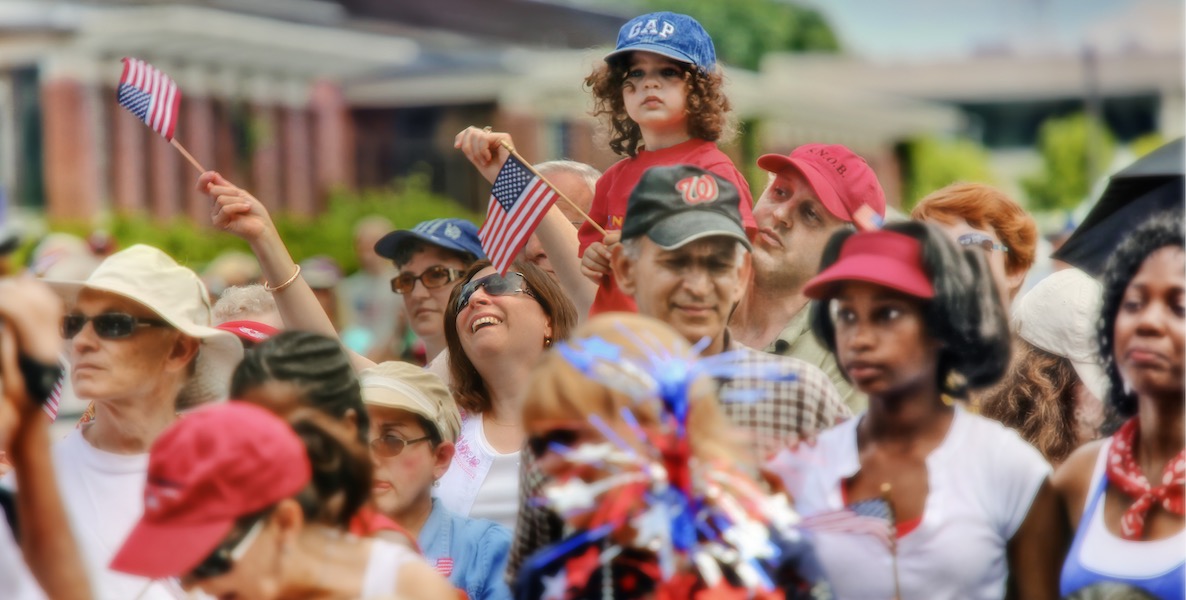
The U.S. flag does not belong to a single party. It belongs to all of us. As our nation turns 250, this moment calls on us to rebuild the habits of citizenship that once taught us how to belong to a shared project. It’s only through showing up together for what we believe in and value most that we can make it better.
The future of the republic depends on more than loving America. It depends on showing up for it — and one another. That is true love of country.
The Honorable Patrick J. Murphy is a Wharton lecturer, vetrepreneur, and the 32nd Army Under Secretary after earning the Bronze Star for service in Baghdad, Iraq as an All-American with the 82nd Airborne Division — @PatrickMurphyPA on Instagram and Twitter. Murphy is a supporter of the Citizen Media Group.
 MORE BY PATRICK J. MURPHY