


Can you believe it’s election season again? Election Day is next Tuesday, November 3, and early voting is already underway in many states. With just a few days to go, the political landscape looks very different from the one that brought Republicans back to power.
President Trump’s approval rating has fallen to 33 percent as his war with Iran has grown increasingly unpopular. Meanwhile, rising gas prices and stubborn inflation are hitting American families and small businesses at home, and some of the voters who helped put Republicans in power are beginning to look for something different.
The parallels with the 2006 midterms are hard to miss. By the fall of that year, George W. Bush’s approval rating had fallen to about 38 percent as an unpopular Iraq War and growing economic anxiety weighed on Republicans. Democrats went on to gain 31 House seats, winning control of the chamber for the first time in 12 years and breaking through in districts that had long seemed out of reach.
I was one of the unlikely candidates who helped make that happen. At 31, fresh from Iraq, I ran in a Republican-leaning Bucks County, Pennsylvania, district that Bush had carried two years earlier. Washington saw me as a long shot.
We proved them wrong.
We won by 1,521 votes — 50.3 percent to 49.7 percent — becoming the first Iraq War veteran elected to Congress and flipping a Republican-held seat in one of the defining upset victories of that election. It was a historic win in a historic election, and it gave me a firsthand understanding of what happens when the political ground suddenly shifts beneath a party’s feet. More importantly, it taught me a lesson Democrats should remember now: A favorable political climate can create an opening, but it cannot build a majority on its own. Winning still requires persuading voters who did not start out on the Democratic side and then leading them to a better United States.
The shift is showing up on the map. The Cook Political Report recently moved Texas and Iowa from “Lean Republican” to “Toss Up,” expanding the core Senate battlefield from four states to six. The Senate itself, once widely viewed as out of reach for Democrats, is now increasingly competitive. But a favorable map is not a coalition. Democrats still have to persuade the voters who are making those races competitive.
The discontent extends beyond Democrats. Seventy-one percent of Americans disapprove of President Trump’s handling of the cost of living, including four in 10 Republicans. Among independents, Democrats currently hold a significant nine point advantage on the congressional ballot. Those numbers should encourage Democrats. They should also be a warning.
A record 45 percent of Americans identified as independents in 2025, according to Gallup, while just 27 percent called themselves Democrats and the same share called themselves Republicans. Independents are the fastest growing political party in the country. These are also voters who move the needle: independents favored Joe Biden in 2020 by 9 points but split evenly between Kamala Harris and Donald Trump four years later. If American politicians want their votes, they have to earn them.
That was certainly true in Bucks County in 2006. More than 2,000 volunteers knocked on roughly 160,000 doors for our campaign. We competed in Republican communities because there was simply no other way to win. Many of the voters I needed had supported George W. Bush. Some had voted for him twice. In purple Bucks County,
My job was not to lecture those voters about why they had been wrong to support Bush. It was to understand why they had voted the way they did, tell them what I believed and give them a reason to make a different choice. Yes, I was making the case for why the incumbent should be fired. But I also had to make the case for why I should be hired. That sounds obvious, but increasingly, it is not. Much of modern politics, particularly online, is organized around affirmation rather than persuasion.
Too often, it has become a form of political infotainment. Candidates are rewarded for proving that they understand the language, priorities and enemies of their own faction to gin up their base for donations and support. The electorate in a Democratic or Republican primary is not the electorate candidates will face in November. In districts like Bucks County, independents are more than 18 percent of the electorate, with Democrats composing 40 percent and Republicans 42 percent, so the general election requires a much broader appeal, especially after Donald Trump edged out Joe Biden here two years ago.
This does not mean Democrats should become ideologically uniform or sprint toward the center on every issue once they win next Tuesday. This is especially true in purple counties and states like Pennsylvania — we are one of only three states with U.S. senators from different parties and a divided state government. Pluralism, even within one’s own party, does not require everybody to believe the same thing. It requires something more basic: respect for people who disagree with you. Millions of Americans voted for Donald Trump because they believed he would improve their lives. Many are now disappointed. Democrats should simply ask whether the president they supported has delivered and explain what they would do differently. Those voters need somewhere else to go.
A voter should not have to apologize for his 2024 ballot before he is welcomed into a Democratic coalition in 2026. Give people a reason to change their minds without demanding that they first confess they were bad people for having held them. Respecting Republican voters is not the same as excusing Republican leaders, and Democrats should criticize the president forcefully where they believe he has failed.
That was one of the great lessons of 2006. The national environment opened the door for Democrats, but voters still had to walk through it. In purple Bucks County, enough Republicans and independents decided that they could disagree with me about some things and still trust me to represent them.
The political climate is once again moving in Democrats’ direction. But politics can be fickle, and favorable conditions alone do not win elections. People do.
Some on the political right are discrediting polling even though the writing is on the wall as Congress has deferred to the executive branch, while many on the left don’t accept the fact that while we’re heading toward another change election, it’s not necessarily because Americans want dramatic policy changes. The last six federal elections have all resulted in a change of party control in the House, Senate, or the White House, and next week — November 3 — will make it seven change elections in a row. And while most Americans want change, it better be the kind that responsibly ends the unnecessary war in Iran and makes the cost of living much more affordable, both at the pump and at home.
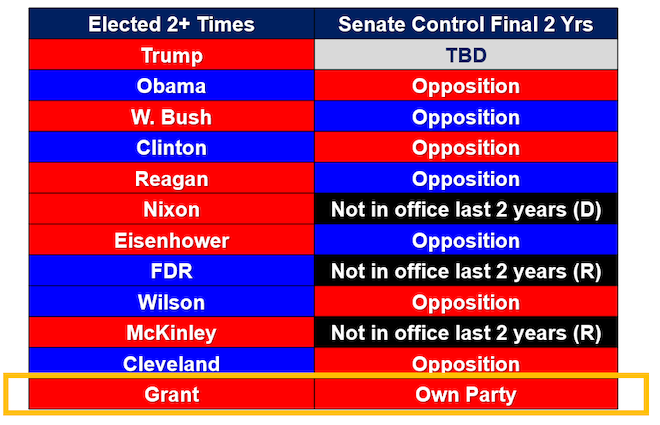
Since 1877, all seven twice-elected presidents who finished their terms ended facing an opposition Senate
Whatever happens next Tuesday, let’s hope we use this as an opportunity to remember God gave us each two ears, two eyes, but only one mouth for a reason — to harness the skill to truly listen and respect viewpoints that aren’t necessarily our own.
The people whose minds differ from Democrats or Republicans are not their enemies. They are our fellow Americans. We should respect them enough to ask for their votes and to give them a reason to believe in political public service again.
The Honorable Patrick J. Murphy is a Wharton lecturer, vetrepreneur, and the 32nd Army Under Secretary after earning the Bronze Star for service in Baghdad, Iraq as an All-American with the 82nd Airborne Division — @PatrickMurphyPA on Instagram and Twitter. Murphy is a supporter of the Citizen Media Group.
This article originally appeared on his Substack.
 MORE FROM PATRICK J. MURPHY
