



The Paul Ingrassia story finally sent me over the edge. Last week Politico reported on texts that showed Trump’s hand-picked candidate to lead the Office of Special Counsel “making racist and antisemitic remarks to fellow Republicans.” Among his many self-revealing and offensive remarks, Ingrassia openly noted that he had a “Nazi streak.”
Ingrassia’s documented antisemitism was so blatant that even complacent Republican Senators, including Rick Scott of Florida, who represents a large Jewish population, finally convinced Trump that this nominee would not be confirmed. Ingrassia pulled out.
Ingrassia is not the first antisemite to be welcomed into the inner circle of Mar-a-Lago. To name a few, there’s Christian nationalist commentator Nick Fuentes, rapper Kanye West (Ye), and Nazi sympathizer Timothy Hale-Cusanelli. Hale-Cusanelli recorded a video rant comparing Orthodox Jews to “a plague of locusts.” It’s important to note that Hale-Cusanelli was convicted of a number of offenses perpetrated during the January 6 attack on the Capitol. Trump pardoned him and all imprisoned January 6 marauders, some of whom had stormed the Capitol brandishing Nazi flags and wearing Nazi insignia.
And yet Trump presents himself as the defender of Jews on the nation’s campuses.
Antisemitism is vile and real at universities, in the nation, and in the world at large
Trump’s haphazard accusations make matters worse.
I’ll concede that at the beginning of the Trump/Congressional Republican onslaught against campuses, including Penn, the hearings and investigations served to raise needed attention to civil rights violations of Jewish university students. I do not doubt that during the Gaza protests, Jewish students were spit at and blocked from getting to class. It’s one thing, as Governor Josh Shapiro has done, to call for “moral clarity” on the issue, and quite another to confuse legitimate criticisms of Israeli Prime Minister Netanyahu’s government with blatant acts of antisemitism.
Universities across the nation have heeded the call to take antisemitism seriously — although there is always more to do. Penn, for example, in September 2024, announced the establishment the Office of Religious and Ethnic Inclusion to continue to fulfill its obligations under Title VI of the Civil Rights Act of 1964, “to protect students, faculty and staff from discrimination based on their religion, ethnicity, shared ancestry, or national origin.” The name of the office has since been changed to the Office of Religious and Ethnic Interests (OREI; emphasis is the writer’s) to recognize that “inclusion” has become a trigger word for the far right.
This office has been zealous — some would say overzealous — in investigating reported instances of bigotry. The Philadelphia Inquirer states that a faculty member was called into the office to answer for assigning “a pedagogically-relevant reading about conflict in Palestine.” Another individual faced questions for wearing a stole with the Palestinian flag at an off-campus event. Penn’s chapter of the American Association of University Professors (AAUP) says these are among “unfounded accusations of antisemitism.”
Given Trump’s support of self-identified Nazis in his inner circle, I now see loud accusations of campus antisemitism as a smoke screen for normalizing Naziism nationwide.
I don’t know the full context of these accusations. The Inquirer reports that the faculty and students referred to above “were not sanctioned or punished for their activities.” But as one AAUP committee member observed, being called in and questioned can have “a chilling effect” on research, teaching, and speech. It’s also human nature to resent those who take offense when none was meant. Suspicion and resentment do not combat bigotry.
On the other hand, as Jack Guerin reports in The Daily Pennsylvanian, the Brandeis Center, a Jewish legal rights advocacy group, has filed an amicus brief urging the U.S. Court of Appeals for the Third Circuit to review the decision to dismiss a lawsuit brought in December 2023 by two Penn students alleging a “hostile environment” for Jewish students.
Nonetheless, I believe overall that Penn’s OREI has the potential to protect Jewish, Muslim and indeed all students. Co-directors Steve Ginsburg and Majid Alsayegh have the background to make the office work effectively. Chief Investigator Deborah Frey is a former assistant U. S. attorney with deep experience with discrimination complaints. Most importantly, OREI is a university initiative, not something imposed by the federal government.
The stunning hypocrisy of Trump’s stance on antisemitism
I write from the perspective of a longtime university president who was ultimately responsible for protecting the civil rights of everyone on my campuses. I also write from the vantage point of an American-Jewish supporter of the state of Israel and the Israeli people, although I detest the Netanyahu government and the far right wing of the prime minister’s party. I also support a two-state solution — Israel and Palestine — fully recognized by all.
I’ve written before about the Trump administration’s strategy of using antisemitism as a weapon against higher education.
I’m now worrying that the problem is even deeper and more insidious. Given Trump’s support of self-identified Nazis in his inner circle, I now see loud accusations of campus antisemitism as a smoke screen for normalizing Naziism nationwide. Trump has mastered the art of diverting attention away from actions and attitudes that would have brought other administrations down. Flooding the zone, he projects his own sins on his opponents.
Vice President JD Vance publicly dismissed the group chat of Young Republicans making glib comments about gas chambers and other racist and antisemitic remarks. He normalized the hatred by characterizing it as ill-considered teenage jokes, even though some of the perpetrators were in their 30s and 40s.
Years ago during heated campus culture wars, my academic friends and I used to say ironically that we might win the English Department and lose the nation. In some ways that actually happened: Public expectations of worthwhile literary study seemed to be winning out over trendy “deconstruction,” enamored by literature professors. Some of the literary principles we then avowed were couched in indecipherable language that excluded the general public and sounded like snobbism.
Now Trump’s purported war on university antisemitism could be seen as a major distraction from the expanded bigotry fomented by Trump allies in the nation as a whole. In other words, Trump’s assault on the English Department diverts attention from normalizing bigotry in the nation.
While minor acts of campus protest are scrutinized, Ingrassia, Fuentes, Hale-Cusanelli and their friends, with passionate intensity, make antisemitism mainstream.
What we can do
- Protest bigotry wherever we see it, on campus and in the nation.
- Support structured conversations at schools and universities, encouraging. students to listen and learn from contrasting points of view.
- Distinguish between disagreements on political issues and hate speech.
- Develop the moral clarity to differentiate support from manipulation.
Elaine Maimon, Ph.D., is the author of Leading Academic Change: Vision, Strategy, Transformation. Her long career in higher education has encompassed top executive positions at public universities as well as distinction as a scholar in rhetoric/composition. Her co-authored book, Writing in the Arts and Sciences, has been designated as a landmark text. She is a Distinguished Fellow of the Association for Writing Across the Curriculum.

MORE FROM ELAINE MAIMON
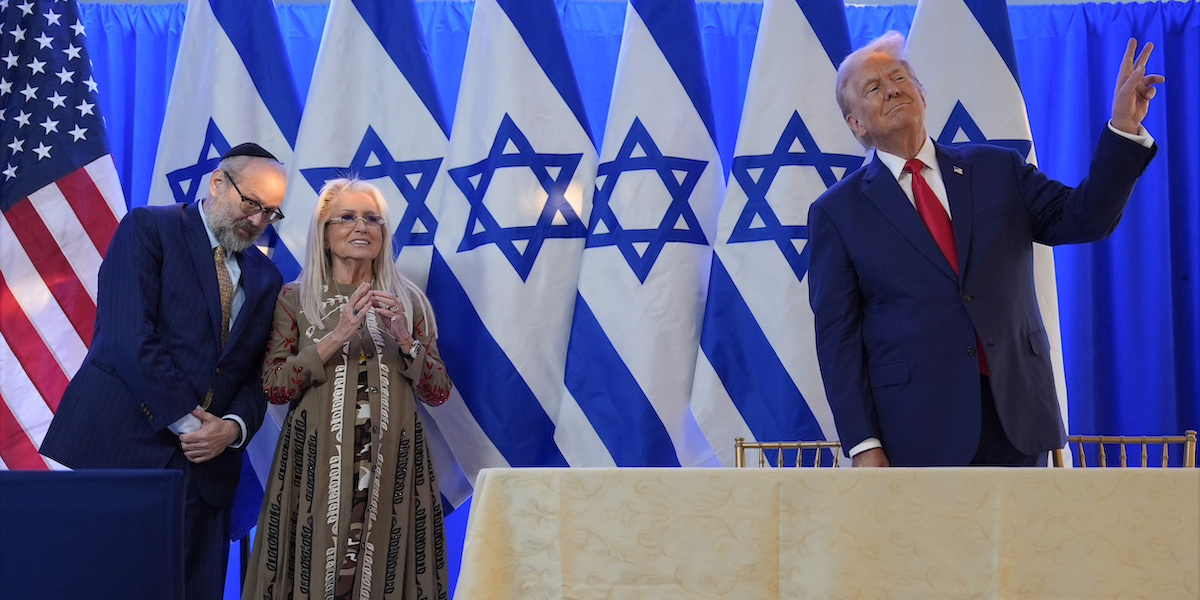
Header photo: Republican presidential nominee former President Donald Trump speaks during an event on combating antisemitism at Trump National Golf Club, Thursday, Aug. 15, 2024, in Bedminster, N.J., as Miriam Adelson and Rabbi Yehuda Kaploun listen. (AP Photo/Julia Nikhinson)
Republican presidential nominee former President Donald Trump speaks during an event on combating antisemitism at Trump National Golf Club, Thursday, Aug. 15, 2024, in Bedminster, N.J., as Miriam Adelson and Rabbi Yehuda Kaploun listen. (AP Photo/Julia Nikhinson)