



If Philadelphians didn’t have concerns about the City of Philadelphia’s waste management system before July’s District Council 33 strike, we do now. Seeing putrid waste pile up in our neighborhoods was disgusting; seeing how ill-equipped the City handled the waste was frustrating. If there was an upside, it was that Philadelphians realized our trash has to go somewhere.
For those still wondering, that “somewhere” is currently incinerators and the ground — basically the same solution that humans have been doing for thousands of years. Only today, we understand the ecological consequences of our reckless waste disposal: landfills pollute groundwater; the food waste rotting in landfills contribute 17 percent of the methane emissions fueling climate change; incinerators cause air pollution in the environmental justice communities they are too often built in.
But Philadelphia has a once-in-a-decade opportunity to change the trajectory of Filthadelphia history. Next spring, City Council votes on municipal waste management and recycling contracts. Council could take an important step toward forging a progressively sustainable path suitable for the needs of the future. How could the City reduce our carbon footprint, support local businesses and job growth, and get residents into better trash habits? Contract with Philadelphia companies that are already responsibly recycling, reusing and composting waste.
How much Philadelphia pays to process waste
City Council last voted on waste management and recycling contracts in June 2019. They gave both to the Houston, TX-based multinational corporation Waste Management (WM). (To be clear, WM handles trash and recycling only after DC33 municipal sanitation workers collect it.)
According to Waste Dive, the waste portion of the contract permitted Waste Management to send 67 percent of Philadelphia’s residential waste to their Fairless Landfill in Morrisville, PA and 33 percent to the Covanta incinerator in Chester, which has been extensively accused of causing Chester’s childhood asthma rate to be four times higher than the national average. WM’s waste contract was valued at $296 million over a seven-year term.
The recycling portion of the contract permitted WM to take recycling to a facility in Northeast Philadelphia The actual value of this contract is a little harder to account: Provisions allowed some profits from the sale of recyclables abroad — mostly China —to go to the City. Unfortunately, the timing was terrible: One year earlier, China’s National Sword policy halted U.S. waste and recycling imports, which depressed recycling markets globally.
Regardless, the base contract assured the City would pay WM a processing fee of $90 to $100 per ton of recycling. According to Grid Magazine, Philadelphia’s Sanitation Department picked up 86,000 tons of recycling in FY2024 — amounting to $8.6 million in recycling fees.
Although Philadelphia residential recycling numbers decreased during the pandemic — current estimates say residents are recycling only 13 percent of our waste — if you factor in a conservative $7 million in recycling fees over the seven-year period ($49 million), combined with the waste contract, the City paid WM a total of $340 million, close to $50 million per year to handle a large quantity of modern trash — plastics, foams, other chemicals and metals — in decidedly outdated ways.
For years, my colleagues and I at Circular Philadelphia have been asking the City a simple question: Instead of awarding the entire contract to one multinational corporation that landfills and incinerates a majority of our waste, what if we contracted to multiple local companies that specialize in and are already doing sustainable waste work? Not only could expanding the contracts create local jobs and grow local businesses, but the solutions that these providers offer would create safe and cleaner working conditions for municipal workers picking up the curbside waste — while making much-needed progress on the City’s zero waste by 2035 goal.
Putting money (and trash) into the local economy
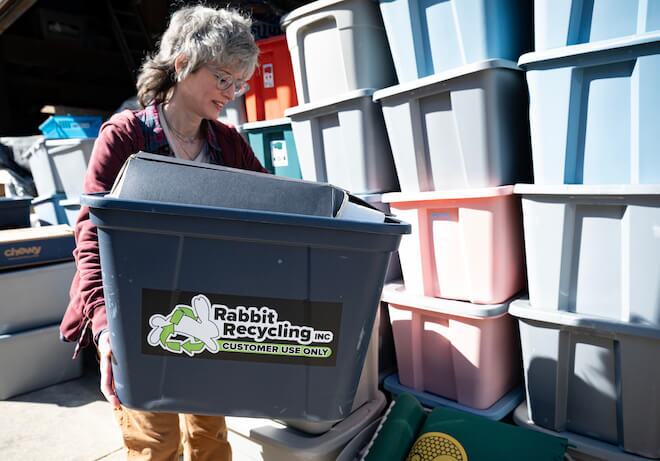
Matt Siegfried co-founded and operates Rabbit Recycling, a paid, on-demand service that specializes in transparent recycling, donation and upcycling for both common recyclables and hard-to-recycle materials. Just like with your blue bin recycling, Rabbit collects bins of plastics, aluminum, paper and glass — plus batteries, clothing, styrofoam, pots and pans, thumb drives, lightbulbs, and dozens more items that would otherwise end up in landfills or incinerators … — and finds domestic markets to process them.
Could Rabbit Recycling scale up their services for all Philadelphia households?
Maybe not right now. But Siegfried estimates that with a $4 million investment Rabbit Recycling could serve between 5,000 and 10,000 new households plus 1,000 businesses per month, which would divert 50 tons of hard to recycle materials from landfills per year. That investment would also allow Rabbit to open four new sorting facilities, create 15 local jobs, and educate residents on recycling and contamination (one way to help resurrect that pathetic recycling rate of ours).
Seigfried says $4 million would be ideal. But if the City were to offer Rabbit Recycling any substantial and recurring funds to expand their work to more businesses and residents, Rabbit could then access other capital to scale on their own. And if the City contract also included the unionized (municipal) collection and drop-off to Rabbit’s sites, Rabbit could scale even faster.
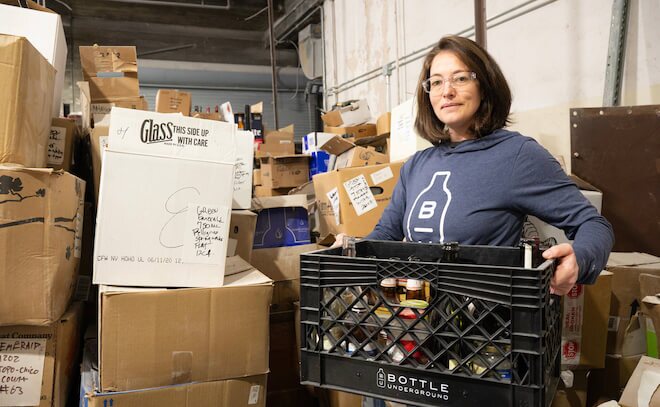
Rebecca Davies, co-founder of Bottle Underground, echoes these ideas. Bottle Underground is a nonprofit subscription and by-appointment-only glass container collector operating in the Bok building. The company partners with Remark Glass, which Davies co-owns, who upcycles the glass and by turning it into lighting fixtures, lotion and candle containers, jewelry and more.
This company’s work is important: According to City recycling reports, Philadelphia collected approximately 21,500 tons of glass last year (an expense of close to $2.2 million), most of which never gets recycled. Instead, because of high levels of contamination due to bits of plastic and paper getting crushed in the compactor and mixed with the glass when it gets to the materials recovery facility, most glass ends up as landfill cover.
Davies speculates that $3 to $4 million would allow a glass recycling operation to invest in processing facilities to manage all of the City’s residential glass recycling. Here again, a guaranteed contract would also allow a glass recycler to better access additional capital to build these facilities.
Although this solution would not address the single-stream collections contamination issue, combined with another of Davies’ ideas, it could get us somewhere. Davies envisions spending $4 to $5 million to set up dedicated, glass only drop-off sites around the City. Although this price tag may seem high, and would require residents to individually or together collect and bring glass to these locations, it would be a lot less than the money it would take to run another fleet of collection trucks throughout the city.
A better way to get rid of organic (food, etc) waste
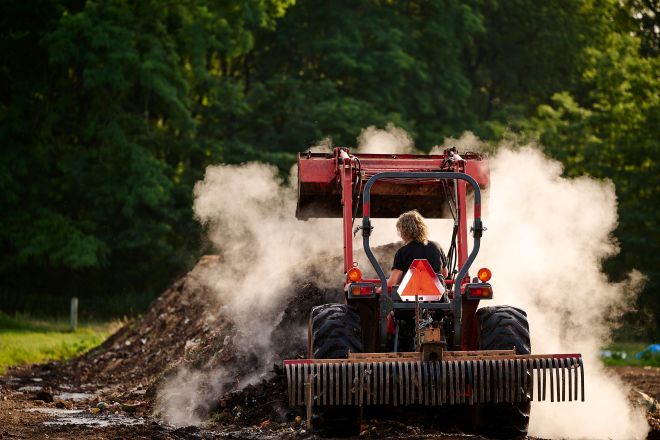
But when it comes to waste, there’s another local solution that could make a major dent in the residential waste stream: composting. About 123,000 tons — or 20 percent — of Philadelphia’s residential waste stream is organic / food waste, which releases 17 percent of a landfill’s methane, creating climate change and extreme weather.
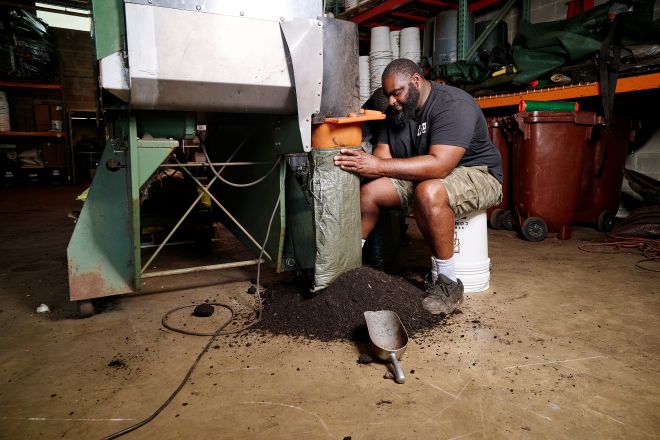
Tim Bennett of Bennett Compost has ideas. He estimates diverting all our food waste would cost the City $7.4 million — at $60 per ton — but would also save the City the current $8.4 million it pays every year to collect and dispose of this waste. Composting citywide, he says “would net a savings of $1 million dollars per year for the City.”
Bennett concedes that there would be challenges around getting clean material at this scale — and that local infrastructure doesn’t currently exist to handle that much tonnage in the region. (For a good primer, read Bennett’s most recent commentary in Grid Magazine.)
But he also contends that if the City could contract with local composters, increase education on how to separate out food and other compostable waste, and pass local ordinances compelling Philadelphia businesses to compost, then the private sector could confidently raise the necessary capital to build such facilities. Bennett adds, “Additionally, if the material was clean enough, the City might get a lower [disposal] fee of $55 or $50 (as opposed to the $68 per ton it’s paying to process solid waste now), resulting in additional savings of $600,000 to $1.23 million per year.”
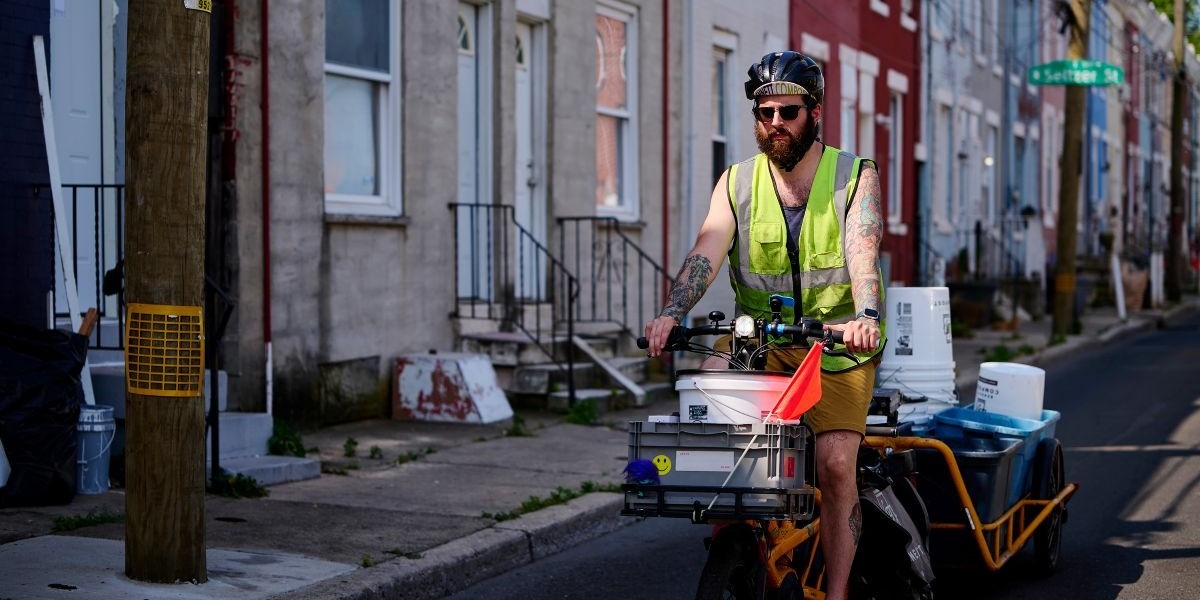
As with glass, another challenge is pickup. Some places — Quebec comes to mind — have on-street compost bins that residents use on their own. Currently, Bottle Underground, Circle and Bennett manage their own collection systems using a mix of pickup with trucks and bikes as well as drop-off points. Could the City learn from their models and scale up to add a third, compost collection to trash day?
Setting itself up for failure?
In full disclosure, the 2019 contract negotiations occurred during my tenure as Zero Waste and Litter Director. I was on the team that reviewed the contracts and made the final recommendation to City Council. Although I can’t comment on those contract negotiations, I can look back on the contracts’ timeline — and suggest how that process could improve the next time around.
The City opened its last waste and recycling contract RFP on August 2, 2018, held a pre-proposal meeting on September 14 to answer questions from potential bidders, and required bids by October 26. There was no RFI (request for information) period, and, as I recall, many of us in City government and outside advocates felt that this was an extremely tight timeline to get quality proposals. Fast forward to today, and the City is even further behind the curve.
To their credit, this time the City’s Chief Administration Office (CAO) issued an RFI (request for information) stating very progressive and lofty goals, to:
- Incorporate best practices to evaluate health and environmental impacts of residential waste management
- Understand capacity and availability of large-scale residential waste disposal providers, including opportunities and challenges to expand and diversify service delivery
- Identify recommendations for new approaches to minimize the City’s waste streams to advance the City’s Safe, Clean, & Green mission and Zero Waste goals.
Unlike before, these goals lead with the need for better data to evaluate the local impacts of our waste and recycling. This can be anything from improved litter indexing and characterization (my premise for years has been that most of the litter you see in Philly’s neighborhoods is generated on trash day) as well as more consistent waste audits to see what Philadelphians are throwing away and what innovative and improved systems we need to sustainably handle this waste. This gets to the third bullet point of recommending new approaches to handle our waste, which prompts the Office of Clean and Green to take a strategic approach that the office currently woefully lacks.
This was an extraordinary feedback — and promotional — opportunity for people like Davies, Siegfried and Bennett and other zero waste and circular economy businesses. The City asked for input that could diversify the City’s megacontract into multiple contracts.
But then there was the downside: The RFI went out June 26; the deadline was July 28. The City still hasn’t announced when they’ll issue an RFP, but they’ve already put themselves in a difficult spot. They’ll need ample time to thoughtfully review submissions — which will put them well behind the crammed 2018 timeline. A naysayer — realist? — might predict the clock is going to run out and the City will do what it notoriously does — the bare minimum: Meet the contract requirements and move on with business as usual. An optimist might hope that, behind the scenes, the Office of Clean and Green Initiatives has some incredible secret plan to incorporate smart, environmentally sound and business savvy findings of the RFI into an RFP that can hit the deadline of a new waste and recycling contract by July 1, 2026.
Or, the City could do this: The RFI states the City is budgeting $55.3 million for the new waste and recycling contract — an annual increase of $5.3 million over the previous contract. Could the City could earmark that additional $5.3 million for contracts with Rabbit Recycling, Bottle Underground and local composting companies?
With the City’s support, we could grow our local, sustainable waste management businesses, so in 2033 — the next time the contract process comes around — they could compete for the whole dang thing.
 MORE ON SOLVING PHILLY’S WASTE PROBLEM