


When Laurel Dye was pregnant, she found it ridiculous that she couldn’t try out some strollers before buying one.
Dye, 33, lives in a fourth-floor, walk-up condo in Fairmont. She wanted a stroller that would be easy to store and that she knew she’d be able to carry up all those stairs while juggling her soon-to-be-born daughter. But she couldn’t find any stores in Philly where she could test-drive different stroller styles and varieties. (She and her husband, Bobby, don’t own a car, so they needed to shop locally in the city.)
Listen to the audio edition here:
“I was definitely intimidated” about all the equipment they were going to need once the baby was born, Dye says.
While posting about the dilemma in local “mom” groups on Facebook and googling for solutions, she came across a business called Baby Gear Group. Founded by Wharton grad and former engineer Bo Zhao, the five-year-old, member-based business helps Philly parents save money and live more sustainably by allowing them to rent, rather than buy, baby gear — everything from major items like strollers and cribs, to toys and travel gear.
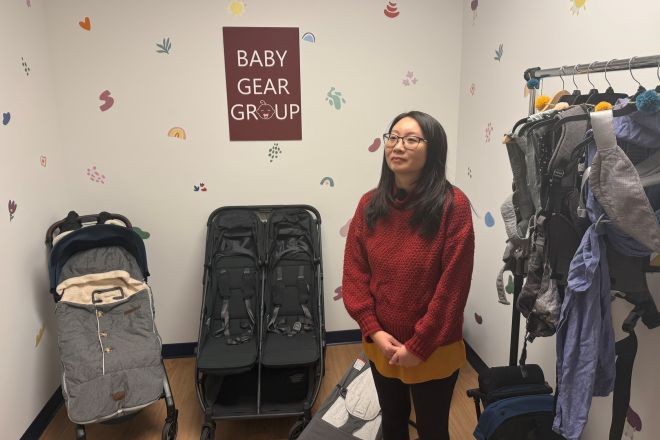
Dye signed up for a membership and met with Zhao at the business’s Center City gear “library” (currently located at Invictus Physical Therapy, in Logan Square), where Zhao let her test out strollers and also offered general parenting advice, based on her own experience as a mom raising kids in the city.
Since launching, Baby Gear Group — which now includes six more branches and was named last month by Time magazine as one of the best inventions of 2025 — claims to have saved families more than $1 million in new-equipment expenses.
With costs for a baby’s first year ranging from $16,905 to $28,166, these savings can be a game changer for parents: renting gear vs. buying it can reduce those costs by 80 percent. To boot, says Zhao, the Baby Gear model has kept 12 metric tons of new-gear packaging out of landfills.
A more sustainable childhood
Zhao was inspired to launch Baby Gear when her first daughter was born in 2018. Like Dye, she found the prospect of buying gear to be confusing and expensive, and she worried about the environmental footprint of parenthood. She asked other frustrated parents about their own experiences, then used their feedback to develop a membership model of renting baby items. She sourced inventory from Target and Amazon, and launched the business in 2020.
Zhao and the other branch owners vet the gear to ensure it’s safe and they clean it between uses. The Philly branch offers three membership tiers ranging in price from $49-$199 per month (there’s also an option to rent items a la carte). Zhao has grown the company to include events, like seasonal baby-clothing swaps between parents and a new-moms circle (in partnership with Invictus) to build community among members.
Participation in Baby Gear Group comes with a guarantee: if membership fees exceed 50 percent of the retail price of the items someone rents, she refunds the difference. A few years back, Zhao surveyed members about what brought them to the service and it was about evenly split between wanting to save money, wanting to be more sustainable, and reducing mental load. Of those who responded that they wanted to save money, many said they were putting those savings toward necessities like childcare and food.
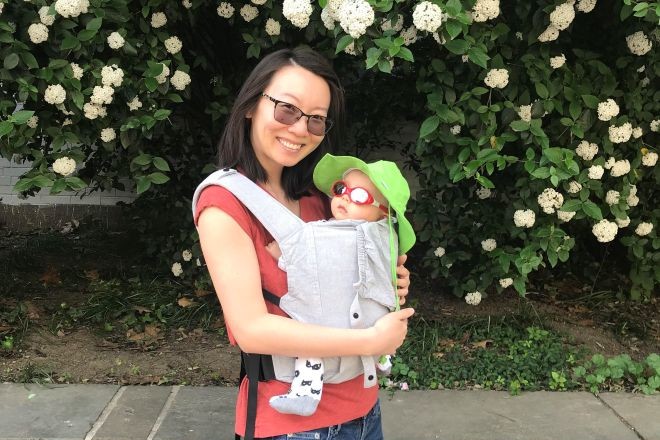
For Dye, Baby Gear Group “made my journey into motherhood really easy,” she says. She feels less stressed about reading product reviews and deciding what to buy because she can talk to Zhao about what gadgets and toys work well for what ages; her condo doesn’t feel crowded with baby items; and she’s saving money by renting rather than buying major items like strollers and travel gear. The latter has been important to Dye: she hails from Tennessee, so the family travels often to visit relatives (and even attended a wedding together in Scotland).
“Having another [experienced] mom share her knowledge and anticipate the needs we’re going to have” at different stages of a child’s development “has been extremely helpful,” Dye says. “I get so excited to be able to tell people about Baby Gear and what my experience has been like.”
Zhao finds the experience satisfying, too.
“I love being a resource for families here and helping them on their parenting journeys,” she says. “People are saving money and they are using that money for other really important things.”
Baby Gear Group around the country
Shortly after launching, Zhao started getting requests from parents outside of the Philly area: can you bring this to our community, too?
At first, Zhou had been delivering gear herself, which obviously made expansion of the Baby Gear model to other parts of the country tricky. That’s why Zhou was delighted when, in 2023, Erika Harman emailed Zhao to request permission to start her own Baby Gear Group in Minnesota’s Twin Cities.
“It was very organic and unexpected,” Zhao says.
She taught Harman how to replicate the model — and then others reached out, too, asking to launch their own new sites. She has since developed a standardized process for opening branches: Owners pay Zhao 10 percent of their revenue as a licensing fee ($300 up front), which provides them training, consulting, and web services, among other startup resources. It’s similar, in some ways, to how restaurant franchising works.
Startup costs — mostly buying gear for the rental “library” — are about $1,000. Costs are low in part because branch owners can often make use of gear their children have outgrown, source donations from their community members, or find things secondhand. Branch owners tend to run their businesses part-time, storing gear and then delivering it to clients without necessarily opening a physical location. There are now branches in the Twin Cities and its suburbs; Boulder, Colorado; and Jenkintown and Newtown, PA.
Sarah Hall is the branch owner of the Newtown Baby Gear Group. A mom of four kids under age 11, she’d been having conversations with parents in Bucks County about the costs of gear and how hard it was to find it at affordable prices or buy it secondhand.
“There was a constant conversation of, Does anybody have this, that I could borrow? Does anyone know if I can get this on short notice? Does anyone have this used? I can’t afford to purchase this baby gear or child gear at full cost,” Hall says.
She read an article about Baby Gear and contacted Zhou about starting a branch. Zhao helped her navigate the legal and financial side of setting up the business, and in May 2024 Hall launched her site, toggling between running the business and working a job in PR.
“I actually was surprised by how warmly the community embraced the idea. I pretty quickly received a number of referrals that were just word-of-mouth,” says Hall, adding that, for now, parents rent equipment mostly a la carte.
“I see Baby Gear Group as civic innovation, and I feel like it combines a lot of the values that I was hoping to pour more of my energy into — the sustainability approach, making the parenting journey just a little bit easier by streamlining access to baby gear, as well as having the gear that people can trust and know is safe.”
Baby gear … for good
Zhao declined to share revenue figures for the Baby Gear Group. The Philly branch alone is run by five employees and serves 400 members. Membership can be fluid; some parents leave for a bit when their baby gets older, only to return when they have another child.
Frustrated by the tech-startup mindset of growth-at-all-costs, Zhao believes that financial gains are only one way to measure her business’ success. Alongside revenue, she considers her environmental and social impact — something she believes should be “table stakes” for all entrepreneurs. She likes to use the metaphor that revenue is “like caloric intake.” Bodies need calories to survive; businesses need funds. But what you do with those calories — or that money — is what matters.
“Profit is necessary to keep the business going,” says Zhao. “But the business has to do the good things, the mission-aligned work. Over time, the mission has become deeper and more meaningful.”
Zhao’s philosophy is part of a broader movement. More and more companies, including local Triple Bottom Brewing, are embracing a triple bottom line, where “people, planet and profit” are all considered. Zhao wants to support other entrepreneurs who share this vision, and has doubled-down on her own commitment. She earned her B-Corp certification in July and is now a member of the Sustainable Business Network of Greater Philadelphia. (She’s also part of a group of local moms who started businesses, many during Covid, and call themselves “mom-preneurs.”)
Growth still matters, of course. Zhao is on track to add 10 more branches by year’s end; long term, she’d like to have 1,000 branches nationwide. Meantime, she’s happy that the B-Corp process — analyzing her businesses impact, looking for ways she could do more — led her to move her business accounts into a Community Development Financial Institution, which helps keep the money she earns local.
“It took me 15 months to qualify, because you have to examine and quantify every aspect of your business,” Zhao says of the process. “It enabled me to align all of my business activities for the positive impact that I wanted to create.”
It’s also led Zhao to formalize something she’s long done with her business: create a “gear access fund” which allows her to provide baby items for no-cost to families experiencing hardship — say, a local family who has lost items in a fire, or a family staying in Philly because their child is receiving care at CHOP. Right now, she’s running a sale: $20 gift cards to the Philly branch are available for $1. The purchases will help support the gear access fund. There were 250 gift cards available at the start of the sale.
“It’s building a real relationship with the family, with the community member,” Zhao says. “We’re helping families in situations where gear should be the last thing on your mind.”
 MORE BUSINESS FOR GOOD FROM THE CITIZEN
