


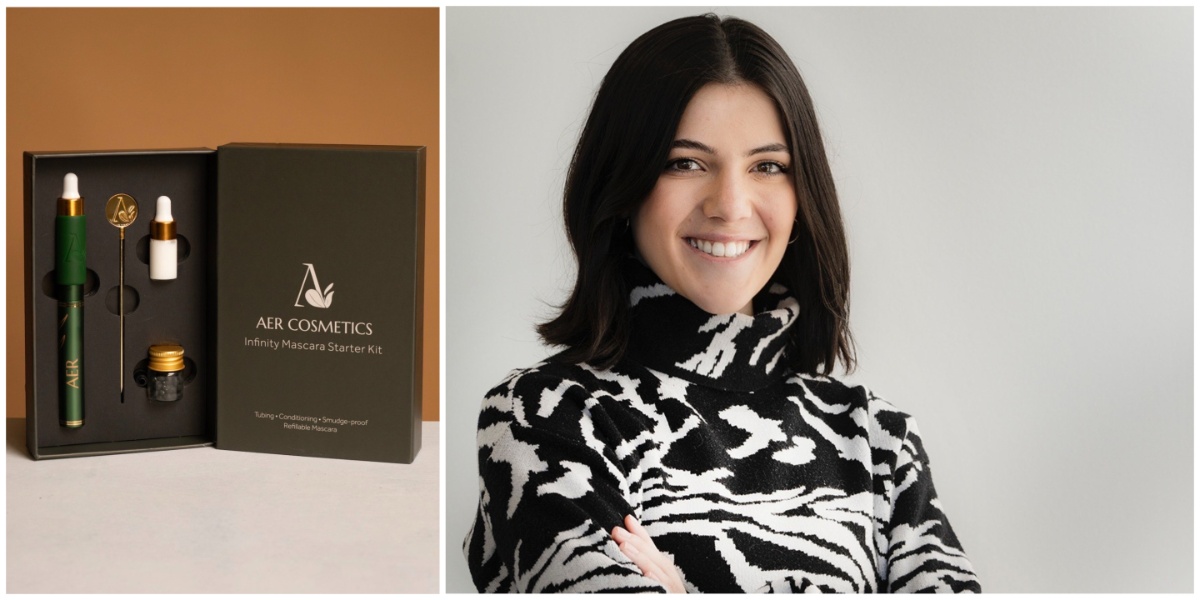


For professional dancers like Paige DeAngelo, it’s not the shoes or the outfit that completes the look. It’s the smudge-proof mascara that can last through hours of sweaty rehearsals and performances without giving you racoon eyes. But back in 2020, DeAngelo — who’s currently donning black and orange as a member of the Flyers Ice Team — was at a loss.
“My biggest waste was my makeup,” she says.
At the time, DeAngelo — a 2025 Rad Awards Entrepreneur of the Year nominee — was dancing competitively at Drexel, applying a full face of makeup for every performance, and burning through tubes and tubes of mascara. Every two or three months, she was tossing an empty tube in the trash. Not only was that expensive — the high-end brands that really stick cost around $20 to $30 (and up!) — but she was conscious of how much plastic waste she was generating.
She began searching for a more sustainable solution — someone had to make a refillable mascara bottle, right? But there were none to be found. So she decided to make her own, and, after some trial and error, she launched Aer Cosmetics in 2021. Her signature product is a mix-your-own mascara, created from dissolvable tablets and a special solution. It comes with a refillable tube and washable wand, so you can truly say goodbye to plastic bottles.
After a strong couple of years — Aer grew from 14,000 in sales in 2024 to 150,000 in 2025 — DeAngelo has her sights set on expanding color offerings and raising $500,000 to improve her manufacturing process to help the company scale.
From testing in an apartment to building a brand
Like many budding entrepreneurs, DeAngelo got the idea for Aer Cosmetics during the pandemic. She’d been studying journalism and meteorology, and when the shutdown prevented her from getting an internship, she started hosting an online segment about sustainability for Inside Ambition, a Drexel YouTube show.
“I was doing all this independent research on individual waste and how to reduce [it],” she says. She thought more about her own environmental impact, starting with her makeup routine. When it comes to makeup waste, the statistics are shocking: The cosmetics industry produces around 120 billion pieces of plastic packaging each year, and 95 percent of it isn’t recycled. DeAngelo knew she was an above average user. “I was wearing a full face of makeup three to four times a week, and going through all these plastic tubes,” she says. Even during the pandemic she was still frequently putting on a full face for the show and for dance. (Drexel’s team held virtual performances during the shutdown.)

The decision to start making her own mascara was a bit impulsive. She did a random Google search and then called her aunt — “the most sustainable person I know,” she says — and asked for ingredient ideas. Also, she needed the product to be sensitivity free, high-performing, lightweight, smudge-proof. Her aunt recommended activated charcoal tablets. She picked some up at CVS, broke them open, mixed them with the wax she used on her charcuterie board, and blended while sitting on the floor at her coffee table.
“It was as if I were in the kitchen.” she says. “I was just going blindly into it to see what would work.”
In 12 hours, she had a prototype tablet that she started using on herself, wearing it to dance performances and on game days. She liked the look of it and when she was confident that it was working well, she started toying with the idea of asking others to try it out.
Then, kismet! Her sister asked if DeAngelo would do her makeup for a wedding she was attending. DeAngelo agreed, with one condition: “If you try out our tablets …” she remembers saying.
That test ended up a little messy. “She cried at the wedding, and it ran … all over her face,” DeAngelo admits. “She was in the bathroom for like 20 minutes trying to scrub it off.”
The experience offered a lesson: She couldn’t just use water to dissolve the tablets. She’d need to formulate a special solution to dissolve them so that they wouldn’t melt off people’s lashes.
DeAngelo was determined to bring her idea to fruition. She switched her major from journalism and meteorology to public relations with a minor in entrepreneurship. She entered pitch competitions at Drexel, winning $75,000 over three years. (All as an undergrad!) She also did an entrepreneurship co-op through Drexel that allowed her to focus solely on the business.
The money from the pitch competitions and the hours she spent working on the business full-time during her co-op allowed her to partner with a team of Florida-based chemists to develop a formula for tubing mascara — one where polymers wrap around the lashes. To take it off, you wet the lashes with warm water, gently pinch them, and tug. The mascara will slip off in tubes. Her dance teammates and sorority sisters were her first product testers.
“She really had to listen to the market and understand who her customer is,” says Chuck Sacco, associate dean of Drexel’s Close School of Entrepreneurship. “She has a lot of work ahead of her, but I have confidence that Paige is the right person to do it. She has a good sense of herself, good sensibilities; she listens to feedback and advice, and pulls in her network when needed.”
She named the company “Aer” — the Latin root for the word “air” — because reducing plastic waste can help lower pollution in the air we breathe. Her grandfather created the gold olive branch logo to symbolize peace; DeAngelo felt that resonated with her vision for her company. She also has a tattoo of an olive branch he drew.
Making your own reusable mascara?
Aer Cosmetics does not sell pre-made mascara. If you buy a starter kit — a slick, olive green box holds a tube, a set of tablets, the solution, and a gold mixing stick — you’ll have to get a little crafty and make the final product yourself.
Colleen Lewis, a Flyers fellow dancer who coached DeAngelo at Drexel before they became teammates, says she finds the process of making her own mascara soothing. (She likes to mix while sitting on the couch, bingeing TV.)
Here’s how it all works: Add a few tablets to the tube, then the mixing solution, at a ratio of one pellet to one drop. Mix using the stick until you reach a liquid consistency, then add more tablets until you’ve used up both bottles. When you run out of the mascara you made, simply handwash the tube using a cosmetic cleaner — DeAngelo recommends the one from EcoTools — and refill it using one of Aer’s refill kits. The starter kit costs $35; the refill is $15. The product is vegan and cruelty-free — and perfectly safe to use on your lashes.
“I don’t feel like it runs at all,” says Lewis, whose first foray into mascara came via an electric pink-and-green tube of Maybelline’s Great Lash. She used MAC In Extreme Dimension Waterproof Lash Mascara for around eight years and found Aer in 2024 after embarking on a mission to reduce her own plastic waste.
DeAngelo has built a loyal fan base. She’s amassed more than 300,000 followers on TikTok who are eager to engage with the brand, vote on future colors, and buy her kits.
Lewis also appreciates how long the mascara stays on and the luxurious feel of both the product and its packaging. “It’s just stunning to have, compared to most generic mascaras,” she says.
DeAngelo works with a small, woman-owned manufacturer in Florida to make the tablets, solution, and kits. She checks the product quality herself and ships from her Fishtown apartment. She estimates that if someone typically buys three conventional mascara tubes per year, by making the switch they’d save 30 tubes from going to the landfill over 10 years. Since she started using the product in 2021, she estimates it’s prevented her from buying 25 tubes of mascara.
Aer’s next steps
Running Aer Cosmetics is DeAngelo’s full-time job. Dancing for the Flyers is her side gig. She’s the company’s only employee and works with a team of freelance photographers and content creators to help promote the brand. So far, the brand has been profitable, but has had its hiccups.
Last year, a manufacturing issue created a four-month pause that’s since been ironed out. And, because the mascara tablets are hand-rolled, scaling up production has been a challenge. She’s in the process of fundraising and looking to raise $500,000 to help scale Aer’s manufacturing.
The three new colors she’s launching — plum, light brown, and a pigment-free version of the black mascara, called BioBlack — are in addition to Aer’s original black. BioBlack and light brown, released earlier this month, while the plum shade is still in the works. The pigment-free product returns to using charcoal powder, which feels like a full-circle moment for DeAngelo. (Aer had been using black colorants instead of charcoal.) “We are back to the original concept and creating an even better performing, natural product,” she says. In the future, she wants to venture into other products, including potentially blush and foundation.
“I want people to come for the sustainability and then stay for the formula,” she says. “I hope to do that with a whole line of cosmetics.”
 MORE BUSINESS FOR GOOD