


Hey, y’all. Hope you’re looking forward to the holidays and the new year ahead. I’m especially excited — I can’t wait to be back on the field against the Bills next week.
I’ve mentioned in this column before how far the NFL has come in terms of taking mental health seriously and normalizing conversations about it. Over the course of my time in the league, I’ve seen mental wellness go from something people only talk about in secrecy, to every team having a dedicated therapist. Now, as a culture, the NFL embraces the idea that our mental wellness fuels our physical wellness — the two go hand in hand.
I was reminded how far the league has come when we played the Commanders this past weekend. Just a few weeks ago, their team partnered with the American Foundation for Suicide Prevention. AFSP is the largest nonprofit focused on suicide prevention and mental health in the country. “We’re really focused on understanding why people die by suicide, and what we can do to prevent that,” says Melanie Varady, Vice President of AFSP’s Eastern Division.
They dubbed their game against the Broncos as “an event to Raise Awareness for Mental Health” — a portion of ticket sales benefited AFSP and fans had access to a pre-game panel featuring my former teammate, Marcus Smith, who is also outspoken about mental health. The focus of their collaboration was specifically on youth mental health and sports — everything from mental resilience and supporting your teammates, to where to find support, to the relationship coaches have with their players.
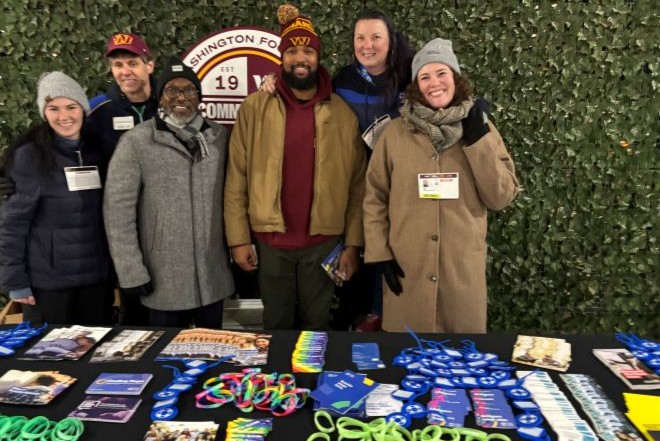
“We want people to know that there’s hope, that they’re not alone, and that this too shall pass,” Melanie says. She means that last part literally: “The research shows that there’s a 30-minute window where, if you’re really struggling and you’re in pain, if someone just sits there with you, even if they say nothing, that’s a protective factor. If someone just says, are you okay, that’s a protective factor,” she says.
Melanie’s colleague, Ellen Shannon, Executive Director for the AFSP Capital Area, was thrilled when the Commanders reached out to her about collaborating. She’d had success working with the Washington Capitals hockey team to bring mental health education and resources to sports fans, and she recognized immediately that working with the NFL would present a meaningful opportunity to further destigmatize the conversations around mental health and suicide.
“Many people and parents, in particular, are afraid to start the conversation around suicide. They’re afraid that if they say something, their child may be inclined to take their life. Or they don’t know what to say. And really, the message is that I care about you. I love you. Tell me what is going on, so that we can figure it out together,” Ellen says.
As a dad, I really appreciate that AFSP is encouraging parents to have open conversations with their children about mental health. “One of the most significant warning signs when a child is struggling is when things start to change, when they start to isolate, when they start maybe having more risky behavior,” Ellen says. “When you notice a difference in their behavior, that can be really telling.”
“Anyone can play a role in suicide prevention. Anyone … We all can make a difference in saving lives and creating a culture that’s smarter about mental health.” — Melanie Varady, American Foundation for Suicide Prevention
AFSP has programs that speak to the universal feelings we all have about mental health. There’s “Talk saves lives,” which drives home the research showing that anyone can have an impact — even peer-to-peer conversations can make a difference. They have a campaign called “Seize the awkward,” acknowledging that talking about these things can be awkward — but is necessary. “Anyone can play a role in suicide prevention. Anyone.” Melanie says. “We of course encourage people to seek out professional help when they need it, but you can save a life by having a caring conversation with someone. We all can make a difference in saving lives and creating a culture that’s smarter about mental health.”
Here in Philly, AFSP has a chapter that leads events like the recent “Out of the Darkness” walk, to raise awareness and funds for suicide research and prevention. You can join next year’s walk and take advantage of AFSP’s free tools online. You can learn how to have conversations with your kids or anyone else you’re worried about — and how to speak up if you’re struggling. Above all, please embrace Melanie’s research-backed insight: You are not alone — and there is hope.
If you are in crisis, please call the Suicide and Crisis Lifeline at 988 or contact the Crisis Text Line by texting 741-741.
 MORE FROM LANE JOHNSON’S SEASON OF STRONG MENTAL HEALTH
