


How do you all with young children handle this …?
I’m on the edge of the creek trying to jump to the other side, but not knowing … if I will make it or not. I am at a loss.
How do you fill their days … surviving boredom?
I have felt alone (especially lately).
These were some of the comments in the chat of a recent Zoom meeting of more than 45 caregivers of people with younger-onset Alzheimer’s Disease. Participants had logged in from all over: Lake Forest, California; Nashville, Tennessee; upstate New York.
Listen to the audio edition here:
Doylestown resident Karen Sandone, who was helping lead the call, had a quick response to that last message: You will never be alone with all of us. XO.
Sandone is a co-founder of Surviving the Now, the organization that hosted the meeting. Ever since Sandone’s husband Anthony was diagnosed in 2023 at age 55, Karen has been an outspoken advocate for younger-onset (also called early onset) Alzheimer’s awareness, juggling her full-time job and Anthony’s care with visits to Capitol Hill, working with local and national Alzheimer’s groups, and organizing Sandone Strong, an annual fundraiser for Alzheimer’s research.
In the process, she’s given her family’s struggles a platform that has helped raise awareness of a need for a cure, but, more immediately, connected and supported loved ones of people with younger-onset Alzheimer’s on their mission to, as her group’s name suggests, Survive the Now.
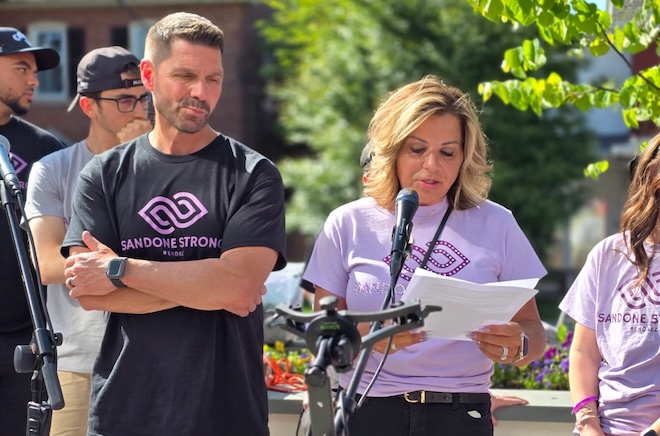
An unwelcome surprise
Karen and Anthony Sandone married in 2007 and share a blended family of six adult children. Anthony worked as a chemical sales manager. Karen is the director of human resources at an education company.
The couple loved to travel and looked forward to retirement years filled with adventure. A little over a decade into their marriage, Sandone noticed Anthony struggling with finding words and learning a new software program. Anthony spent years getting tested, visiting doctor after doctor, before they learned what was going on.
“We knew something was wrong, but we didn’t understand the level of severity,” she says. “It’s so difficult for anybody to understand: You’re planning your future, you’re planning for your retirement, we were going to travel and do all of these things and all of that stops … It was a life-changing moment.”
“When you have this diagnosis, you have a couple of options: One is to stay very private and try to figure it out on your own. We chose to share our story.” — Karen Sandone
Young-onset Alzheimer’s is considered rare, affecting 41 out of 100,000 people between the ages of 30 and 64, according to the Mayo Clinic. There is no cure, and little treatment. Patients typically gradually lose their short term, then long term memory, eventually becoming unable to recognize loved ones or to care for themselves. The disease progresses differently in different people, however.
While Anthony was able, the couple worked with the Alzheimer’s Foundation, taking part in their fundraisers and starting their own. They gave media interviews and created Anthony vs. Alzheimer’s social media accounts to document day-to-day life with the disease. Today more than 32,000 people follow them on TikTok, and 55,000 on Instagram.
Karen jokes that she has a big mouth — and her 5-plus years as an Eagles cheerleader proves she has the lungs — but she never imagined their story would appear in People magazine.
“When you have this diagnosis, you have a couple of options: One is to stay very private and try to figure it out on your own,” she says. “We chose to share our story.”
Sharing her story has also given her a new tribe.
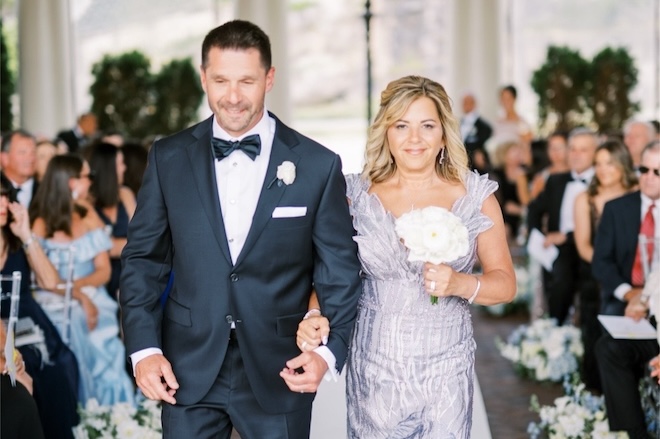
Surviving the Now
Eileen Faulkner Ware in New Jersey, Cherie Davies in upstate New York and Becca O’Neil in Rhode Island all have husbands who received the same diagnosis as Anthony. They met each other — and recognized similarities in their day-to-day living with younger-onset — on social media. Sandone had posted videos on TikTok, which O’Neil saw. Thousands of Instagram users learned about Sandone’s efforts from her personal page (which now has 114,000 followers) as well as Anthony’s, Anthony vs. Alzheimer’s (55,100 followers).
“I couldn’t believe that there were people who looked like me, women in their 50s whose husbands were in their 50s, when they were diagnosed,” says O’Neil. “The four of us just banded together almost in desperation.”
O’Neil’s husband Charlie was 51 when he was diagnosed, also in 2023. It was a lot for a middle-aged couple to get used to. “Most people are relating [the condition] to a parent or a grandparent, who’s retired, owns a house, and these are 40- to 50-, 60-year-old men who don’t look like they have a disease, but yet they’re cognitively impaired, and everything’s changed,” she says. “In some cases, they’re the family’s primary breadwinner and there are young children … It completely upends your life and you’re not ready for it. You’re just not prepared.”
“Advocacy saved me from the grief. It creates connection, understanding, policy changes, and hope.” — Karen Sandone
O’Neil’s husband is currently a Stage 4 (see chart below), often called Moderate Decline on the 7 stage Alzheimer’s assessment chart. He had to leave his job as a software sales executive but is still active, playing tennis weekly with men who are older than him by 20 years or more.
“I just can’t even imagine Stage 5 [Moderately Severe Decline],” O’Neil says.
Because even with the charts and expectations and experiences of others to review, all cases are different. Cofounder Eileen Faulkner Ware’s husband, Steve, was diagnosed 2021 at age 54 and died less than five years later.
Doctors gave co-founder Cherie Davies’s husband, Chris, his diagnosis in 2019 when he was 52. He’s now at Stage 6 on the progression scale.
“We’re all just trying to do the best that we can with the resources we have,” O’Neil says.
What they did was create a text chain, talk to each other on the phone, and, eventually, fund and form Surviving the Now. What began as an across-the-miles friend group can now draw between 50 to 100 people during its monthly Zoom meetings. The women are now dividing up interested individuals by location – there are eight already and their newest, on the West Coast, will soon hold their first meeting. They’ve built a webpage of resources and personal stories, hold monthly Zoom meetings, and, last year, launched a podcast. They’re currently working on getting nonprofit status.

Holding onto hope
Sandone’s efforts were recognized in May, when the Women’s Alzheimer’s Movement (WAM) at Cleveland Clinic honored Sandone with its Caregiving Award. WAM was founded by Maria Shriver in 2010 after research showed that women are at increased risk of Alzheimer’s — two-thirds of the estimated 55 million people worldwide living with Alzheimer’s are women. According to the Alzheimer’s Association, more than three in five unpaid caregivers for people with Alzheimer’s are also women, typically wives and daughters. Shriver’s father, Sargent Shriver, had the disease.
At the ceremony, Sandone told organizers that Anthony is now at Stage 6 (Severe Decline). He also has aphasia, which makes speaking difficult. So, she said, “I’m going to be his voice.”
“It started for him, with him, and now, as the disease progresses, I’m doing this on behalf of him,” she says. “I even said that in my speech: Anthony, I love you. Everything I do, I do for you. And I mean that.”
“Advocacy saved me from the grief,” Sandone said in her speech. “It creates connection, understanding, policy changes, and hope. I still have hope, although it might not be for us.”
Although every case is different, many medical professionals use a 7-Stage scale to chart the progression of Alzheimer’s:
Stage 1: Normal Outward Behavior: No symptoms. Only a PET scan would reveal the diagnosis.
Stage 2: Very Mild Changes: Signs include forgetting words and misplacing objects.
Stage 3: Mild Decline: Signs include repeatedly asking the same question, having trouble making plans, and forgetting names of people they’ve recently met.
Stage 4: Moderate Decline: Signs include forgetting personal details, not understanding what others are talking about, and struggling with routine chores.
Stage 5: Moderately Severe Decline: Signs include having trouble knowing where they are, being unable to track the passage of time, and confusion over issues like dressing appropriately for the weather.
Stage 6: Severe Decline: Signs include an inability to recognize people they know, difficulty walking, and needing assistance eating or dressing.
Stage 7: Very Severe Decline: The patient loses the ability to walk, eat, toilet, and bathe by themselves. They are completely dependent on caretakers.
 MORE CITIZENS OF THE WEEK
