

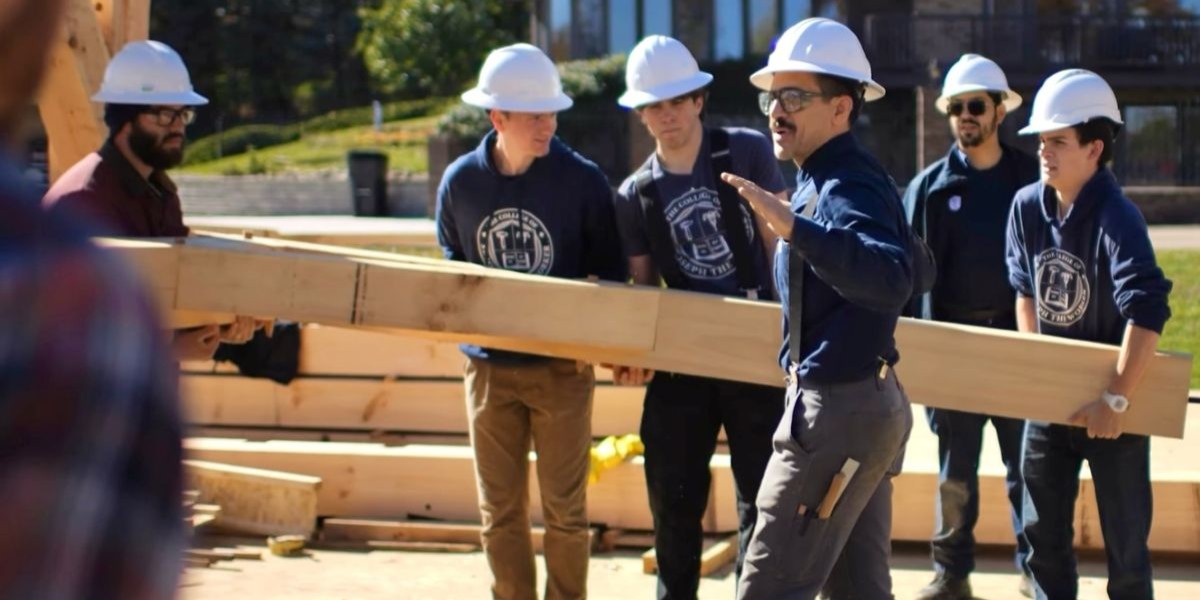


“We’re totally trying to call the bluff on the great divorce between the head and the hands,” Jacob Imam, the founder of the College of St. Joseph the Worker in Steubenville, Ohio, told The New Yorker. The unique school, which opened in 2024 and has a current enrollment of 63, combines apprenticeships in the trades (carpentry, HVAC, electrical work, plumbing) with a meaningful liberal arts, Catholicism-centered education.
As the magazine’s Emma Green reported, “The college aims to give its students an education that is not just about their work but about their lives — instilling in them a sense of purpose, restoring their feeling of competence, teaching them virtue.”
The College of St. Joseph the Worker connects trade apprenticeships to a liberal arts degree in Catholic studies — something that LaSalle, Villanova, St. Joe’s, and other Philadelphia-area Catholic higher educational institutions might consider, perhaps in partnership with the Community College of Philadelphia (CCP). Already, Rowan University has a partnership with Philly’s electrician’s union to offer limited bachelors degrees to those getting their licenses. But I encourage all colleges and universities offering a liberal arts curriculum to adapt the idea of connecting the head and hands to their settings.
Society as a whole suffers from the oppositional categorization of the liberal arts as elite and the trades as lacking in prestige, alienating those who work with their hands from full community commitment. The College of St. Joseph the Worker believes that bridging this divide will enable students to feel a sense of overall competence, leading to more active citizenship.
It’s important to note that many students prefer to start learning by working with their hands and then to reflect on these practical experiences as they connect with theories and abstractions.
At the three universities I led — Governors State, University of Alaska Anchorage, and Arizona State University West Campus — we encouraged students who had studied trades in community college to transfer to the university to complete the bachelor’s degree with liberal arts courses (business courses too). But we highlighted (at least I did where I could) courses in the humanities. Did your two-year Associate of Applied Science degree focus on food preparation in culinary arts? Do an independent study on the culture of food. Did the community college prepare you as a welder? Perhaps, you are curious about the history of welding. Whatever your skill, you may be interested in studying philosophy and literature — courses that help you think about meaning in life.
In short, we must stop being snobs about the “purity” of the liberal arts and look for educational ways to connect the head and the hand.
Skill training first, then liberal arts education — it’s called an inverted baccalaureate. It’s something that every Philadelphia-area college and university could explore and highlight as an option. That would mean close and deep cooperation with CCP. And that cooperation should in any case be happening much more now and not just on this topic. One of the great benefits for students at the College of St. Joseph the Worker is that through paid apprenticeships they will graduate without debt. Creative partnerships between universities and CCP, where tuition is more affordable and apprenticeships could be undertaken, would be ways to avoid college debt — something devoutly to be wished for in the current environment.
Universities can also seek innovative partnerships with labor unions, as New Jersey’s Rowan University has done locally. In July 2024, Rowan and Philadelphia’s IBEW Local 98 worked out an arrangement annually for 200 electrician-apprentices to earn college certificates and degrees while completing their training. Apprentices, based in the Philadelphia Naval Yard, balance full-time work, union training and university courses. Rowan offers flexible online learning making it possible to design a course schedule around working hours. Apprentices can gain stackable undergraduate construction certificates (stackable because the credits can also apply to the next higher degree), a Bachelor of Arts in construction management, two graduate certificates in engineering management, and a Master of Engineering Management. One option is the B.A. in Liberal Studies with concentrations in humanities/social sciences. This combined program of work and study is another way for participants to be free of college debt.
More creative ideas to promote the liberal arts
Hampshire College, a Massachusetts college devoted to the arts and humanities, just closed its doors. I keep reading doom and gloom about the potential closures of other small, tuition-dependent liberal arts institutions. I’m calling on liberal arts colleges in our area to avoid the fate of Cabrini by finding creative ways to connect productive work with a meaningful life.
Here are some ideas:
Hire craftspeople, jewelry makers and repairers, for example, to train students in their techniques. Offer this for credit or as a cocurricular opportunity. From my personal experience, I can tell you that I would pay a lot for someone skilled in restringing my pearl necklace. I’ve googled and searched through Jewelers Row to no avail.
Offer courses in entrepreneurship to liberal arts majors and hire Philadelphia-area entrepreneurs for mentoring, perhaps offering apprenticeships, but also encouraging productive business opportunities for students’ own ideas.
In short, we must stop being snobs about the “purity” of the liberal arts and look for educational ways to connect the head and the hand.
The College of St. Joseph the Worker is named for Joseph, Mary’s husband and the patron saint of laborers. Christian texts imagine Joseph and Jesus together at the workbench. In whatever way we do it, colleges and universities in 2026 should steal the idea of connecting the highest skills with the loftiest thoughts.
Elaine Maimon, Ph.D., is the author of Leading Academic Change: Vision, Strategy, Transformation. Her long career in higher education has encompassed top executive positions at Governors State University (IL), University of Alaska Anchorage, and Arizona State University West Campus, as well as distinction as a scholar in rhetoric/composition. Her co-authored book, Writing in the Arts and Sciences, has been designated as a landmark text. She is a Distinguished Fellow of the Association for Writing Across the Curriculum.
 MORE FROM ELAINE MAIMON