


Picture Rittenhouse Row on a typical Sunday morning. People fill the sidewalks, browse Anthropologie, Philadelphia Runner, or the Apple Store, people-watch over brunch at one of Parc’s coveted sidewalk tables facing Rittenhouse Square. Yet, despite the retail activity and sidewalk animation, two-thirds of the space between buildings is allocated to vehicular storage and movement rather than the foot traffic that is generating commercial revenue.
Now, picture the same street on any Open Streets Sunday. Thousands of people are strolling, sitting, eating, playing and discovering a version of their city that the street, on any other day, makes structurally impossible. Toddlers, initially cautious about crossing the curb line, chase giant bubbles through the middle of an intersection. Couples, families, and friends linger over brunch on tables that spill up and down 18th Street. Dogs make friends. Suburbanites make a day of it. And, critically, retail sales and foot traffic are up significantly: Economic benefits include a 38 percent average sales increase for businesses and a 62 percent rise in in-store foot traffic on event days.
Nothing about the street has been rebuilt or redesigned. The space has simply been reallocated, temporarily privileging people and place over throughput.
Streets consume an extraordinary share of urban land, and for most of the last century, cities have operated under a single, largely unexamined assumption about what they are for. Moving cars through has been the default. Everything else — walking, jogging, sitting, playing, gathering — must negotiate for whatever is left over.
Open Streets questioned that assumption, temporarily, and revealed what becomes possible when a city’s default operating code gets rewritten in favor of people and place.
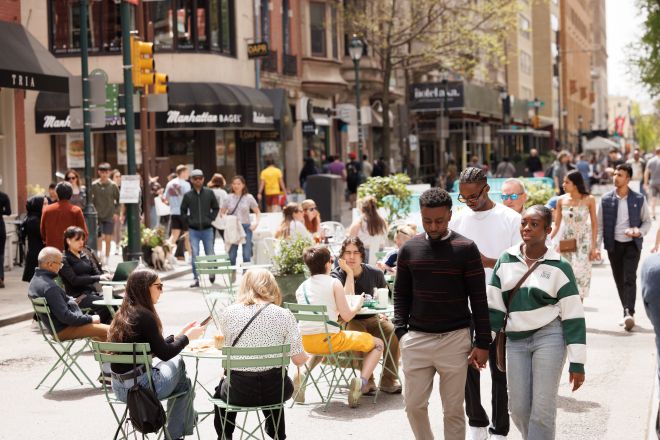
Around the world, great shopping streets are places first. As a college student studying abroad in Florence, I marveled at (and was perhaps radicalized by) the nightly Passeggiata — the liminal time between work and supper when Florentines strolled the pedestrianized shopping streets to see and be seen. Copenhagen’s Stroget and Barcelona’s Ramblas are two iconic examples of well-performing retail streets that are great places. There are many examples outside of Europe, from Mexico City and Bogota to Tokyo and Sydney.
What these streets share is something that has become increasingly rare and increasingly valuable: they are places where diverse groups of people gather, encounter one another serendipitously, and share physical space. Much has been written about the troubling rise of loneliness and isolation in modern life, a crisis accelerated by a culture that has placed growing value on the remote, the private, and the digital, from where we work and shop to how we celebrate and socialize. So much of life has migrated elsewhere that the streets and public spaces where unscripted human connection still happens at scale have taken on heightened significance.
America’s experiments with pedestrianized streets, from Denver’s 16th Street Mall to Santa Monica’s 3rd Street Promenade, have produced mixed results, and those results have made cities cautious. But the choice is not binary. Between a street that belongs entirely to cars and one that belongs entirely to pedestrians lies a broad and largely unexplored middle ground. The Open Streets model is temporary, flexible, and reversible, capturing the benefits of a people-first street without requiring a costly, irreversible, permanent bet. A partial, temporary reallocation of street space toward people delivers returns that car-dominated streets cannot.
Philadelphia, through Open Streets, has begun to claim that middle ground; few cities are better positioned to do so. In 2025, Philadelphia was named the most walkable city in America by USA Today‘s 10 Best Readers’ Choice Awards for the third consecutive year. Developed largely before the automobile became dominant, Center City concentrates residential towers, office buildings, restaurants, shops, arts institutions, and services on a compact, flat footprint, with interwoven land uses that would be nearly impossible to create from scratch today. Ground-floor retail and restaurants keep sidewalks animated and interesting, and, of course, Center City District’s on-street teams provide cleaning, public safety, homeless outreach, and hospitality services that make those sidewalks comfortable and inviting for everyone.
Rittenhouse Row has earned a place among the nation’s premier urban retail corridors, alongside Georgetown’s M Street and Venice Beach’s Abbot Kinney, a must-have location for expansion-minded brands. Among these are Vuori, Veronica Beard, Glossier, and North America’s very first Michael Jordan World of Flight store. The area delivers what today’s best retail brands seek: density, walkability, a growing residential population, and an engaging cadence of storefronts under a tree canopy that maintains visual interest and invites exploration on every block.
Open Streets was the obvious answer — doubling down on the walkability, density, and street-level vitality that already define the corridor, while testing a proposition that the world’s great retail streets had long since proven: that people on foot are better for business than people in cars.
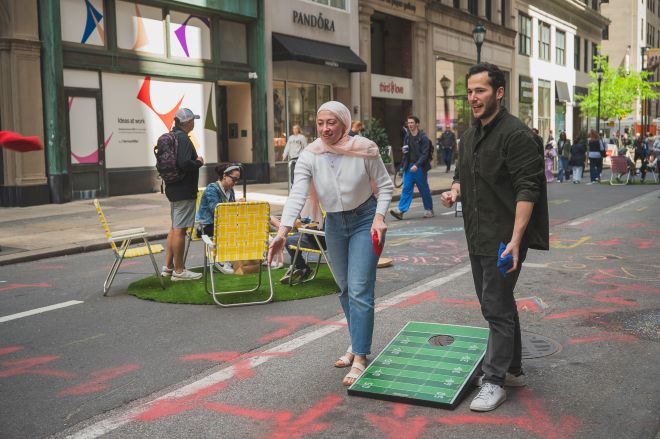
Twenty events later, the results exceeded what our measured optimism allowed us to predict. More than 170,000 visitors. A “Best of Philly” recognition from Philadelphia Magazine. Inga Saffron declaring Open Streets a “Philadelphia Ramblas on Walnut Street.” The Philadelphia Inquirer’s editorial board calling it an example of “thinking big — and sticking the landing.” A recurrence that has evolved the program from novelty to expectation without losing the quality that made people show up in the first place.
Our team built something special and we built it carefully, earning trust from restaurants and retailers, coordinating city agencies, and executing the event with the kind of operational precision that only looks easy from the outside. I am so grateful for everyone who contributed to it: our staff who set up and broke down every barrier, our partners in the administration of Mayor Cherelle Parker, including the Philadelphia Police Department, who made it operationally possible, the businesses that took a chance on something new, and the community members who showed up and kept showing up until Open Streets felt less like a program and more like a fixture of city life.
From Market East to various neighborhood commercial corridors, conversations about how Philadelphia’s streets should be used is only growing — and the enthusiasm for pedestrianization should not outrun the conditions that make it work. A healthy downtown needs a differentiated street network: arterial corridors optimized for movement and efficiency, and others, where density, retail, and residential demand have converged, functioning as destinations rather than conduits. Open Streets succeeded on West Walnut because the conditions were right. The lesson is not that cars don’t belong downtown. It is that on the right street, at the right moment, temporarily changing the default operating code of a street in favor of people and place generates economic and civic returns that the default cannot. Knowing the difference is what separates thoughtful placemaking from magical thinking.
After 20 events and counting, it’s no longer a question of whether Open Streets works. It’s how far we can take it.
Prema Katari Gupta is the President and CEO of Center City District. Previously she was Senior Vice President at PIDC, leading the Philadelphia Navy Yard’s redevelopment, and has had additional roles with University City District and the Urban Land Institute. She holds degrees from Bowdoin College and the University of Pennsylvania.
The Citizen welcomes guest commentary from community members who represent that it is their own work and their own opinion based on true facts that they know firsthand.
 MORE WAYS TO ENJOY PHILADELPHIA